
The Rise of Simplified Consumer Products in the Post-Recall Market: How Transparency and Streamlined Supply Chains Are Reshaping the Food Industry
The food industry is at a crossroads. A spate of high-profile recalls—from listeria-tainted deli meats to contaminated chocolate bars—has left consumers wary, brands scarred, and investors scrambling to identify resilient opportunities. Recent data reveals that 40% of Americans now distrust government food safety oversight, while 68% would abandon a brand after a contamination scandal. Against this backdrop, a new paradigm is emerging: simplified consumer products powered by radical transparency and streamlined supply chains. This shift isn't just about risk mitigation; it's a structural realignment of the food industry, favoring companies that can deliver safety, trust, and efficiency.
The Recall Crisis: A Catalyst for Change
Recent recalls, such as Hartford Bakery's 2024 bread recall affecting 12 states, underscore systemic vulnerabilities. These incidents expose the fragility of complex global supply chains, where multi-tiered sourcing, opaque logistics, and reliance on third-party farms create blind spots for contamination. The financial toll is staggering: recalls now cost companies an average of $10 million per incident, with indirect costs—lost brand equity, customer attrition—often dwarfing direct losses.

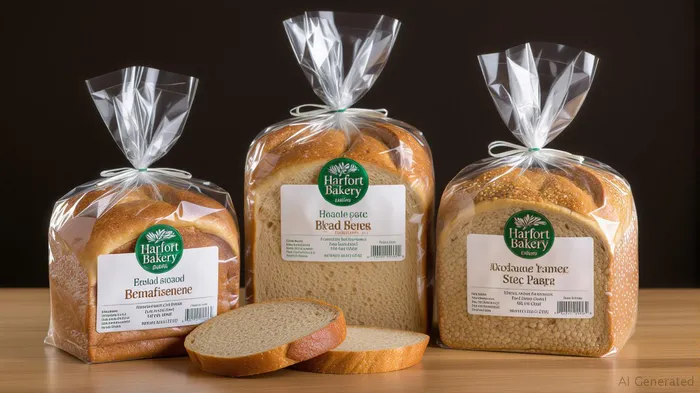
Investors should note that this crisis isn't merely cyclical. The 2026 FDA Digital Food Traceability Rule, requiring end-to-end digital tracking for high-risk foods, signals a regulatory inflection point. Companies that cannot adapt risk obsolescence.
Sector Spotlight: Vertical Farming—Where Simplicity Meets Safety
Vertical farming is the poster child of this new era. By growing crops in controlled indoor environments, these companies eliminate 99% of land use and 95% of water compared to traditional agriculture. This radical simplification isn't just eco-friendly—it's a food safety revolution.
Take Gotham Greens, which operates rooftop greenhouses near urban centers. Their hydroponic systems eliminate pesticides and pathogens, while short distribution routes reduce transit time by 70%. Their real-time IoT monitoring ensures every head of lettuce can be traced to its exact planting date. Similarly, Bowery Farming uses AI-driven nutrient optimization and blockchain traceability to achieve 99.9% contamination-free yields.
These firms are not just surviving—they're thriving. Gotham Greens' revenue grew 140% from 2020 to 2024, while Bowery secured $300M in funding to expand its 20-city footprint. Investors should prioritize vertical farms with urban proximity, closed-loop systems, and partnerships with major retailers (e.g., Walmart's $2B investment in Gotham Greens).
Private-Label Groceries: The Stealth Leader in Simplification
While often overlooked, private-label brands are quietly capitalizing on the demand for trust. Unlike complex multi-tiered supply chains, private-label products like Kroger's Simple Truth or Target's Archer Farms are designed for simplicity: single-source suppliers, transparent labeling, and direct retailer control.
A 2024 Nielsen study found that 58% of consumers now prefer private-label brands for “known safety standards.” The sector's market value is projected to hit $450B by 2026, up from $300B in 2020.
Investors should target retailers with strong private-label portfolios and in-house traceability systems. For instance, Aldi's “Farm to Fork” initiative, which tracks 85% of its produce via blockchain, has driven a 22% rise in customer loyalty since 2022.
Blockchain Logistics: The Invisible Backbone of Trust
Behind the scenes, blockchain is transforming supply chain transparency. Startups like Ecotrace (Brazil) and IBM's Food Trust are enabling real-time tracking of products from farm to fork. For example, Ecotrace's blockchain-IoT hybrid reduced recall scope for a major dairy client by 80%, saving $2.5M in a single incident.
These technologies are no longer niche. WalmartWMT-- now mandates blockchain traceability for all leafy green suppliers, and Nestlé's use of blockchain to track cocoa sourcing has cut contamination risks by 35%. Investors should look to firms like IBM (which holds 70% of blockchain supply chain patents) or VeChain, a blockchain-as-a-service provider for food safety.
Investment Takeaways: Build Portfolios for the New Normal
- Bet on Vertical Farmers: Companies like Gotham Greens and Bowery Farming are scaling with unit economics that defy traditional agriculture's volatility. Their focus on urban markets and closed systems makes them recession-resistant.
- Embrace Private Labels: Retailers with strong private-label brands and in-house traceability (e.g., Aldi, Costco) are well-positioned to capture consumer trust.
- Leverage Blockchain Infrastructure: Invest in platforms like Ecotrace or IBM's Food Trust, which are essential for compliance with upcoming regulations.
Avoid companies with opaque supply chains or reliance on low-cost, distant suppliers—these will face rising recall risks and regulatory penalties.
Conclusion: The Future is Simple
The post-recall market isn't just about avoiding contamination; it's about redefining trust through simplicity. Companies that streamline their supply chains, adopt transparency technologies, and engage directly with consumers will dominate. For investors, this isn't just a defensive play—it's an offensive opportunity to profit from the food industry's most profound transformation in decades.
The era of complexity is over. The era of simplified trust has begun.
*Note: Data queries marked

Delivering real-time insights and analysis on emerging financial trends and market movements.
Latest Articles
Stay ahead of the market.
Get curated U.S. market news, insights and key dates delivered to your inbox.
AInvest
PRO
AInvest
PRO



Comments
No comments yet