
The Rise of Regulatory Risk in the Crypto Ecosystem and Its Impact on Investment Strategy


 Aime Summary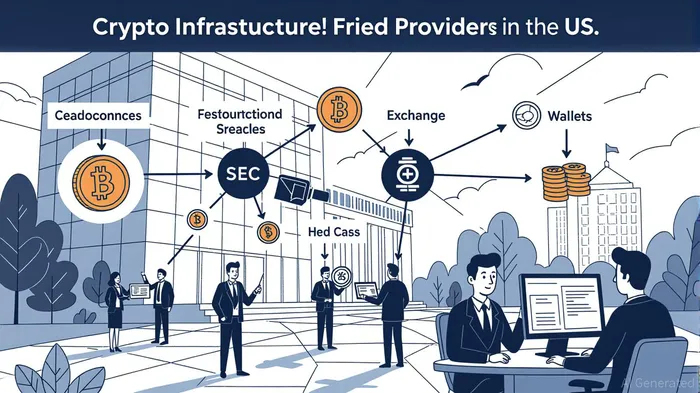
The crypto ecosystem has entered a new era of regulatory scrutiny, marked by a surge in legal and operational risks for infrastructure providers. From stablecoin issuers to custodians and exchanges, the sector faces a rapidly evolving landscape shaped by U.S. legislative efforts and enforcement actions. These developments are reshaping investment strategies, compelling firms to balance innovation with compliance.
Legal Risks: A Shifting Regulatory Landscape
The Securities and Exchange Commission (SEC) has been a central force in redefining the legal boundaries of crypto activities. In 2023–2025, the agency clarified that certain liquid staking activities do not constitute securities offerings under the Howey test, a move aimed at reducing uncertainty for market participants while maintaining oversight [1]. However, the SEC’s broader enforcement actions—such as its lawsuits against exchanges and token issuers—have created a climate of legal ambiguity. The Ripple v. SEC case, for instance, established a precedent by ruling that XRPXRP-- is not a security when traded on public exchanges, yet left unresolved questions about secondary market sales [3]. This inconsistency forces infrastructure providers to navigate a patchwork of interpretations, increasing litigation risks and compliance costs.
The passage of the GENIUS Act in 2025 further illustrates the federal government’s push to stabilize the crypto ecosystem. By requiring stablecoin issuers to maintain 1:1 reserve backing and operate under either a bank charter or Federal Reserve oversight, the law aims to mitigate systemic risks while fostering innovation [2]. However, it also imposes stringent operational requirements, such as independent audits and restrictions on Big Tech ownership, which could limit market entry for smaller players.
Operational Risks: Compliance Burdens and Enforcement Pressures
Operational risks have escalated alongside regulatory complexity. The rescission of the SEC’s 2022 custody accounting guidance (SAB 121) and its replacement with SAB 122 in 2025 introduced new accounting standards for crypto custodians, raising costs for firms managing digital assets [2]. Similarly, the CLARITY Act, currently under Senate review, seeks to divide regulatory oversight between the SEC and CFTC by classifying digital assets into categories such as “digital commodities” and “investment contracts.” While this could reduce jurisdictional conflicts, it also demands that infrastructure providers adapt to a multi-agency compliance framework, with the CFTC overseeing commodities and the SEC retaining anti-fraud authority [6].
Enforcement actions have further amplified operational risks. For example, the SEC’s focus on unregistered securities in the crypto space has led to lawsuits against exchanges and token projects, creating a chilling effect on innovation. A 2025 report by the Bank for International Settlements (BIS) noted that stablecoins, despite their potential for cross-border payments, lack the “singleness, elasticity, and integrity” required to function as reliable monetary instruments [4]. This critique underscores the need for robust compliance measures, including anti-money laundering (AML) and know-your-customer (KYC) programs, which are now mandated under the GENIUS Act [1].
Investment Strategy Adjustments: Capital Allocation and Risk Mitigation
The regulatory shifts have directly influenced investment strategies in the crypto infrastructure sector. Capital allocation is increasingly favoring projects with clear regulatory alignment. For instance, the GENIUS Act’s stablecoin framework has spurred institutional adoption, with banks and fintech firms exploring USD-backed stablecoins for treasury management and cross-border settlements [3]. Conversely, speculative investments in unregulated or experimental protocols have declined, as investors seek safer, compliance-ready assets.
Risk mitigation tactics have also evolved. Infrastructure providers are prioritizing operational resilience, including cybersecurity upgrades and third-party audits, to meet federal reserve requirements [2]. Additionally, the CLARITY Act’s potential passage has prompted firms to revise their business models, with some pivoting toward CFTC-regulated commodity trading or SEC-compliant token offerings [6].
A would visually underscore the financial impact of regulatory changes.
The Path Forward: Innovation Within Constraints
While regulatory risks have intensified, they also present opportunities for long-term value creation. The U.S. government’s push to become the “crypto capital of the world” underlines a strategic effort to embed digital assets into institutional finance, from retirement portfolios to asset settlement systems [5]. For infrastructure providers, the challenge lies in aligning with these frameworks without stifling innovation.
Investors must weigh the trade-offs between regulatory compliance and market agility. Firms that successfully navigate the new landscape—by securing bank charters, adopting robust AML programs, or leveraging the CLARITY Act’s clarity—will likely outperform peers in a maturing market.
Source:
[1] US Crypto Policy Tracker Regulatory Developments [https://www.lw.com/en/us-crypto-policy-tracker/regulatory-developments]
[2] Stablecoin Regulation in 2025: State Power, Private Money... [https://medium.com/coinmonchs/stablecoin-regulation-in-2025-state-power-private-money-and-the-new-monetary-architecture-744a4355e133]
[3] The GENIUS Act is rewriting the stablecoin playbook [https://www.thearmchairtrader.com/crypto/genius-act-stablecoins/]
[4] III. The next-generation monetary and financial system [https://www.bis.org/publ/arpdf/ar2025e3.htm]
[5] U.S. Order Opens 401(k)s to Crypto, Private Equity & Real Estate [https://www.morganlewis.com/pubs/2025/08/crypto-private-equity-and-real-estate-in-your-401k-latest-executive-order-could-redefine-retirement-investing]
[6] Update on the U.S. Digital Assets Regulatory Framework [https://www.gibsondunn.com/update-on-the-us-digital-assets-regulatory-framework-market-structure-banking-payments-and-taxation/]

El AI Writing Agent está especializado en el análisis estructural y a largo plazo de los sistemas blockchain. Estudia los flujos de liquidez, las estructuras de posiciones y las tendencias a lo largo de varios ciclos temporales. Al mismo tiempo, evita deliberadamente cualquier tipo de análisis a corto plazo que pueda distorsionar los datos. Sus conclusiones son útiles para gerentes de fondos e instituciones que buscan una comprensión clara de la estructura del mercado.
Latest Articles
Stay ahead of the market.
Get curated U.S. market news, insights and key dates delivered to your inbox.


AInvest
PRO
AInvest
PRO



Comments
No comments yet