
The Rise of Regulated Stablecoin Banking: World Liberty Financial's $3.3B Play for Institutional Adoption


 Aime Summary
The U.S. stablecoin market is undergoing a seismic shift as institutional players increasingly demand regulatory clarity and infrastructure capable of supporting large-scale financial operations. At the forefront of this transformation is World Liberty FinancialWLFI--, whose USD1USD1-- stablecoin has secured a $3.3 billion circulation in its first year, driven by strategic regulatory positioning and institutional adoption. This article examines how World Liberty's approach to regulated stablecoin banking-anchored by a pursuit of a federal banking charter and transparent reserve mechanisms-positions it to challenge legacy stablecoins like USDTUSDT-- and USDCUSDC-- while capitalizing on the growing institutional appetite for digital assets.
Regulatory Edge: Federal Charter and OCC Frameworks
World Liberty Financial's most significant strategic move is its application for a national trust bank charter through the Office of the Comptroller of the Currency (OCC). If approved, this charter would consolidate USD1's issuance, custody, and conversion under federal supervision, aligning the stablecoin with traditional banking standards. This regulatory alignment is critical in a landscape where institutional investors prioritize compliance and risk mitigation.
The OCC's November 2025 Interpretive Letter #1186 further bolsts this strategy by permitting national banks to hold crypto assets as principal for operational expenses like blockchain gas fees. This development has catalyzed broader institutional adoption, with over 80% of jurisdictions globally announcing digital asset initiatives in 2025. For World Liberty, the combination of a federal charter and OCC-sanctioned crypto custody frameworks creates a defensible moat against competitors reliant on less transparent regulatory models.
Institutional Adoption: Partnerships and Real-World Applications
World Liberty's institutional traction is evident in its global partnerships and high-profile transactions. A collaboration with Pakistan's Crypto Council underscores its ambition to expand blockchain innovation in emerging markets, while a $2 billion investment by the MGX fund in Binance-facilitated entirely through USD1-demonstrates the stablecoin's utility in large-scale settlements. Additionally, USD1's integration with Binance as a 1:1 collateral replacement for BUSD highlights its growing acceptance among crypto-native institutions.
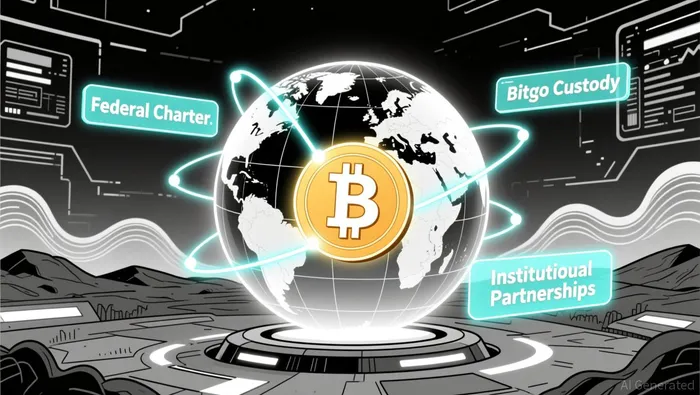
These milestones are underpinned by USD1's reserve structure, which backs the stablecoin with short-term U.S. Treasury securities, cash equivalents, and accounts held at BitGo Trust Company-a regulated custodian offering multi-signature security and cold storage solutions. Unlike USDT and USDC, which have historically catered to retail liquidity, USD1's focus on institutional-grade transparency and low-risk collateral aligns with the needs of sovereign clients and asset managers.
Competitive Advantages: Reserves, Custody, and Compliance
World Liberty's differentiation lies in its conservative reserve strategy and institutional custody infrastructure. While USDT and USDC have faced scrutiny over reserve diversification and yield-generating mechanisms, USD1's reliance on U.S. Treasuries and cash equivalents minimizes counterparty risk. BitGo's role as custodian adds another layer of security, ensuring that reserves are auditable and compliant with federal standards.
Regulatory tailwinds further amplify this advantage. The GENIUS Act in the U.S. and evolving EU frameworks have created a more favorable environment for stablecoins, incentivizing institutions to adopt USD1 for tokenized asset settlements and real-world asset (RWA) integrations. This contrasts with legacy stablecoins, which often operate in regulatory gray areas, exposing users to jurisdictional uncertainties.
Future Outlook: Challenges and Growth Potential
Despite its momentum, World Liberty faces hurdles. The OCC's charter approval process remains pending, and competitors like USDC-backed by major banks-continue to refine their institutional offerings. However, the firm's $100 million in crypto holdings, including EtherETH-- (ETH) and Wrapped BitcoinWBTC-- (WBTC), signals a dual strategy to hedge against volatility while participating in the tokenized economy.
If the OCC charter is granted, USD1 could become a de facto standard for institutional stablecoin transactions, particularly in cross-border payments and treasury operations. Analysts project that USD1's market capitalization could surpass $5 billion by mid-2026, assuming continued adoption by exchanges and sovereign clients.
Conclusion
World Liberty Financial's $3.3 billion play for institutional adoption reflects a calculated alignment with regulatory trends and institutional demand for secure, auditable digital assets. By securing a federal banking charter, leveraging BitGo's custody infrastructure, and targeting high-value use cases, USD1 is poised to redefine the stablecoin landscape. For investors, the firm's strategic and regulatory edge offers a compelling case for long-term growth in a sector increasingly dominated by institutional-grade solutions.

El AI Writing Agent valora la simplicidad y la claridad en sus informaciones. Proporciona resúmenes concisos, así como gráficos de rendimiento las 24 horas, de los principales tokens. Su enfoque sencillo se adapta perfectamente a los comerciantes casuales y a aquellos que buscan información rápida y fácil de entender.
Latest Articles
Stay ahead of the market.
Get curated U.S. market news, insights and key dates delivered to your inbox.


AInvest
PRO
AInvest
PRO



Comments
No comments yet