
The Rise of Real World Asset (RWA) Tokenization in 2025
 Aime Summary
Market Growth and Key Asset Classes
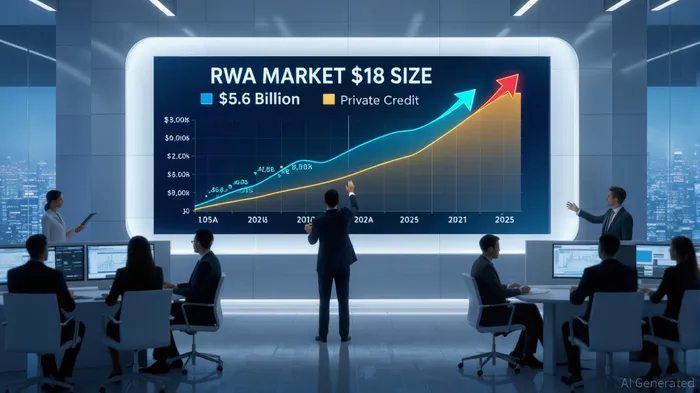
The RWA tokenization market has expanded rapidly, tripling from $5.5 billion in early 2025 to approximately $18.6 billion by year-end according to Q3 2025 market report. U.S. Treasuries remain the largest segment, with a total value of $8.86 billion as of December 2025 according to RWA use cases data, while tokenized gold surged 227% year-to-date to $3.27 billion according to RWA trends analysis. Private credit, commodities, and institutional alternative funds have also gained traction, with private credit alone accounting for $8.6 billion of on-chain RWA value according to RWA trends report. These developments highlight the diversification of RWA tokenization beyond speculative assets, offering institutional investors a range of entry points.
 Ethereum dominates the blockchain landscape for RWA tokenization, hosting $12.3 billion in distributed assets according to regulatory framework analysis, but platforms like BNBBNB-- Chain, SolanaSOL--, and ArbitrumARB-- are gaining ground. The appeal lies in tokenization's inherent advantages: fractional ownership, faster settlement (reducing counterparty risk), and enhanced transparency according to crypto regulatory trends. For example, tokenized real estate now allows investors to purchase fractional stakes in high-value properties, such as a New York luxury hotel, with investments as low as $1,000 according to RWA use cases.
Regulatory Clarity: A Catalyst for Institutional Adoption
Regulatory frameworks have evolved significantly in 2025, providing the stability needed for institutional participation. The European Union's Markets in Crypto-Assets (MiCA) regulation, fully implemented in 2025, has positioned tokenization as a strategic pillar for capital market competitiveness according to crypto regulatory round-up. In the U.S., the SEC's "Project Crypto" initiative has enabled the tokenization of traditional assets like bonds and equities, while the GENIUS Act established reserve requirements for stablecoins, further legitimizing the sector according to crypto regulatory trends.
Singapore's Project Guardian and Hong Kong's Stablecoins Ordinance have also attracted major players like TetherUSDT-- and Circle, creating a global hub for tokenized asset issuance according to RWA trends analysis. These frameworks address critical concerns such as liquidity, valuation, and anti-money laundering (AML) compliance, reducing barriers for institutional entry. As noted by a report from Chainalysis, the harmonization of regulations across jurisdictions is now a key priority to prevent arbitrage and ensure consistent enforcement according to crypto regulatory round-up.
Institutional Strategies and Case Studies
Leading asset managers have pioneered RWA tokenization strategies, demonstrating scalable models for institutional investors. BlackRock's USD Institutional Digital Liquidity Fund (BUIDL) grew from $615 million to $1.87 billion within a year, showcasing the appetite for tokenized liquidity solutions according to Q3 2025 market report. Franklin Templeton integrated its money market fund onto the blockchain, blending traditional and digital instruments according to RWA trends report, while Goldman Sachs and BNY Mellon issued tokenized money market funds (MMFs), enhancing accessibility for institutional clients according to RWA use cases.
Tokenized private credit has also gained momentum, with Santander's $20 million bond issuance on blockchain reducing time-to-market to days according to RWA trends analysis. In real estate, the UAE has emerged as a hub for tokenized property, though regulatory specifics remain under development according to RWA trends report. These case studies underscore the operational efficiency and yield potential of RWA tokenization, particularly in asset classes with illiquid or fragmented markets.
Strategic Entry Points for Institutional Investors
For institutions seeking to capitalize on RWA tokenization, three key entry points stand out:
1. Private Credit: Tokenized debt instruments enable direct issuance on blockchain, streamlining capital formation and reducing intermediation costs according to RWA use cases.
2. Real Estate: Fractional ownership models democratize access to high-value properties, while tokenization improves liquidity for traditionally illiquid assets according to Q3 2025 market report.
3. Commodities and Gold: Tokenized gold's 227% growth in 2025 highlights its role as a hedge against macroeconomic uncertainty according to RWA trends analysis.
Institutional investors should also prioritize partnerships with blockchain infrastructure providers and regulatory consultants to navigate jurisdictional nuances. For instance, the EU's DLT Pilot Regime and Switzerland's DLT Act offer frameworks for testing tokenized asset solutions according to crypto regulatory round-up.
The Road Ahead: Challenges and Opportunities
Despite its promise, RWA tokenization faces hurdles. Liquidity remains a concern, particularly for niche asset classes, while valuation models for tokenized assets are still evolving according to regulatory framework analysis. However, the projected $2–$4 trillion market size by 2030 according to market analysis suggests these challenges will be mitigated as infrastructure matures.
Institutional investors must also balance innovation with risk management. As emphasized by a report from Fireblocks, operational risks such as smart contract vulnerabilities and cross-chain interoperability issues require robust due diligence according to policy changes outlook.
Conclusion
The RWA tokenization market in 2025 represents a confluence of technological innovation, regulatory progress, and institutional demand. For investors, the strategic entry points lie in asset classes with inherent inefficiencies-private credit, real estate, and commodities-where tokenization unlocks liquidity and operational efficiency. As frameworks like MiCA and Project Crypto continue to evolve, the next 12–18 months will likely see a surge in institutional participation, cementing RWA tokenization as a cornerstone of modern portfolio strategy.

Blending traditional trading wisdom with cutting-edge cryptocurrency insights.
Latest Articles
Stay ahead of the market.
Get curated U.S. market news, insights and key dates delivered to your inbox.




Comments
No comments yet