
The Rise of Prediction Markets in Media and Investing: What CNN's Kalshi Partnership Means for Retail Traders


 Aime Summary
The integration of prediction markets into mainstream media marks a pivotal shift in how information is consumed and traded. CNN's recent partnership with Kalshi, the U.S.-regulated prediction market platform, underscores this transformation. By embedding Kalshi's real-time market probabilities into its news coverage, CNN is not only redefining journalistic storytelling but also democratizing access to speculative assets for retail traders. This collaboration, coupled with Kalshi's explosive growth and regulatory advancements, signals a broader financial innovation trend: prediction markets are evolving from niche curiosities into mainstream tools for forecasting and risk management.
Market Democratization: Prediction Markets Go Mainstream
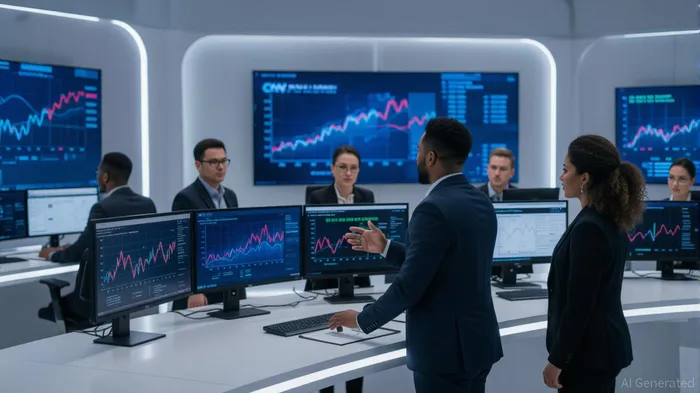
CNN's partnership with Kalshi represents a watershed moment for market democratization. For the first time, real-time prediction market data-once confined to niche platforms-will be broadcast to a global audience. Kalshi's probabilities will now appear in CNN's political, economic, and cultural coverage, including a live on-screen ticker. This visibility demystifies prediction markets, making them accessible to viewers who may have never traded them before.
The partnership's timing is telling. Kalshi , . This surge reflects growing institutional confidence in prediction markets as a legitimate data source. For retail traders, the CNN-Kalshi collaboration lowers barriers to entry. As Kalshi's data becomes part of mainstream discourse, it normalizes the idea of trading probabilities on events ranging from election outcomes to economic indicators. This normalization could drive mass adoption, particularly among younger investors accustomed to real-time, data-driven decision-making.
Speculative Asset Diversification: A New Frontier for Retail Traders
Prediction markets are rapidly becoming a distinct asset class, offering retail traders a tool for diversification and hedging. Unlike traditional equities or commodities, prediction markets allow bets on discrete events-such as interest rate hikes, corporate earnings surprises, or even cultural phenomena like Taylor Swift's tour decisions-according to research. This granularity enables traders to allocate capital across a spectrum of outcomes, effectively diversifying portfolios beyond conventional assets.
The exponential growth of the sector underscores its appeal. From January to October 2025, , with . This growth is driven by both retail and institutional participants, with platforms like Robinhood integrating prediction markets into their offerings. For individual traders, the ability to hedge against uncertain outcomes-such as a surprise election result or a corporate scandal-adds a new dimension to portfolio management.
Expert Commentary: Prediction Markets as Financial Infrastructure
Experts argue that prediction markets are outperforming traditional forecasting methods, positioning them as the next frontier in financial innovation. According to a report by Forbes, platforms like Kalshi and Polymarket have consistently anticipated outcomes before polls or expert analyses, leveraging the financial incentives of participants to generate more accurate probabilities. This "wisdom of crowds" effect is amplified by real-time price discovery, which updates dynamically as new information emerges.
The sector's legitimacy is further bolstered by regulatory clarity. The Commodity Futures Trading Commission (CFTC) has provided a framework for platforms like Kalshi to operate legally, while traditional institutions are taking notice. Intercontinental Exchange (ICE), parent company of the New York Stock Exchange, has invested in Polymarket, signaling recognition of prediction markets as a source of alternative data. As stated by a KPMG analysis, prediction markets are "reshaping how institutions forecast outcomes, offering a decentralized, incentive-driven alternative to traditional models" according to KPMG.
Implications for Retail Traders: Opportunities and Risks
For retail traders, the CNN-Kalshi partnership and the sector's growth present both opportunities and challenges. On the one hand, increased visibility and accessibility could attract a new wave of participants, driving liquidity and reducing spreads. On the other hand, the speculative nature of prediction markets requires a nuanced understanding of risk. Unlike stocks or bonds, these markets often trade on highly volatile, event-driven outcomes, which can lead to rapid price swings.
Moreover, the integration of prediction markets into media coverage raises questions about information asymmetry. As CNN broadcasts Kalshi's probabilities, traders must discern whether these prices reflect genuine market sentiment or are influenced by the platform's own liquidity. This dynamic mirrors the challenges faced by traditional investors in interpreting news-driven market movements.
Conclusion: A New Era of Financial Innovation
The CNN-Kalshi partnership is more than a media experiment-it is a harbinger of a broader financial revolution. By democratizing access to prediction markets and legitimizing them as a forecasting tool, the collaboration accelerates their adoption among retail traders. As these markets mature, they will likely serve as both a speculative asset class and a real-time barometer of collective expectations. For investors, the key takeaway is clear: prediction markets are no longer on the fringes. They are becoming an essential component of a diversified, forward-looking portfolio.

Delivering real-time insights and analysis on emerging financial trends and market movements.
Latest Articles
Stay ahead of the market.
Get curated U.S. market news, insights and key dates delivered to your inbox.


AInvest
PRO
AInvest
PRO



Comments
No comments yet