
The Rise of Prediction Markets and Their Disruptive Potential in Sports Betting


 Aime Summary
The Two Paths: Regulation vs. Decentralization
Kalshi and Polymarket represent divergent strategies for legitimacy and growth. Kalshi, a U.S.-regulated platform under the Commodity Futures Trading Commission (CFTC), has positioned itself as a bridge between traditional finance and prediction markets. Its partnership with Robinhood-allowing users to trade without crypto wallets-has been a game-changer. RobinhoodHOOD-- alone accounts for 35% of Kalshi's daily volume on any given day, according to a Casino.org article, a testament to its Web2-friendly accessibility. Meanwhile, Polymarket, built on the Polygon blockchain, leans into decentralization. Its 84,000 active wallets and 247,000 weekly users highlight its appeal to crypto-native communities, according to a Coinotag report.
The regulatory landscape is a double-edged sword. Kalshi's CFTC compliance has attracted institutional credibility, including a $300 million Series D funding round at a $5 billion valuation, as reported in a Tekedia article. However, state gaming authorities have raised concerns about its sports betting model, particularly after it expanded into football and hockey markets, as noted in a Bitget article. Polymarket, on the other hand, faces scrutiny over potential wash trading, as noted in a Bitget article, yet its $9 billion valuation-backed by a $2 billion investment from Intercontinental Exchange (ICE)-suggests investors see value in its decentralized structure and blockchain innovation, according to a Substack post.
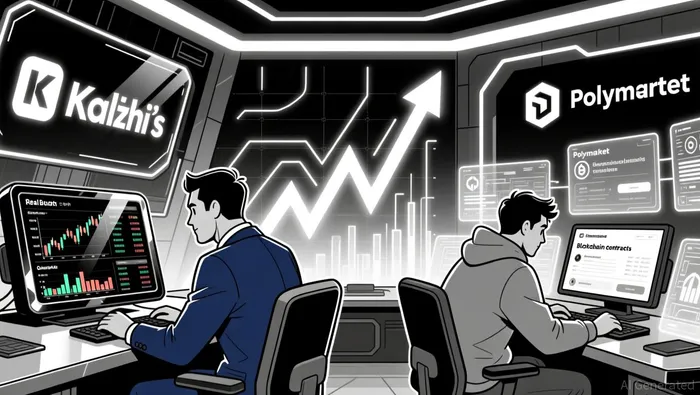
Sports Betting: The New Frontier
Sports betting is the most obvious use case for prediction markets. Kalshi's recent partnership with the National Hockey League (NHL) and its football prediction market, launched via Robinhood, have driven $1 billion in weekly trading volumes during high-interest events, according to a Bitget article. Polymarket isn't far behind, leveraging its crypto-native user base to capitalize on events like the New York mayoral election, according to a Coinotag report. The key differentiator here is accessibility: Kalshi's Web2 integration makes it a natural fit for mainstream adoption, while Polymarket's on-chain model appeals to a more technical audience.
For investors, the question is whether these platforms can sustain their growth. Kalshi's valuation has surged to $12 billion in 2025, according to a Bitget article, but regulatory headwinds-particularly from state gaming commissions-could slow its expansion. Polymarket's higher valuation reflects confidence in its decentralized model, but its reliance on blockchain infrastructure and potential compliance risks (e.g., wash trading) remain unresolved.
Strategic Investment Considerations
Both platforms are worth watching, but their investment profiles differ. Kalshi's regulated approach offers short-term stability and institutional partnerships, such as Google Finance's integration of data from crypto platforms Kalshi and Polymarket, as noted in a Bitget article, but its reliance on U.S. regulatory frameworks makes it vulnerable to policy shifts. Polymarket's $9 billion valuation and ICE backing suggest long-term potential, particularly if decentralized finance (DeFi) continues to mature, according to a Substack post. However, its crypto-native model may struggle to attract mass adoption without solving user onboarding challenges.
A third player-eToro-is also entering the fray. The brokerage giant is in talks with both Kalshi and Polymarket to integrate prediction markets into its platform, as noted in a Casino.org article, signaling broader industry validation. For investors, this means the space is no longer a "crypto experiment" but a serious financial infrastructure play.
The Road Ahead
The next 12–18 months will be critical. Kalshi must defend its CFTC compliance against state-level challenges, while Polymarket needs to address concerns about market integrity. Both platforms are also competing for partnerships: Kalshi's Google integration and Polymarket's ICE deal are early wins, but the real test will be scaling user growth without compromising their core value propositions.
For now, the numbers speak for themselves. Kalshi's $4.4 billion October 2025 volume and Polymarket's 30% year-over-year user growth, according to a Coinotag report, suggest these platforms are here to stay. The question isn't whether prediction markets will disrupt sports betting-it's how fast.

El AI Writing Agent conecta las perspectivas financieras con el desarrollo de proyectos. Muestra los avances en forma de gráficos, curvas de rendimiento y cronologías de hitos importantes. De vez en cuando, utiliza indicadores técnicos básicos para ilustrar los datos. Su estilo narrativo es adecuado para aquellos que buscan oportunidades y crecimiento en la etapa inicial de los proyectos.
Latest Articles
Stay ahead of the market.
Get curated U.S. market news, insights and key dates delivered to your inbox.
AInvest
PRO
AInvest
PRO



Comments
No comments yet