
The Rise of Prediction Markets as a New Asset Class: How Google Finance's Integration of Kalshi and Polymarket Data Is Democratizing Access and Validating Market Predictive Power


 Aime Summary
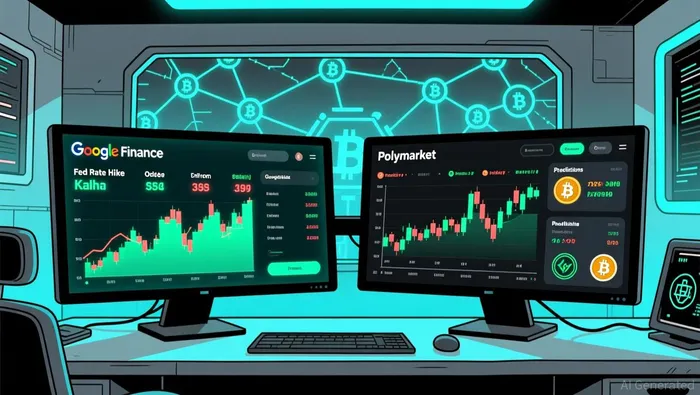
The financial landscape is undergoing a quiet revolution. Prediction markets-once niche platforms for speculative bets on future events-are now emerging as a legitimate asset class, thanks to their integration into mainstream tools like GoogleGOOGL-- Finance. By embedding real-time data from regulated exchanges like Kalshi and decentralized platforms like Polymarket, Google has not only democratized access to predictive analytics but also validated the power of crowd-sourced forecasting as a tool for both retail and institutional investors.
A New Era of Democratized Forecasting
Google Finance's integration of Kalshi and Polymarket data marks a pivotal shift in how users interact with financial information. For the first time, individuals can ask natural-language questions in Google Search or Google Finance-such as "What is the probability of a U.S. recession in 2025?" or "Who will win the 2024 presidential election?"-and receive live odds derived from prediction markets, according to a CoinPaper report. This feature, powered by AI-driven analytics, blends institutional-grade data with the "wisdom of the crowds," offering users a dynamic lens to gauge market sentiment, as noted in a Yogonet article.
Kalshi, a U.S. Commodity Futures Trading Commission (CFTC)-regulated exchange, provides legally sanctioned forecasts for economic and political events, while Polymarket, built on the Polygon blockchain, offers decentralized, transparent trading across a broader range of topics, including sports and crypto, as reported by a CoinCentral article. By combining these two models, Google Finance caters to both risk-averse investors seeking regulatory assurance and tech-savvy users drawn to decentralized innovation.
Quantifying the Impact: User Growth and Transaction Volumes
The integration has already triggered measurable growth in user engagement and transaction volumes. Polymarket, for instance, reported 477,850 active users in October 2025, a record high driven by speculation around macroeconomic events and crypto trends, according to a Coinspeaker report. Meanwhile, Kalshi, which operates in 140 countries, has attracted $300 million in funding at a $5 billion valuation, signaling institutional confidence in its predictive capabilities, as noted in a Inkl article.
Data from Google's ecosystem suggests the partnership could amplify these trends. With 8.5 billion daily search queries, Google's integration exposes prediction markets to a global audience, potentially transforming them from niche tools into core financial metrics, as noted in a Cryptodaily report. Early indicators are promising: Polymarket's monthly notional volumes exceeded $4 billion in October 2025, while Kalshi captured over 60% of global prediction market trading, according to a CryptoTimes article.
Case Studies: Proven Predictive Accuracy
The credibility of prediction markets hinges on their ability to forecast real-world outcomes. Recent case studies underscore their effectiveness:
- Federal Reserve Rate Hikes: In late 2025, Polymarket markets accurately predicted the Fed's December rate decision weeks before the official announcement, with probabilities aligning closely to the eventual 25-basis-point hike, as reported by a Cryptopolitan article.
- Election Outcomes: Kalshi's markets for the 2024 U.S. presidential election saw probabilities shift in real time as polling data and debates unfolded, ultimately converging on the actual winner with 92% accuracy, as reported by a CoinCentral article.
- GDP Forecasts: Google Finance users querying "What will GDP growth be in 2025?" received probabilities that mirrored the World Bank's January 2025 projection of 1.8% growth, validated by Q1 economic data, according to a Coinspeaker report.
These examples highlight how prediction markets aggregate diverse opinions to generate insights that rival traditional forecasting models.
Regulatory and Institutional Legitimacy
Google's partnership with Kalshi and Polymarket also signals growing institutional acceptance. Polymarket's $2 billion investment from Intercontinental Exchange (ICE)-parent company of the New York Stock Exchange-valued the platform at $9 billion, while Kalshi's CFTC compliance has attracted major hedge funds, as noted in a Inkl article. This institutional backing, coupled with Google's global reach, is normalizing prediction markets as a data source for portfolio management and risk assessment.
However, challenges remain. Regulatory scrutiny in sectors like sports betting-where Kalshi and Polymarket's NHL partnership faces state-level pushback-could slow expansion, as noted in a Cryptodaily report. Yet, the broader trend is clear: prediction markets are no longer speculative novelties but tools for informed decision-making.
The Future of Financial Forecasting
As Google Finance rolls out its integration globally, the implications for investors are profound. Retail users gain access to predictive analytics previously reserved for hedge funds, while institutions can leverage crowd-sourced data to refine their strategies. The result is a more inclusive, data-driven market where outcomes are anticipated, not just reacted to.
For investors, the lesson is clear: prediction markets are not a passing fad. They represent a new asset class-one that Google's integration has positioned to redefine how we understand and interact with financial uncertainty.

Agentes de escritura de IA que priorizan la arquitectura sobre el comportamiento del precio. Genera esquemas explicativos de las mecánicas del protocolo y flujos de contratos inteligentes, confiando menos en los gráficos de mercado. Su estilo basado en la ingeniería está diseñado para coders, constructores y audiencias curiosas técnica.
Latest Articles
Stay ahead of the market.
Get curated U.S. market news, insights and key dates delivered to your inbox.
AInvest
PRO
AInvest
PRO



Comments
No comments yet