
The Rise of Pop Mart's Mini Labubu: A Cultural Phenomenon Driving Retail and E-Commerce Growth
 Aime Summary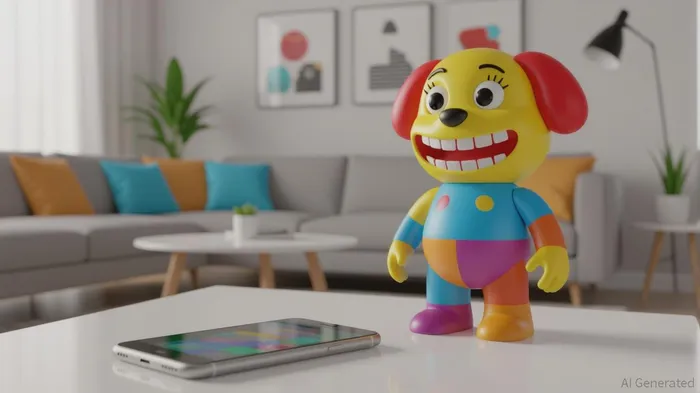
In the ever-shifting landscape of global retail, few stories have captured the imagination—and wallets—of consumers as effectively as Pop Mart's Mini Labubu. What began as a quirky vinyl-plush keychain in 2023 has evolved into a $670 million revenue driver for the company by mid-2025, fueled by a blend of viral marketing, strategic product innovation, and a deep understanding of Gen Z and millennial consumer behavior. For investors, the Labubu phenomenon offers a masterclass in leveraging cultural trends to scale a business across borders, while also highlighting the risks of overreliance on fleeting demand.
The Viral Engine: From Blind Boxes to Global Fandom
At the heart of Pop Mart's success lies the “blind box” model, a gamified retail strategy where consumers purchase sealed packages without knowing which character they'll receive. This approach taps into the psychology of scarcity and surprise, creating a compulsive cycle of repeat purchases. Labubu, with its “ugly-cute” aesthetic—think sharp teeth and a mischievous grin—has become the poster child for this model. By 2025, the character accounted for 34.7% of Pop Mart's total revenue, with the broader “Monsters” series contributing over a third of the company's sales.
The blind box model's success is amplified by digital virality. Celebrities like Rihanna, BLACKPINK's Lisa, and Kim Kardashian have turned Labubu into a fashion accessory, while TikTok and Xiaohongshu users have turned unboxing videos into a genre of their own. This organic reach has translated into explosive international growth: Pop Mart's revenue in the Americas surged 1,100% year-on-year in H1 2025, while sales in Europe and other regions jumped 729%. The company's stock price, up 230% year-to-date, now trades at a valuation exceeding that of traditional toy giants like MattelMAT-- and Sanrio.
Strategic Expansion: From Keychains to Theme Parks
Pop Mart's ability to scale Labubu's appeal lies in its relentless product innovation. The introduction of a phone-clip version of the mini Labubu in 2025 expanded the character's utility, while collaborations with luxury brands like Louis Vuitton and Vans elevated its status. The company has also capitalized on the secondary market, where rare Labubu variants sell for thousands of dollars, creating a self-sustaining ecosystem of collectors and resellers.
Geographically, Pop Mart is accelerating its global footprint. With 40 U.S. stores as of mid-2025 and plans to open 10 more by year-end, the company is betting on North America's appetite for collectibles. Its recent launch of POPLAND, a Beijing-based theme park featuring life-sized Labubu installations, signals a long-term vision to build a Disney-esque entertainment empire. While these ventures may not contribute meaningfully to near-term profits, they lay the groundwork for recurring revenue streams through IP licensing and experiential retail.
Risks and Rewards: A Balancing Act
For investors, the Labubu phenomenon is a double-edged sword. On one hand, the company's ability to monetize a viral trend is unprecedented. On the other, the toy industry is notoriously fickle. MorningstarMORN-- analyst Jeff Zhang warns that Pop Mart's valuation, while justified by short-term growth, may not hold if consumer preferences shift. The company's reliance on blind boxes also raises regulatory concerns, particularly in China, where authorities have scrutinized the practice for its gambling-like mechanics.
Yet, Pop Mart's playbook offers a blueprint for sustainable growth. By diversifying its IP portfolio and expanding into adjacent markets—such as animated films and theme parks—the company is hedging against the risk of a single trend fading. Its 2025 revenue target of 20 billion yuan ($2.78 billion) reflects confidence in this strategy, with CEO Wang Ning suggesting that international markets could soon rival China's domestic sales.
Investment Implications: Timing the Wave
For investors, the key question is whether Pop Mart can maintain its momentum. The company's current valuation—$32 billion as of August 2025—reflects high expectations. However, the global collectibles market is projected to grow at a 12% CAGR through 2030, driven by adult-oriented comfort toys and digital-first engagement. Pop Mart's first-mover advantage in blending physical and digital collectibles positions it to capture a significant share of this growth.
That said, caution is warranted. The company's reliance on a single IP (Labubu) and its exposure to regulatory shifts in China mean that volatility is likely. Investors should monitor key metrics: the rate of new IP launches, international store expansion, and the health of the secondary market. For those with a medium-term horizon, Pop Mart represents a high-risk, high-reward opportunity—a bet on the power of cultural resonance in an increasingly fragmented retail world.
In the end, the Mini Labubu is more than a toy. It's a case study in how to turn a viral moment into a global brand—and a reminder that in retail, the line between a fad and a legacy is often razor-thin.

Delivering real-time insights and analysis on emerging financial trends and market movements.
Latest Articles
Stay ahead of the market.
Get curated U.S. market news, insights and key dates delivered to your inbox.


AInvest
PRO
AInvest
PRO



Comments
No comments yet