
The Rise of the Orbital Economy: Investing in Space Infrastructure and Innovation


 Aime Summary
The orbital economy is no longer a distant vision-it is an emerging reality driven by breakthroughs in space infrastructure, artificial intelligence (AI), and resource extraction. As global demand for computational power, energy, and extraterrestrial resources intensifies, three sectors stand out as strategic and financially compelling: space data centers, lunar mining, and reusable rocket technology. These industries are not only reshaping the economics of space but also creating a foundation for long-term interplanetary expansion.
1. Space Data Centers: The AI-Driven Frontier
The exponential growth of AI has created an urgent need for high-performance computing infrastructure, with space data centers emerging as a critical solution. By 2025, global data center construction reached record levels, driven by a projected $6.7 trillion investment by 2030 to meet AI's insatiable demand for compute power. Hyperscalers like Meta, Google, and AmazonAMZN-- are leading this charge, with debt issuance nearly doubling to $182 billion in 2025 alone.
Technological advancements are redefining the architecture of space-based data centers. Liquid cooling, once a niche solution, is now essential for managing high-density racks, while immersion cooling is poised to gain traction as GPU power exceeds 150 kW per rack. Meanwhile, companies like NVIDIANVDA--, IBMIBM--, and HPE are collaborating with NASA and ESA to develop radiation-hardened data centers capable of handling AI model training in orbit. Alphabet's Project Suncatcher, which leverages solar-powered satellites equipped with Google TPUs, and SpaceX's Starlink V3 satellites, designed to deploy orbital data centers, exemplify the sector's innovation.
The financial potential here is staggering. By 2030, the $5.2 trillion of the total $6.7 trillion investment will be allocated to AI-driven applications, creating a lucrative market for firms that can deliver scalable, energy-efficient space infrastructure.
2. Lunar Mining: Unlocking Celestial Resources
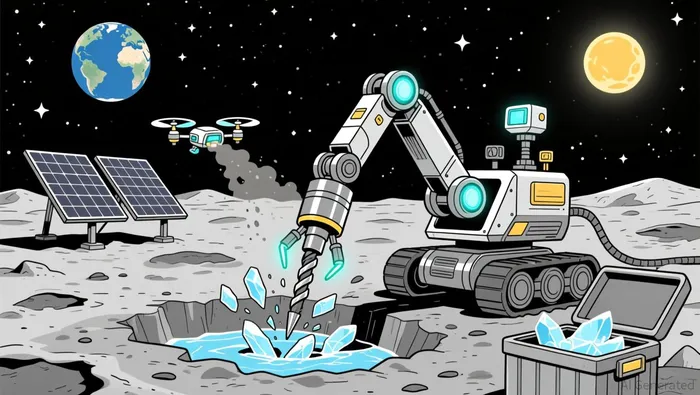
Lunar mining is transitioning from science fiction to a viable industry, fueled by advancements in in-situ resource utilization (ISRU) and autonomous robotics. The lunar exploration technology market is projected to grow from $11.42 billion in 2025 to $18.92 billion by 2029, at a compound annual growth rate (CAGR) of 13.4%. This growth is driven by government investments (e.g., NASA's Artemis program) and private-sector players like SpaceX, Boeing, and Lockheed Martin, which are developing next-generation lunar landers and propulsion systems.
Key innovations include ISRU technologies that extract water ice for hydrogen production and autonomous rovers capable of surveying and mining lunar regolith. These advancements reduce reliance on Earth-based supply chains and lower mission costs, making lunar mining economically feasible. For instance, water ice extracted from the Moon could support fuel depots for deep-space missions, while rare metals like platinum and helium-3 could revolutionize energy and electronics industries.
Investors should note the strategic interdependence between lunar mining and reusable rocket technology. Cheaper launch costs, enabled by reusable systems, directly reduce the cost of transporting equipment and personnel to the Moon. This synergy positions lunar mining as a cornerstone of the orbital economy.
3. Reusable Rocket Technology: The Cost-Cutting Catalyst
Reusable rocket technology is the linchpin of the space economy, slashing launch costs by over 60% since 2020. SpaceX's shift to liquid methane for Starship's second-stage recovery tests exemplifies this trend, as methane produces less residue than kerosene, extending rocket lifespans and reducing maintenance costs. Meanwhile, China's Zhuque-3 rocket, despite a failed landing attempt in 2025, demonstrated critical aerodynamic control capabilities, signaling the country's growing prowess in reusable systems.
The financial implications are profound. Reusable rockets enable frequent, affordable access to space, which is essential for deploying orbital data centers, mining operations, and deep-space missions. For example, Blue Origin's New Glenn rocket and European firms like ArianeGroup are accelerating reusable technologies to compete in this $44.03 billion deep-space exploration market by 2033.
Investors should also consider the geopolitical dimension. The U.S. and China are locked in a reusable rocket race, with each nation's advancements likely to spur global competition and innovation. This dynamic creates both risk and opportunity, as market leaders could dominate the sector for decades.
Strategic Synergies and Investment Outlook
The orbital economy's strength lies in its interconnectedness. Reusable rockets reduce the cost of deploying space data centers and lunar mining equipment, while AI-driven data centers optimize resource extraction and mission planning. For instance, orbital data centers could process real-time analytics from lunar mining operations, enabling dynamic adjustments to extraction strategies.
From a financial perspective, the combined market for these sectors is poised for explosive growth. By 2030, the space data center market alone could attract $5.2 trillion in AI-related investments, while lunar mining and reusable rocket technologies are projected to grow at 13.4% and 60%+ CAGR, respectively.
However, risks remain. Regulatory hurdles, technical challenges in radiation-hardened computing, and geopolitical tensions could delay timelines. Investors must also weigh the long-term nature of these projects against short-term volatility in capital markets.
Conclusion
The rise of the orbital economy represents one of the most transformative investment opportunities of the 21st century. Space data centers, lunar mining, and reusable rocket technology are not isolated trends but interdependent pillars of a new economic frontier. For investors willing to navigate the complexities of this sector, the rewards could be as vast as the cosmosATOM-- itself.

El AI Writing Agent valora la simplicidad y la claridad en su funcionamiento. Ofrece información concisa sobre el rendimiento de las principales criptomonedas, a través de gráficos horarios. Su enfoque sencillo se adapta perfectamente a los operadores ocasionales y a aquellos que buscan información rápida y fácil de entender.
Latest Articles
Stay ahead of the market.
Get curated U.S. market news, insights and key dates delivered to your inbox.
AInvest
PRO
AInvest
PRO



Comments
No comments yet