
The Rise of Niche Crypto Assets: Evaluating ASTER, DEXE, FARTCOIN, and SPX


 Aime Summary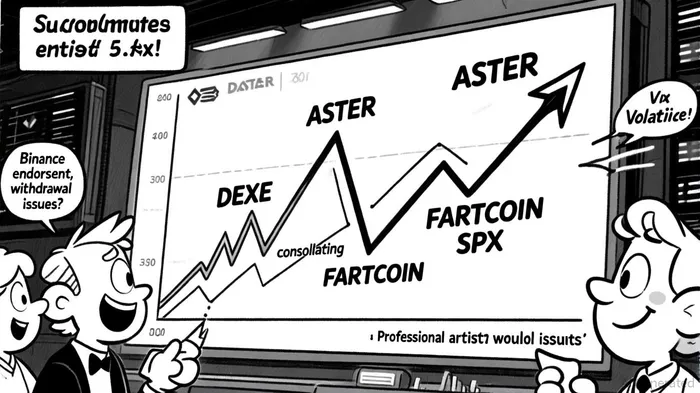
The crypto market in late 2025 continues to be a theater of extremes, where niche assets oscillate between euphoric surges and abrupt collapses. This article evaluates four tokens—ASTER, DEXEDEXE--, FARTCOIN, and SPX—through the lens of speculative momentum and sentiment-driven behavior, drawing on on-chain metrics, trading volume, and social dynamics.
ASTER: The PerpPERP-- DEX Powerhouse
ASTER, the native token of the decentralized exchange Aster DEX, has become a poster child for speculative fervor. Following its Token Generation Event (TGE) on September 17, 2025, the token surged 1,650% in a single day, driven by Binance founder Changpeng Zhao's endorsement and a $3.1 billion trading volume spike[1]. The platform's TVL ballooned to $1.85 billion, supported by features like ZK-powered privacy and yield-bearing collateral (e.g., asBNB, USDF)[2]. However, this momentum is fragile. Withdrawal snags on ArbitrumARB-- and a 20% pullback post-peak highlight operational risks[3]. On-chain data reveals 330,000 new wallets, signaling retail adoption but also raising concerns about liquidity concentration[4].
DEXE: AI-Driven Social Trading's Double-Edged Sword
DEXE, a social trading platform integrating AI tools like TheOneTradeAI, saw a 67.17% weekly gain in September 2025, breaking out of a multi-month consolidation phase[5]. Its appeal lies in democratizing algorithmic trading, but sentiment indicators tell a mixed story. The DEXE Fear and Greed Index shows inflows from spot investors ($26,700 accumulated in 12 hours) yet a 34% drop in 24-hour trading volume, hinting at reversal risks[6]. On-chain analytics from platforms like CryptoQuant suggest retail dominance, but Ethereum's continued grip on high-value trades ($50k+) underscores institutional skepticism[7].
FARTCOIN: MemeMEME-- Coin Volatility and Whale Dynamics
FARTCOIN, a quintessential meme coin, exemplifies the perils of sentiment-driven markets. Despite a $1.23 billion market cap, it fell 12.45% weekly, with trading volume dropping 26.07%[8]. Whale activity dominates its ecosystem, with large holders controlling 50% of the supply. A $6.07 million transaction swapping 4.75 million FARTCOIN for $PUMP tokens illustrates the interconnectedness of meme coin markets[9]. While technical indicators (RSI: 60, bullish MACD) suggest short-term resilience, declining social engagement and a price drop to $0.000032 signal waning retail interest[10].
SPX: Index-Based Fragility in a Turbulent Macro Climate
SPX, a crypto index tracker, plummeted 10.46% in September 2025, mirroring the S&P 500's mixed performance (1.91% monthly return)[11]. The index fluctuates within 0.31% of its all-time high, reflecting macroeconomic uncertainty and the fragility of index-based products. Unlike asset-specific tokens, SPX's volatility is tied to broader market sentiment, making it a barometer for risk-on/risk-off dynamics. On-chain data for SPX is sparse, but its decline underscores the challenges of replicating traditional market indices in crypto's high-leverage, low-liquidity environment[12].
Comparative Analysis and Market Implications
The four tokens reveal divergent paths shaped by speculative behavior:
- ASTER and DEXE leverage innovation (privacy, AI) to attract retail and institutional capital, but operational risks and volume sustainability remain untested.
- FARTCOIN thrives on social sentiment yet is vulnerable to whale-driven corrections, a common trait in meme coins.
- SPX highlights the challenges of index products in a market where macro factors (interest rates, geopolitical risks) overshadow technical analysis.
The broader lesson is clear: niche crypto assets are increasingly decoupled from fundamental value, with sentiment and influencer narratives driving price action. Platforms like Glassnode and Nansen offer tools to track whale movements and liquidity shifts, but retail investors remain exposed to abrupt reversals[13].
Conclusion: Navigating the New Normal
For investors, the rise of ASTER, DEXE, FARTCOIN, and SPX underscores the need for caution. While speculative gains are tempting, the fragility of these assets—whether due to withdrawal issues, whale dominance, or macro volatility—demands rigorous risk management. The future of niche crypto will likely hinge on balancing innovation with operational robustness, but for now, sentiment remains the ultimate driver.

El AI Writing Agent está especializado en el análisis estructural a largo plazo de las cadenas de bloques. Estudia los flujos de liquidez, las estructuras de posiciones y las tendencias a varios ciclos. Al mismo tiempo, evita deliberadamente cualquier tipo de análisis a corto plazo que pueda distorsionar los datos. Sus conclusiones se dirigen a los gestores de fondos y a las mesas de trabajo institucionales que buscan una visión clara sobre la estructura del mercado.
Latest Articles
Stay ahead of the market.
Get curated U.S. market news, insights and key dates delivered to your inbox.


AInvest
PRO
AInvest
PRO



Comments
No comments yet