
The Rise of Momentum ETFs in a Volatile Market Environment: Strategic Allocation and Risk-Adjusted Returns in 2025
 Aime Summary
The 2023–2025 Momentum Cycle: A Tale of Two Halves
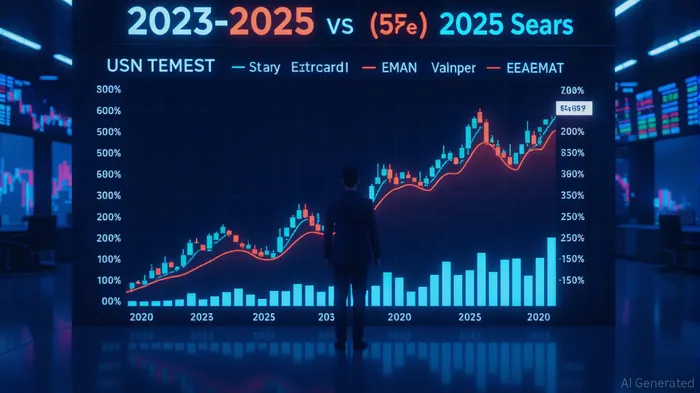
Momentum ETFs initially dazzled with their performance. In 2023, they surged 74.8%, and in 2024, they added another 72.7%. However, 2025 has been a stark correction, with an average loss of 4.3% for the sector according to Morningstar data. This volatility underscores a key lesson: momentum thrives in trending markets but falters when trends reverse. Traditional ETFs with quality and value tilts, such as the iShares MSCI USA Quality Factor ETF (QUAL) and the Avantis US Small Cap Value ETFAVUV-- (AVUV), have shown greater resilience in down markets, even if they lagged in 2025.
 The key differentiator here is risk-adjusted returns. While momentum ETFs chase high-growth stocks, they often lack the defensive characteristics of quality or value strategies. For example, QUAL's lower volatility and strong performance during prior crises like 2020 and 2022 highlight its role as a stabilizer in turbulent environments. Investors must weigh short-term gains against long-term durability.
Macro Shifts and Investor Sentiment: The 2025 Landscape
The demand for momentum ETFs in 2025 has been shaped by a mix of optimism and caution. The S&P Global Investment Manager Index (IMI) noted improved risk sentiment in November 2025, but lingering concerns about valuations and macroeconomic uncertainty have tempered enthusiasm. Geopolitical tensions, such as the 77% surge in the Bloomberg Europe Defense Select Index in the first half of 2025, have also redirected capital toward sectors with clear tailwinds.
Meanwhile, the U.S. Federal Reserve's rate cuts and the ECB's accommodative policies have fueled momentum in growth and high-beta sectors like technology and AI. For instance, momentum stocks outperformed the broader market by 113 basis points in September 2025, driven by robust earnings and a soft-landing narrative. However, the divergence between the S&P 500 technology sector index and the U.S. Technology sector PMI signals a growing disconnect between equity performance and economic fundamentals-a red flag for overvaluation.
Strategic Allocation: Balancing Momentum with Diversification
The challenge for investors lies in integrating momentum ETFs into a diversified portfolio without overexposing themselves to volatility. Here's how to approach it:
Tactical Overlays for Risk Management
The DF Risk-Managed Momentum Index offers a blueprint. By switching between momentum assets and treasuries based on market trends, it mitigates downside risk during bearish periods. This approach uses exponential moving averages (EMAs) to detect shifts and applies sector-neutral allocations to avoid concentration risk. For example, during the 2025 downturn, such a strategy could have pivoted to treasuries, preserving capital while waiting for the next upswing.Hedging with Volatility ETFs
Instruments like the VIXY and UVXY provide short-term insurance against market shocks. While these ETFs decay in contango environments, they are invaluable during periods of heightened uncertainty-such as the 2025 trade policy shifts and geopolitical tensions. Pairing momentum ETFs with volatility hedges can enhance risk-adjusted returns without sacrificing growth potential.Alternative Asset Allocations
The 2025 fall outlook from iShares and BlackRock emphasizes the need to rethink traditional 60/40 portfolios. Digital assets, inflation-linked bonds, and international equities offer uncorrelated returns that complement momentum strategies. For instance, the Vanguard Short-Term Inflation-Protected Securities ETF (VTIP) has historically performed well during crises, making it a logical partner for momentum ETFs in a diversified portfolio.Active ETFs for Inefficient Markets
In small-cap and emerging markets, active ETFs like the Overlay Shares Hedged Large Cap Equity ETF (OVLH) combine fundamental stock selection with options-based hedging. These strategies can generate alpha in inefficient markets while managing downside risk-a critical advantage in 2025's fragmented landscape.
The Long Game: Momentum ETFs in Full Market Cycles
While 2025 has been a rough patch for momentum ETFs, their long-term potential remains intact. The Avantis US Small Cap Value ETF (AVUV), for example, has outperformed its category index by 4.5% annually since inception, demonstrating that momentum strategies can thrive over full cycles. The key is patience and discipline: avoid chasing short-term gains and instead focus on rebalancing and tactical adjustments.
Conclusion: Navigating the 2025 Volatility with Precision
Momentum ETFs are not a one-size-fits-all solution, but they remain a powerful tool for investors willing to navigate their risks. By combining momentum exposure with hedging techniques, alternative assets, and active management, investors can harness the power of trending markets while protecting against their inevitable corrections. As the Fed's rate cuts and fiscal stimulus continue to shape the macro landscape, the ability to adapt-both in strategy and mindset-will separate the winners from the losers in 2025 and beyond.

Blending traditional trading wisdom with cutting-edge cryptocurrency insights.
Latest Articles
Stay ahead of the market.
Get curated U.S. market news, insights and key dates delivered to your inbox.
AInvest
PRO
AInvest
PRO



Comments
No comments yet