
The Rise of Investment Income Accounts and Their Impact on Consumer Financial Behavior
 Aime Summary
The U.S. financial landscape has undergone a seismic shift in recent years, driven by the rapid adoption of investment income accounts and a cultural pivot toward long-term financial planning. From 2023 to 2025, the interplay between macroeconomic trends and consumer behavior has created a unique environment where investment income is not just a tool for wealth creation but a cornerstone of economic resilience. This transformation is reshaping the financial services sector and unlocking opportunities for investors who understand the evolving dynamics.
The Macroeconomic Catalysts
The U.S. net international investment position (NIIP) of –$24.61 trillion in Q1 2025, while still negative, reflects a nuanced story of recovery. Foreign stock price gains and favorable exchange rates have offset domestic liabilities, signaling a rebalancing of global capital flows. Meanwhile, private equity and real estate markets have surged, fueled by deregulation, AI-driven infrastructure demand, and a housing shortage. For instance, private equity dealmaking rebounded after the Federal Reserve's first rate cut in September 2024, with secondary markets processing 9%–10% of primary commitments annually. These trends underscore a broader shift toward alternative assets and long-term capital deployment.
Consumer Behavior: From Skepticism to Strategic Planning
At the individual level, Americans are increasingly embracing investment income accounts as a hedge against inflation and a pathway to financial independence. The adoption of IRAs, 401(k)s, and digital investment platforms has accelerated, particularly among younger demographics and middle-income households. By 2025, 60% of Americans reported holding retirement accounts, with Gen Z and millennials driving a 27% year-over-year growth in fintech app usage.
The SECURE 2.0 Act has been a game-changer, mandating automatic enrollment in 401(k)s and boosting contribution limits for older workers. This legislation, combined with the rise of robo-advisors managing $1.3 trillion in assets, has democratized access to sophisticated investment strategies. Women aged 30–50, for example, saw a 17% surge in platform adoption, reflecting a growing emphasis on personalized, low-cost wealth management.
The Digital Revolution in Financial Services
Digital investment platforms are not merely tools; they are catalysts for behavioral change. By reducing transaction costs and information asymmetry, these platforms have enabled micro-investing, fractional shares, and real-time portfolio analytics, empowering consumers to diversify and optimize their holdings. The result? A 38% increase in middle-income households using wealthtech tools for retirement planning, with 68% of Gen Z now favoring fintechs over traditional banks.
This shift has profound implications for financial institutionsFISI--. Banks that fail to integrate AI-driven advisory services or blockchain-based asset management risk obsolescence. Conversely, firms that embrace innovation—such as those offering health savings accounts (HSAs) with retirement integration—are capturing market share by addressing holistic financial needs.
Opportunities in the Financial Services Sector
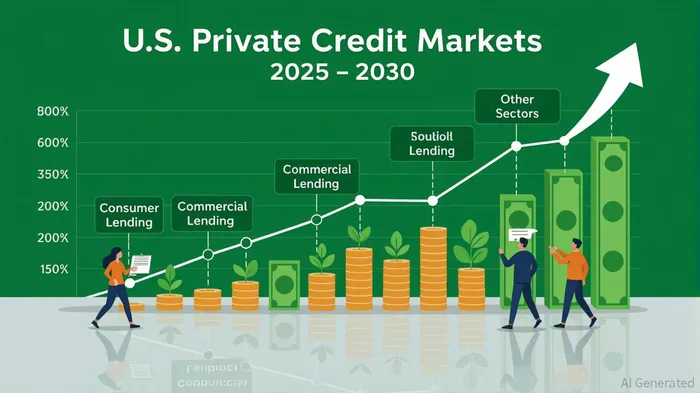
The rise of investment income accounts is creating fertile ground for private credit, AI infrastructure, and fintech innovation. As interest rates stabilize, private credit funds are capitalizing on higher-yield opportunities in distressed debt and asset-backed lending. Meanwhile, the AI-driven energy bottleneck is spurring demand for power infrastructure, with data centers and battery storage attracting over $50 billion in private investment in 2025 alone.
For equity investors, the S&P 500's major tech companies—trading at a discount to historical peak multiples—offer compelling value. Similarly, real estate development in workforce housing and senior residential markets is poised for growth, given the persistent housing shortage and demographic tailwinds.
A Strategic Outlook for Investors
The U.S. economy's long-term resilience hinges on its ability to adapt to these trends. For investors, the key lies in balancing growth and value strategies while leveraging technological and regulatory developments. Here's how to position for success:
- Allocate to AI and Energy Infrastructure: Companies leading in semiconductors, renewable energy, and grid modernization are likely to outperform as demand for computational power and clean energy surges.
- Invest in Financial Services Innovators: Firms that integrate AI-driven robo-advisory, blockchain, and ESG-focused wealth management will benefit from the shift toward digital-first financial planning.
- Diversify Across Asset Classes: A mix of private equity, real estate, and high-yield private credit can provide uncorrelated returns while mitigating risks from market volatility.
Conclusion
The rise of investment income accounts is more than a financial trend—it's a cultural shift toward empowerment, diversification, and long-term thinking. As consumers embrace these tools and financial services evolve to meet their needs, the U.S. economy is poised for a period of sustained growth. For investors, the challenge is to align with these dynamics, harnessing innovation and strategic foresight to capitalize on the opportunities ahead.

Stay ahead of the market.
Get curated U.S. market news, insights and key dates delivered to your inbox.


AInvest
PRO
AInvest
PRO



Comments
No comments yet