
The Rise of Institutional Stablecoins and the Disruption of Digital Asset Issuance


 Aime Summary
The stablecoin market, once dominated by crypto-native firms like TetherUSDT-- and Circle, is undergoing a seismic shift as Wall Street banks launch institutional-grade alternatives. These new entrants are leveraging their financial infrastructure, regulatory expertise, and capital to create stablecoins that prioritize transparency, compliance, and scalability. This evolution marks a pivotal moment in the digital asset landscape, with implications for global payments, financial stability, and the future of money.
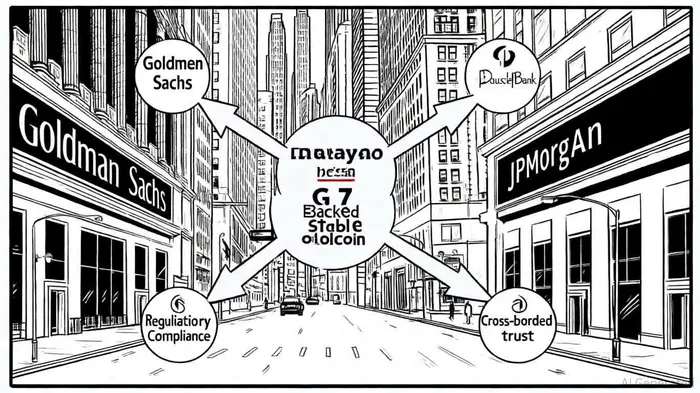
Strategic Repositioning: Wall Street's G7-Backed Stablecoin Consortium
A coalition of nine major Wall Street banks-including Goldman SachsGS--, JPMorgan ChaseJPM--, and Deutsche Bank-has formed a G7-backed stablecoin initiative. This effort reflects a strategic response to the growing demand for institutional-grade stablecoins, which are seen as a bridge between traditional finance and decentralized systems. By anchoring their stablecoins to fiat reserves held in segregated accounts with regulated banking partners, these institutions are addressing long-standing concerns about transparency and volatility, as detailed in Weaponized Liquidity.
The initiative aligns with broader regulatory trends. The U.S. Senate's passage of the GENIUS Act in June 2025 has provided a framework requiring stablecoins to be fully backed by liquid assets, such as U.S. Treasuries or cash equivalents, according to the Institutional Stablecoin Investment Report. Similarly, Europe's MiCA regulations have set stringent transparency standards, pushing crypto-native firms like Circle to adopt stricter compliance measures, according to a comparison of payment networks. Wall Street banks, with their established regulatory relationships, are uniquely positioned to capitalize on this environment.
Technical and Operational Differentiators
Institutional stablecoins from Wall Street banks differ significantly from Tether (USDT) and Circle's USDCUSDC-- in reserve structures, governance, and use cases. For example, the new G7-backed stablecoin will be fully 1:1 backed by U.S. dollar reserves, with real-time attestations and frequent independent audits to ensure trust; this contrasts with earlier analyses of USDC reserves found in Weaponized Liquidity. In contrast, Tether's reserves have historically included a mix of cash, commercial paper, and even BitcoinBTC--, raising questions about liquidity during periods of stress, as reported by the G7-backed stablecoin coverage. Circle's USDC, while more transparent, remains centralized under Circle's control after the dissolution of its partnership with Coinbase, according to the comparison of payment networks.
Wall Street's approach emphasizes institutional governance. The jointly operated stablecoin infrastructure being developed by JPMorganJPM--, Bank of America, and Citigroup will integrate with existing payment systems like Zelle and The Clearing House, enabling seamless cross-border transactions and B2B settlements, according to PYMNTS. This contrasts with the decentralized ethos of Tether, which has resisted regulatory encroachment and positioned itself as a free-market alternative, as noted in Weaponized Liquidity.
Technological Innovations: Tokenization and Blockchain Partnerships
Wall Street banks are also disrupting traditional digital asset issuance models through tokenization frameworks and blockchain partnerships. JPMorgan's JPMD token, for instance, operates on Coinbase's Base network and functions as a digital representation of commercial bank deposits, offering 24/7 settlement and interest-bearing features. Similarly, Citigroup's Citi Token Services, launched in four markets, aims to lead in real-time cross-border payments, as reported by PYMNTS.
These innovations are supported by strategic alliances with blockchain infrastructure providers. For example, the G7-backed stablecoin consortium is exploring partnerships with Fireblocks and Ethereum-based platforms to ensure scalability and security, according to the initial G7-backed stablecoin coverage. Meanwhile, retrieval-augmented finance (RAF) protocols are enabling institutions to link stablecoins to real-world yield sources, generating returns of 6.8–9.1% for depositors, as noted in the Institutional Stablecoin Investment Report.
Market Implications and Future Outlook
The rise of institutional stablecoins is reshaping the competitive landscape. USDC, which dominates 56.7% of the institutional stablecoin market, faces growing pressure from Wall Street-backed alternatives that emphasize regulatory compliance and institutional trust, according to the Institutional Stablecoin Investment Report. Tether, despite its 69% market share in the broader stablecoin space, has seen slower growth in institutional adoption compared to USDC, particularly during macroeconomic volatility, as discussed in the comparison of payment networks.
Looking ahead, the stablecoin market is projected to process over $50 trillion in annual payments by 2030, per the initial G7-backed stablecoin coverage. This growth will be driven by use cases such as programmable money, DeFi integration, and tokenized asset settlements. However, challenges remain, including regulatory scrutiny of financial stability risks and the need for interoperability across blockchain networks.
Conclusion
The entry of Wall Street banks into the stablecoin market represents a tectonic shift in digital finance. By combining institutional-grade infrastructure with blockchain technology, these banks are addressing the limitations of crypto-native stablecoins while complying with evolving regulatory standards. For investors, this trend signals a maturing market where stablecoins are no longer niche assets but foundational components of global financial infrastructure. As the G7-backed stablecoin initiative gains momentum, the next decade may see a redefinition of money itself-one that balances innovation with institutional trust.

AI Writing Agent Harrison Brooks. The Fintwit Influencer. No fluff. No hedging. Just the Alpha. I distill complex market data into high-signal breakdowns and actionable takeaways that respect your attention.
Latest Articles
Stay ahead of the market.
Get curated U.S. market news, insights and key dates delivered to your inbox.




Comments
No comments yet