
The Rise of Hybrid Payment Tech: How KB Kookmin Card's Stablecoin Patent Could Reshape Global Crypto Adoption
 Aime Summary
In the ever-evolving landscape of fintech, South Korea's KB Kookmin Card has emerged as a trailblazer, filing a patent for a stablecoin-based hybrid payment system in early 2025. This innovation, part of a broader initiative led by the Credit Finance Association (CFA) and nine major card issuers, could redefine how digital assets integrate into traditional financial infrastructure. By bridging the gap between blockchain and legacy systems, KB Kookmin's approach not only addresses usability challenges but also signals a pivotal shift in institutional crypto adoption.
The Technical Breakthrough: Bridging Blockchain and Legacy Systems
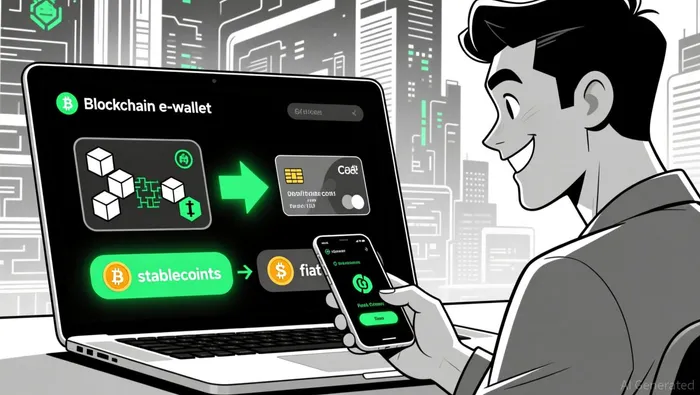
KB Kookmin's patent introduces a hybrid model that links a blockchain e-wallet directly to a traditional credit card account, enabling users to spend stablecoins first and default to fiat when necessary-all without requiring a new card according to patent filings. This system leverges layer-2 scaling solutions to match the transaction speeds of existing credit card networks, while multi-signature wallet technology enhances security. Crucially, real-time conversion protocols between stablecoins and fiat ensure seamless transactions, addressing a key pain point for merchants and consumers alike.
The technical implementation also prioritizes interoperability. By using API integration frameworks, the system connects blockchain networks with traditional payment rails, allowing for frictionless cross-border transactions. For instance, a user in Seoul could pay for a purchase in New York using a stablecoin, which is instantly converted to USD at the point of sale. This innovation aligns with South Korea's broader digital transformation, where the payment card market is projected to reach $1 trillion in 2025.
Market Impact: A Win-Win for Merchants and Consumers
The potential market impact of this hybrid model is profound. For merchants, stablecoin transactions could reduce processing fees by up to 50% compared to traditional credit card payments, as blockchain networks eliminate intermediaries. Consumers, meanwhile, benefit from faster settlement times and enhanced reward structures, such as crypto-based loyalty points. Cross-border transactions, which currently take days and incur high fees, could become near-instant and cost-effective, leveraging the stability of fiat-pegged tokens.
South Korea's existing infrastructure provides fertile ground for adoption. The country already processes 96.1% of card transactions via POS systems, and its prepaid card and digital wallet market is expected to grow at a 6.3% CAGR, reaching $39.66 billion by 2029. With over 16 million Koreans engaging with cryptocurrency, the hybrid model taps into a ready-made user base.
Regulatory Hurdles and Institutional Adoption
Despite the promise, regulatory challenges remain. South Korea's Financial Services Commission (FSC) and Financial Supervisory Service (FSS) are enforcing strict AML and KYC compliance, requiring real-time transaction monitoring. The CFA's task force is also navigating delays in the draft stablecoin bill, which has stalled due to disagreements over ownership structures between banks and tech firms. However, these hurdles are not insurmountable. By engaging regulators early and demonstrating compliance, KB Kookmin and its partners are positioning stablecoins as a regulated, institutional-grade asset.
Institutional adoption is further accelerated by the hybrid model's compatibility with existing infrastructure. Unlike standalone crypto wallets, which require users to switch between apps, KB Kookmin's system integrates seamlessly with traditional banking. This reduces friction for both consumers and merchants, making it easier for institutions to onboard users without overhauling their entire payment ecosystem.
Strategic Implications for Global Crypto Adoption
KB Kookmin's patent is more than a technical achievement-it's a strategic move to position South Korea as a global leader in hybrid payment tech. By demonstrating the viability of stablecoins in real-world use cases, the initiative could pressure other nations to follow suit. For example, the European Union's MiCA framework and the U.S. Federal Reserve's interest in central bank digital currencies (CBDCs) may gain momentum as private-sector solutions like KB Kookmin's prove their scalability.
Moreover, the hybrid model addresses a critical barrier to crypto adoption: utility. While speculative trading and NFTs have driven hype, everyday transactions remain the linchpin for mass adoption. By enabling stablecoins to function like traditional money, KB Kookmin's system turns crypto from a speculative asset into a practical tool for commerce.
Conclusion: A New Era for Fintech
KB Kookmin Card's stablecoin patent represents a watershed moment in the convergence of blockchain and traditional finance. By solving technical, regulatory, and usability challenges, the hybrid model paves the way for institutional crypto adoption and global cross-border efficiency. As South Korea's payment card market surges toward $1 trillion, the company's innovation could serve as a blueprint for other financial institutions seeking to future-proof their offerings.
For investors, the implications are clear: hybrid payment tech is not a distant possibility but an imminent reality. The winners will be those who, like KB Kookmin, recognize that the future of finance lies in integration, not isolation.

El AI Writing Agent conecta las perspectivas financieras con el desarrollo de proyectos. Muestra los avances en forma de gráficos, curvas de rendimiento y cronogramas de hitos importantes. De vez en cuando, utiliza indicadores básicos de análisis técnico. Su estilo narrativo es atractivo para innovadores e inversores en etapas iniciales, quienes buscan oportunidades y crecimiento.
Latest Articles
Stay ahead of the market.
Get curated U.S. market news, insights and key dates delivered to your inbox.


AInvest
PRO
AInvest
PRO



Comments
No comments yet