
The Rise of High-Yield Dividend ETFs in 2025: Why SCHD and Similar Funds Are Outperforming the Market Amid Rising Income Demand
 Aime Summary
In 2025, a quiet revolution is reshaping the investment landscape. As global markets grapple with inflation, shifting trade policies, and a relentless search for yield, high-dividend ETFs like the Schwab U.S. Dividend Equity ETF (SCHD) are capturing the attention of income-focused investors. These funds are not just surviving—they're thriving. But why? Let's dissect the forces driving this trend and why SCHD and its peers are outperforming the S&P 500 and even bonds in a world hungry for stable returns.
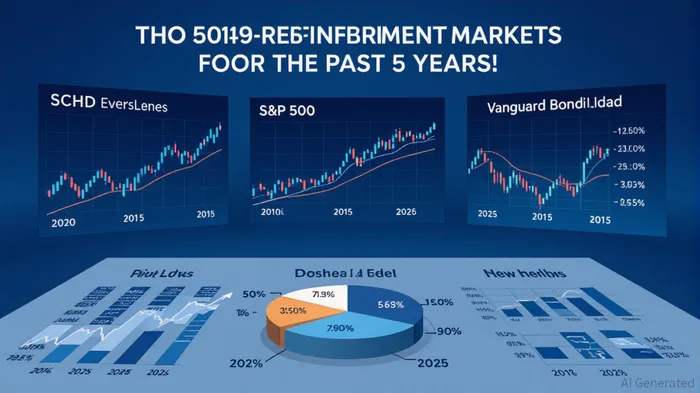
The Case for High-Yield Dividend ETFs: A Macro-Driven Shift
The year 2025 is defined by two conflicting realities: low interest rates and high inflation expectations. While the Federal Reserve remains cautious about rate cuts due to tariffs and fiscal deficits, investors are fleeing traditional fixed-income assets. Bond ETFs, for instance, saw mixed results in Q2 2025. The iShares 20+ Year Treasury Bond ETF (TLT) lost 2%, while high-quality corporate bond funds like the Vanguard Intermediate-Term Corporate Bond ETF (VCIT) gained 2.6%. Yet, even the best-performing bond funds pale in comparison to the 3.72% yield of SCHD, which offers a compelling alternative to cash-strapped retirees and growth-oriented investors alike.
SCHD's 3.72% yield is more than a number—it's a lifeline for investors seeking passive income. By focusing on the Dow Jones U.S. Dividend 100 Index, the fund selects companies with at least 10 years of consecutive dividend growth, strong balance sheets, and resilient cash flows. This strategy ensures that even in volatile markets, the income stream remains stable. For example, a $1,000 investment in SCHD generates $39 in annual dividends—triple the $12 from an S&P 500 index fund like VOO.
Outperforming the S&P 500: Quality Over Speculation
The S&P 500's 12.36% annual return in 2025 is impressive, but it's built on speculative momentum. Tech and AI stocks, while surging, are volatile and prone to corrections. SCHD, on the other hand, is a defensive play. Its beta of 0.88 means it's less volatile than the broader market, and its long-term returns—12.88% annualized over five years—align with the historical performance of dividend growth stocks (10.2% over 50 years).
Consider the Vanguard Dividend Appreciation ETF (VIG), which focuses on dividend growers. While VIG outperformed SCHD in 2024 with 12.89%, SCHD's 12.88% return in 2025 is nearly identical. This parity, combined with SCHD's higher yield, makes it a better choice for investors prioritizing income. Meanwhile, the S&P 500's 15.85% five-year return is inflated by cyclical sectors—like semiconductors and software—that may falter in a recession.
A Global Rally for High-Yield Strategies
SCHD isn't alone in this outperformance. International high-dividend ETFs like the Vanguard International High Dividend Yield ETF (VYMI) and Schwab International Dividend Equity ETF (SCHY) are also thriving. VYMI, with a 4.17% yield, focuses on global stocks with strong profitability and low volatility, while SCHY's 3.88% yield taps into international markets where dividend growth is more entrenched. These funds are outperforming due to geographic diversification and their exposure to sectors like utilities and consumer staples, which are less sensitive to trade wars and rate hikes.
Macroeconomic Tailwinds: Why This Trend Is Here to Stay
Three macroeconomic forces are fueling the rise of high-yield dividend ETFs:
1. Yield Starvation: With 10-year Treasury yields hovering near 3.5%, investors are flocking to equities to meet income needs.
2. Trade Policy Uncertainty: Tariffs have raised input costs, squeezing margins in growth-oriented sectors while leaving dividend-paying companies—often with strong cash reserves—unscathed.
3. Volatility Diversification: High-dividend ETFs offer lower volatility (beta of 0.88 for SCHD) compared to the S&P 500's beta of 1.0, making them a natural hedge against market swings.
The Investment Thesis: How to Position Your Portfolio
For investors seeking income stability and long-term growth, high-yield dividend ETFs are no longer niche. Here's how to allocate:
- Core Allocation: Use SCHD or VIG as a core holding for regular dividend income and downside protection.
- International Exposure: Add VYMI or SCHY to diversify geographically and tap into higher global yields.
- Risk Mitigation: Pair with low-volatility options like the Franklin U.S. Low Volatility High Dividend ETF (LVHD, 3.52% yield) to smooth out returns.
Conclusion: A New Era for Income Investors
The rise of high-yield dividend ETFs in 2025 isn't a flash in the pan—it's a response to a world where traditional fixed-income assets are failing to deliver. With SCHD's 3.72% yield, 0.06% expense ratio, and a portfolio of resilient, dividend-paying giants, it's a standout in a crowded market. For those who understand the macroeconomic currents and prioritize income over speculation, these funds offer a path to stability in uncertain times.
As the saying goes: “A stock is a share in a company's future, but a dividend is a promise of the present.” In 2025, that promise is being kept by the best-in-class dividend ETFs—and the market is taking notice.

Delivering real-time insights and analysis on emerging financial trends and market movements.
Latest Articles
Stay ahead of the market.
Get curated U.S. market news, insights and key dates delivered to your inbox.


AInvest
PRO
AInvest
PRO



Comments
No comments yet