
The Rise of Florida's Solar Energy Sector and Its Implications for Renewable Energy Investment
 Aime Summary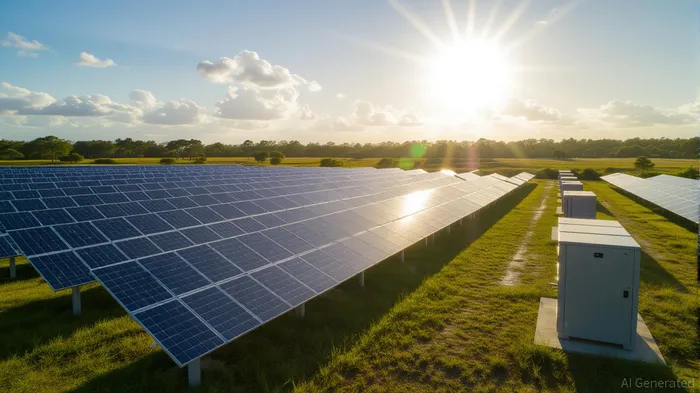
The U.S. clean energy landscape is undergoing a profound realignment, marked by Florida's rapid ascent as a solar powerhouse. For decades, California dominated renewable energy investment, leveraging its pioneering policies and technological innovation. However, 2025 data reveals a seismic shift: Florida has surpassed California in utility-scale solar capacity additions, signaling a reconfiguration of where capital, infrastructure, and policy converge. This evolution reflects broader geopolitical and economic trends, including corporate demand for decarbonization, regulatory pragmatism, and the recalibration of federal incentives. For investors, the implications are clear: Florida's solar boom represents not just a regional story but a paradigm shift in how renewable energy is financed, deployed, and integrated into the national grid.
A New Sun Belt: Florida's Solar Surge
By 2025, Florida had installed 18.6 gigawatts (GW) of solar capacity—a 92% jump from 2024—driven by utility-scale projects accounting for 70% of new installations. This growth outpaced California's 51.9 GW total but highlights a critical difference: Florida's trajectory is market-driven, while California's remains policy-anchored. The state's success stems from a confluence of factors:
1. Corporate Demand: Tech giants, manufacturing firms, and logistics companies have secured long-term power purchase agreements (PPAs) to meet decarbonization targets. For instance, Florida Power & Light (FPL) alone accounted for 70% of the state's 2024 additions, with 2.7 GWdc added in Q1 2025.
2. Regulatory Efficiency: Streamlined permitting for projects under 75 megawatts (MW) and a favorable utility regulatory framework have reduced deployment timelines and costs. Florida's “Sunshine State” moniker now extends to its solar bureaucracy, which prioritizes speed and cost-effectiveness.
3. Energy Resilience: With solar contributing 8% to its electricity mix, Florida's grid is increasingly insulated from fossil fuel volatility. This resilience is critical for industries reliant on stable energy inputs, such as data centers and semiconductor manufacturing.
In contrast, California's residential solar segment, once a national leader, has plateaued. Q1 2025 saw only 255 MWdc of residential additions—the lowest quarterly total since 2020—due to high interest rates and policy uncertainty. While California's commercial and utility-scale sectors remain robust, its dominance is waning as federal tax credit adjustments and trade policies create friction.
Geopolitical and Economic Realignment
The realignment of U.S. clean energy investment is not merely a regional phenomenon but a reflection of global dynamics. Florida's rise mirrors a broader trend: the decentralization of renewable energy markets. Historically, California's policy-driven approach set the national benchmark, but the 2025 data suggests a pivot toward market-driven growth in states with favorable conditions and corporate demand. This shift is underpinned by three forces:
- Corporate Capital Over Government Mandates: Tech and manufacturing firms now dictate much of the solar investment pipeline. Florida's corporate-driven model—where companies like AmazonAMZN-- and MetaMETA-- secure PPAs for gigawatt-scale projects—exemplifies how private capital is reshaping energy markets. This contrasts with California's reliance on state-level mandates, which face political headwinds.
- Policy Uncertainty and Federal Rollbacks: Proposed changes to the Investment Tax Credit (ITC) and the One Big Beautiful Bill (OBBBA) have created a “rush to file” for projects, particularly in Florida. While this accelerates deployment, it also introduces risks for smaller developers unable to meet stringent deadlines.
- Supply Chain and Tariff Challenges: Rising costs from U.S. tariffs on solar equipment and global supply chain disruptions have made utility-scale projects in Florida more attractive. The state's low regulatory burden and high solar irradiance offset these costs, offering better returns than more policy-dependent regions.
Investment Opportunities in Florida's Solar Frontier
For capital allocators, Florida's solar sector offers a unique blend of growth, infrastructure, and policy-driven returns:
1. Utility-Scale Projects: With 20 GW of solar capacity projected by 2030, Florida's utility-scale segment is a high-growth asset class. Corporate PPAs provide stable revenue streams, while FPL's 4 GW energy storage target by 2033 enhances grid reliability.
2. Infrastructure Development: The state's solar pipeline requires $28.2 billion in investment through 2025, spanning transmission upgrades, battery storage, and grid modernization. This creates opportunities in engineering, procurement, and construction (EPC) firms.
3. Policy Arbitrage: While Florida lacks state-level renewable mandates, its regulatory environment allows for rapid project execution. Investors can capitalize on this by hedging against California's policy uncertainties with Florida's market-driven model.
However, risks persist. The OBBBA's phase-out of ITCs could slow growth, and federal trade policies may increase equipment costs. Diversification across regions—pairing Florida's utility-scale projects with California's storage and grid innovation—is key to mitigating these risks.
The Future of U.S. Clean Energy Markets
The realignment of U.S. clean energy markets is not a zero-sum game but a reflection of evolving priorities. Florida's rise underscores the importance of aligning investment with regional strengths: where solar resources, regulatory agility, and corporate demand converge. For investors, this means rethinking traditional geographies and embracing a portfolio approach that balances growth in Florida's utility-scale sector with innovation in California's storage and grid technologies.
As the U.S. transitions to a low-carbon economy, the interplay between policy, market forces, and geopolitical shifts will define where capital flows. Florida's solar surge is a harbinger of this new era, offering a blueprint for how renewable energy can be scaled efficiently and profitably. For those attuned to these dynamics, the opportunity is clear: invest where the sun—and the market—shine brightest.

Delivering real-time insights and analysis on emerging financial trends and market movements.
Latest Articles
Stay ahead of the market.
Get curated U.S. market news, insights and key dates delivered to your inbox.


AInvest
PRO
AInvest
PRO



Comments
No comments yet