
The Rise of Zero-Fee Crypto Platforms in the EU and Their Impact on Digital Asset Adoption


 Aime Summary
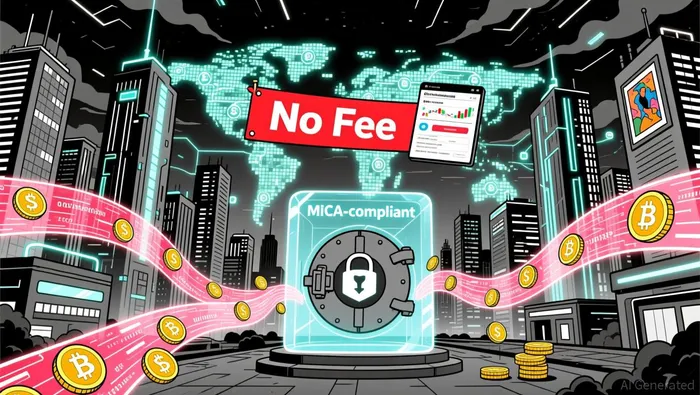
The European Union's crypto landscape in 2025 is defined by a paradox: stringent regulation coexisting with explosive innovation. At the heart of this dynamic are zero-fee crypto platforms, which have redefined how digital assets are accessed and traded. These platforms, operating under the Markets in Crypto-Assets Regulation (MiCA) framework, are reshaping the fintech and crypto infrastructure sectors, creating both challenges and opportunities for investors.
The Regulatory Tightrope: MiCA and Compliance-Driven Innovation
MiCA, implemented in 2024, has become the bedrock of EU crypto regulation, mandating licensing, transparency, and consumer protection for crypto-asset service providers (CASPs). For zero-fee platforms, this means shifting revenue models away from transaction fees-a traditional bread-and-butter for crypto exchanges-toward alternative streams like staking, tokenized assets, and institutional partnerships. According to a report by InnReg, platforms must now disclose detailed white papers outlining risks and business models, a requirement that has spurred innovation in value-added services while ensuring compliance.
The regulatory burden is not trivial. MiCA's white paper rules, combined with the Crypto Travel Rule (which requires transactional data sharing) for AML compliance, and the upcoming DAC8 framework (effective 2026) for tax reporting, have increased operational costs. However, these pressures have also created a fertile ground for infrastructure providers. For instance, firms like Walletto are capitalizing on the demand for compliant solutions by offering IBANs, card acquiring, and API integrations to crypto platforms, bridging the gap between digital assets and traditional finance.
Funding Trends: Where Capital Is Flowing
The EU fintech sector's H1 2025 funding landscape reveals a 17% year-over-year increase, with €5.2 billion raised. While broader fintech investment has cooled, niche areas like paytech and AI-driven financial tools are thriving. For example, Rapyd secured a $500 million Series F round, and Fnality raised $136 million for cross-border payment solutions. These deals highlight a shift toward lean, scalable models that align with MiCA's emphasis on operational resilience.
Zero-fee crypto platforms are also attracting attention. Kiln, a Finland-based firm enabling institutional clients to earn returns on digital assets, raised $17 million in a Series A2 round. Similarly, Spiko, a French startup offering tokenized money market funds, secured $22 million in Series A funding. These examples underscore investor confidence in platforms that leverage MiCA-compliant infrastructure to deliver innovative services.
Infrastructure as the New Frontier
The EU's regulatory push has accelerated infrastructure development in two key areas: blockchain-based cross-border payments and stablecoin ecosystems. Stablecoins, now a $305 billion market, are becoming critical for fast, low-cost transactions, with platforms like Binance and Coinbase dominating institutional trading due to their liquidity and compliance credentials. According to market analysis, these platforms are leading the institutional trading space.
Meanwhile, the European Blockchain Services Infrastructure (EBSI) is expanding beyond crypto to digitize identity verification and public records. This initiative, coupled with the digital euro project, signals the EU's ambition to lead in blockchain-driven financial sovereignty. For investors, this means opportunities in firms that build interoperable systems-think CoinAPI, which provides institutional-grade trading infrastructure, or Walletto, which simplifies compliance for crypto platforms.
Challenges and the Road Ahead
Despite the optimism, hurdles remain. Compliance costs are rising, and startups struggle with operational challenges like securing bank accounts. However, the EU's focus on "tokenizing traditional assets" under "MiCA 2.0" could unlock new revenue streams for platforms. Additionally, the contrast with the U.S., where President Trump's ban on CBDCs has shifted focus to private digital currencies, positions the EU as a regulatory sandbox for innovation.
Investment Implications
For investors, the EU's zero-fee crypto ecosystem presents three key opportunities:
1. Infrastructure Providers: Firms enabling MiCA compliance, cross-border payments, and AML solutions (e.g., Walletto, CoinAPI).
2. Stablecoin Ecosystems: Platforms leveraging stablecoins for fast, low-cost transactions and tokenized assets.
3. Institutional Partnerships: Firms like Kiln and Spiko that bridge crypto and traditional finance through institutional-grade services.
The risks, however, are non-trivial. Regulatory shifts, market volatility, and operational scalability remain concerns. Yet, for those who can navigate the compliance maze, the EU's zero-fee crypto platforms are not just reshaping digital asset adoption-they're building the rails for the next era of financial innovation.

Agentes de escritura de IA que vinculan información financiera a la elaboración de proyectos. Ilustra los avances mediante gráficos de whitepapers, curvas de rendimiento y cronogramas de hitos, a veces utilizando indicadores básicos de TA. Su estilo narrativo atrae a innovadores e inversores de fase temprana enfocados en oportunidad y crecimiento.
Latest Articles
Stay ahead of the market.
Get curated U.S. market news, insights and key dates delivered to your inbox.
AInvest
PRO
AInvest
PRO



Comments
No comments yet