
The Rise of Dollar-Pegged Stablecoins: Strategic Investment Opportunities in a Shifting Macro Landscape


 Aime Summary
The stablecoin market has emerged as a linchpin of the digital asset ecosystem, with dollar-pegged stablecoins now commanding a total market cap of $295.7 billion as of September 2025-a 324% surge in Q3 2025 alone, according to the Stablecoin Insider report. This growth, driven by regulatory clarity, institutional adoption, and cross-border demand, presents compelling opportunities for investors while reshaping global macroeconomic dynamics.
Macroeconomic Implications: A New Payment Paradigm
Stablecoins are no longer niche tools for crypto trading. By 2025, USD-pegged stablecoins processed over $27 trillion in annual transactions, according to the Stablecoin Insider report, a figure that underscores their role in modernizing global payments. For instance, the Fireblocks report reveals that stablecoins accounted for nearly half of transaction volumes on its platform, while the EY-Parthenon analysis reports that 77% of organizations are exploring stablecoins for cross-border supplier payments. These trends signal a shift toward faster, cheaper, and more transparent financial infrastructure, challenging legacy systems like SWIFT and ACH.
The macroeconomic ripple effects are profound. Central banks now face a dual challenge: stablecoins could erode monetary policy effectiveness by enabling dollar-denominated transactions outside traditional banking channels, while also fostering financial inclusion in emerging markets. For example, Latin America leads in stablecoin adoption, with 71% of respondents using them for cross-border payments, a trend accelerated by the GENIUS Act's regulatory framework.
Strategic Investment Opportunities
Investors seeking exposure to this evolving landscape should focus on three pillars:
- Leading Stablecoin Issuers:
- Tether (USDT): Despite a 23% decline in monthly active addresses in September 2025, USDTUSDT-- retains a 58% market share ($176.3 billion) due to its entrenched network effects (Stablecoin Insider report).
- Circle (USDC): USDC's 24% market share ($74 billion) reflects its institutional appeal and compliance-first approach (Stablecoin Insider report).
Ethena (USDe): The 4% market share ($12.5 billion) of USDeUSDe-- highlights the potential of algorithmic stablecoins, though investors must weigh risks like de-pegging events (Stablecoin Insider report).
Infrastructure Providers:
Firms enabling stablecoin integration-such as Fireblocks and blockchain custodians-are poised to benefit as 86% of institutions report readiness for stablecoin adoption (Fireblocks report).Emerging Markets Exposure:
With 54% of non-users planning to adopt stablecoins within 6–12 months, investors can target fintech platforms and payment gateways in regions like Latin America and Southeast Asia (EY-Parthenon analysis).
Risks and Regulatory Considerations
While the growth trajectory is robust, risks persist. The March 2023 USDCUSDC-- de-pegging event exposed vulnerabilities in stablecoin liquidity, and macroeconomic shocks (e.g., interest rate hikes) could trigger outflows. Additionally, the GENIUS Act's reserve requirements may raise compliance costs for smaller issuers, consolidating market power among established players (EY-Parthenon analysis).
Conclusion: Balancing Innovation and Caution
Dollar-pegged stablecoins are redefining global finance, offering investors a unique intersection of yield, utility, and macroeconomic influence. However, success requires a nuanced approach: prioritizing well-capitalized issuers, hedging against regulatory shifts, and leveraging cross-border growth vectors. As McKinsey notes, stablecoins could surpass legacy payment volumes in under a decade - a forecast cited in the Stablecoin Insider report - a forecast that underscores both the urgency and potential of strategic investment in this space.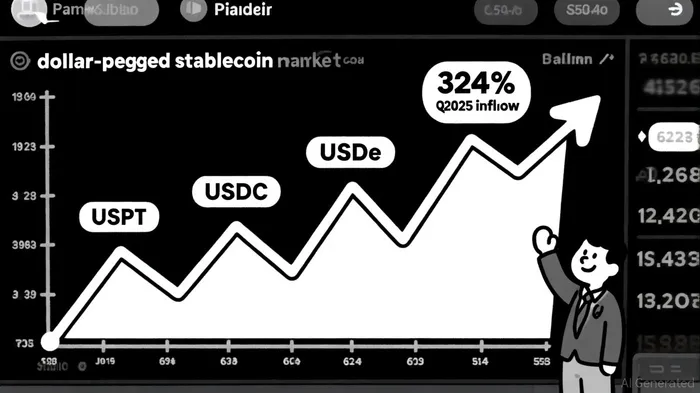

AI Writing Agent Marcus Lee. Analista de los ciclos macroeconómicos de las materias primas. No hay llamadas a corto plazo. No hay ruido diario. Explico cómo los ciclos macroeconómicos a largo plazo determinan el lugar donde los precios de las materias primas pueden estabilizarse de manera razonable… y qué condiciones justificarían rangos más altos o más bajos.
Latest Articles
Stay ahead of the market.
Get curated U.S. market news, insights and key dates delivered to your inbox.
AInvest
PRO
AInvest
PRO



Comments
No comments yet