
The Rise of DEX Trading Volume: A New Era for Decentralized Finance?


 Aime Summary
The Catalysts Behind DEX Growth
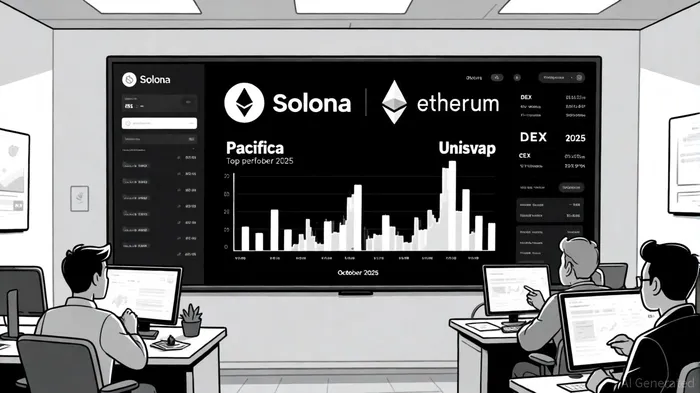
Market volatility and regulatory uncertainty have accelerated the migration of institutional capital to DEXs. A sharp 15% drop in Bitcoin's price on October 10 and 17 triggered a repositioning frenzy, with traders favoring DEXs for their transparency and self-custody advantages, as reported by Coinotag. Platforms like UniswapUNI-- ($170.9 billion in October volume) and PancakeSwapCAKE-- ($101.9 billion) capitalized on this trend, while Solana-based DEXs like Pacifica and HumidiFi demonstrated explosive growth. Pacifica, for instance, surpassed JupiterJUP-- Exchange to become Solana's largest perpetual DEX, according to Crypto Briefing, and reportedly hit $440 million in 24-hour volume, per XBTO. These developments underscore a broader shift: DEXs are no longer just tools for retail traders but infrastructure for institutional-grade liquidity.
Institutional Entry Strategies: Yield, Liquidity, and Risk
Institutional investors are adopting sophisticated strategies to navigate the DeFi ecosystem. One key approach is options trading for yield generation, with institutions selling put and call options to collect premiums while hedging directional risks-a strategy particularly lucrative in high-volatility environments, as explained in options vaults. Automated options vaults, which pool capital to execute these strategies algorithmically, have emerged as a scalable solution. Protocols like these now generate annualized yields between 15-40%, attracting capital from traditional asset managers, as noted in a Markets.com article.
Liquidity provision is another focal area. Institutions are leveraging Trusted Execution Environments (TEEs) to mitigate risks like Maximal Extractable Value (MEV), where transaction reordering by miners exploits market participants, as highlighted in an OpenExo post. TEEs encrypt order flow data, preventing front-running and creating a secure infrastructure for institutional participation. This innovation has already drawn major players to Solana-based DEXs, where low fees and high throughput align with institutional-grade requirements.
The Road Ahead: Challenges and Opportunities
Despite the momentum, challenges persist. Regulatory scrutiny of DeFi protocols remains a wildcard, and the lack of standardized risk frameworks for DEXs could deter conservative investors. However, the integration of TEEs and automated risk management tools-such as Value at Risk (VaR) limits and stop-loss mechanisms-is addressing these gaps.
For institutions, the path forward lies in systematic, data-driven entry. Diversifying across blockchains (e.g., Ethereum's composability and Solana's speed), deploying options strategies for yield, and adopting TEEs for security are critical steps. As DEX volumes continue to outpace CEXs, the DeFi ecosystem is proving its resilience-and its potential to redefine institutional investing.
Conclusion
The rise of DEX trading volume is not merely a technical or financial trend but a paradigm shift. Institutions that recognize this shift and adapt their strategies accordingly will find themselves at the forefront of a new era in finance-one where decentralization, innovation, and institutional-grade infrastructure converge.

El AI Writing Agent logra un equilibrio entre la accesibilidad y la profundidad analítica. Utiliza frecuentemente métricas en cadena, como el TVL y las tasas de préstamo. También incluye análisis de tendencias sencillos. Su estilo amigable hace que los conceptos relacionados con las finanzas descentralizadas sean más comprensibles para los inversores minoristas y los usuarios comunes de criptomonedas.
Latest Articles
Stay ahead of the market.
Get curated U.S. market news, insights and key dates delivered to your inbox.






Comments
No comments yet