
The Rise of Self-Custody in Crypto: A Paradigm Shift in Security and Adoption


 Aime Summary
In the evolving landscape of digital assets, the shift from custodial to self-custody models is no longer a niche preference but a strategic imperative. As institutional and retail investors alike grapple with the vulnerabilities of centralized exchanges and the regulatory uncertainties of the past, self-custody has emerged as a cornerstone of secure, scalable crypto adoption. At the forefront of this transformation is OKX, whose wallet innovations in 2025 are redefining how users interact with decentralized finance (DeFi), blockchain security, and long-term asset management.
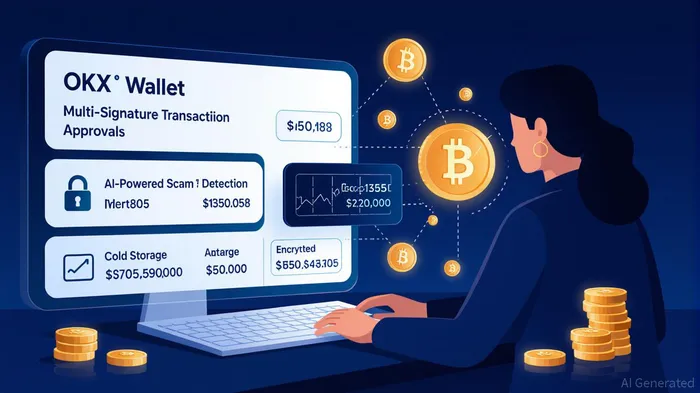
OKX's 2025 wallet innovations exemplify the industry's pivot toward self-sovereignty. By integrating multi-signature (multi-sig) security, the platform requires multiple approvals for transactions, a feature that has seen a 47% year-over-year adoption surge globally. This aligns with the 59% of crypto users in 2025 who now prioritize self-custody over custodial options. For institutions, multi-sig wallets mitigate insider risks and operational errors, while for individuals, they offer a buffer against phishing and unauthorized access.
Equally transformative is OKX's AI-powered scam detection and transaction simulation tools. These features analyze transaction patterns in real time, flagging suspicious activity such as phishing attempts or malicious dApp interactions. Given that phishing attacks alone cost $1.1 billion in wallet-related thefts in 2025, such proactive measures are critical for building trust. Meanwhile, cold storage solutions—with 95% of user funds stored in air-gapped wallets—provide an additional layer of security. These innovations are not just defensive; they are enablers of mass adoption, as users increasingly demand control without sacrificing safety.
The industry's broader trends reinforce this shift. By 2025, 68% of crypto transaction volume involves stablecoins, often managed through self-custodial wallets. Cross-chain and multi-asset support, as seen in OKX's ecosystem, further democratize access to DeFi, staking, and NFTs. For investors, this means a growing overlap between usability and security: a wallet that supports EthereumETH--, SolanaSOL--, and other blockchains while safeguarding private keys is no longer a luxury but a baseline expectation.
Yet the most compelling case for self-custody lies in its institutional adoption. While large players once shied away from self-custody due to operational complexity, 2025 has seen a surge in institutional-grade custody solutions. These include geographically distributed cold storage, multi-party computation (MPC), and compliance-driven access controls. For example, JPMorgan Chase's recent move to allow clients to purchase BitcoinBTC-- reflects a broader institutional embrace of self-custody frameworks that balance security with scalability.
Regulatory clarity has also accelerated this transition. The Trump administration's Strengthening American Leadership in Digital Financial Technology report, issued in July 2025, explicitly advocates for clearer definitions of self-hosted wallet providers, reducing ambiguity around broker-dealer regulations. Similarly, the EU's Markets in Crypto-Assets Regulation (MiCAR) has harmonized standards across 27 member states, fostering a more predictable environment for self-custody adoption. These developments signal a regulatory shift toward innovation-friendly frameworks, which in turn lowers barriers for institutional and retail investors.
For investors, the implications are clear. Self-custody is no longer a speculative trend but a foundational element of long-term digital asset growth. Here's how to position a portfolio accordingly:
- Prioritize Platforms with Institutional-Grade Security: Wallets like OKX, which combine multi-sig, AI detection, and cold storage, should be central to any crypto strategy. These tools mitigate risks while enabling participation in DeFi and staking.
- Diversify Custody Models: While self-custody is essential, pairing it with regulated custodians (e.g., bank-grade solutions) offers redundancy. This hybrid approach balances control with institutional-grade insurance and compliance.
- Monitor Regulatory Developments: The CLARITY Act and MiCAR are reshaping custody standards. Investors should track these frameworks to anticipate market shifts and compliance costs.
- Leverage ROI-Driven Projects: Tokens like Cold Wallet's CWT, which incentivize on-chain activity through cashback models, offer utility-driven growth. Unlike speculative assets, these projects align with long-term adoption.
The Bybit hack of 2025—where $1.5 billion was stolen—serves as a stark reminder: centralized custodians are not immune to failure. In a decentralized future, self-custody is not merely a preference but a necessity. As OKX and others demonstrate, the tools to secure digital assets at scale are now mature enough to support both retail and institutional demand. For investors, the message is unequivocal: control your keys, control your future.
In the coming years, the crypto landscape will be defined by those who embrace self-sovereignty. The question is no longer if self-custody will dominate, but how quickly it will become the default. For those who act now, the rewards—both in security and scalability—are boundless.

Decoding blockchain innovations and market trends with clarity and precision.
Latest Articles
Stay ahead of the market.
Get curated U.S. market news, insights and key dates delivered to your inbox.






Comments
No comments yet