
The Rise of Crypto Options as a Strategic Hedging Tool in Volatile Markets


 Aime Summary
Hedging in a World of Jumps and Jitters
The cryptocurrency market's defining trait-its susceptibility to sudden, large price movements-has forced risk managers to abandon traditional models. A 2024 study highlights that affine jump diffusion models and infinite activity Lévy processes are now standard tools for hedging contingent claims on BTC, according to a ResearchGate study. These models account for "kinks" in price behavior, such as the 2025 U.S.-China trade agreement's ripple effects, which sent Bitcoin tumbling below $110,000 despite a temporary suspension of Trump-era tariffs, as noted in a CoinMarketCap article.
Dynamic hedging strategies, including Delta–Gamma and Delta–Vega approaches, have proven particularly effective in mitigating tail risks. For instance, multi-instrument hedges-combining options with futures or stablecoins-reduced downside exposure by up to 40% in simulated "stressed market" scenarios, the study found. However, the same study cautions that these benefits diminish for short-dated options, where execution costs often outweigh gains. This underscores a critical lesson: hedging in crypto is less about one-size-fits-all solutions and more about aligning strategies with time horizons and market conditions.
The Sentiment-Driven Edge
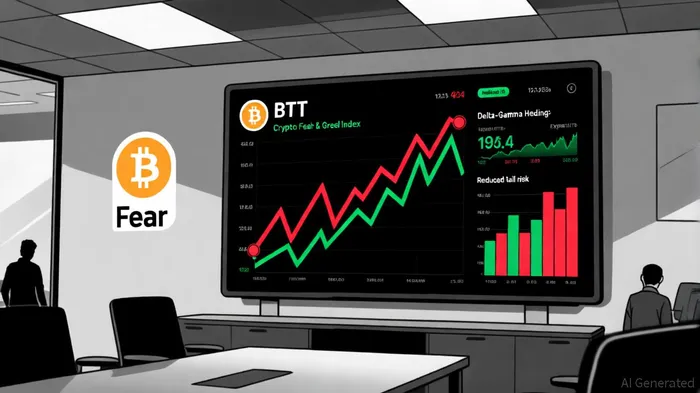
While quantitative models provide structure, market sentiment remains the wildcard. The 2025 Crypto Fear & Greed Index, which dipped to 18 during October's crash, has emerged as a critical input for options traders, according to a Coinotag article. When the index hit this extreme low, it signaled a potential inflection point: traders who bought put options at that juncture capitalized on a subsequent rebound, while those who sold calls during the panic minimized losses.
This behavioral lens is not new. A 2024 ScienceDirect study found that Bitcoin's hedging capacity against stock market risk is asymmetric-it shines during high economic policy uncertainty (EPU) but falters in calm periods. For example, during the Trump-Xi trade agreement's announcement, the index briefly rose to 37, yet Bitcoin's price remained stagnant, illustrating how sentiment and fundamentals can diverge, as discussed in the CoinMarketCap article. Savvy hedgers now layer sentiment analysis into their strategies: negative funding rates on Binance and Fear & Greed readings below 25 have historically preceded market bottoms, prompting contrarian options positioning, as noted in a Yahoo Finance piece.
The Limits of Digital Gold
Despite its allure, Bitcoin's role as a hedging asset is far from settled. A 2025 ScienceDirect comparison found that index futures outperformed crypto, gold, and oil in variance minimization. This doesn't invalidate crypto options but highlights the need for context-specific strategies. For instance, during the October 2025 crash, investors who hedged with Ethereum put options saw better returns than those relying on Bitcoin, as ETH's lower correlation with traditional assets provided diversification benefits.
Conclusion: Hedging as a Mindset
The rise of crypto options as a hedging tool reflects a broader shift in investor behavior. No longer are traders treating BTC as a speculative asset in isolation; instead, they're deploying options to create portfolios resilient to both macro shocks and sentiment-driven swings. As models evolve and sentiment indicators gain precision, the line between speculation and risk management will blur further. For now, the lesson is clear: in a market where fear and greed dictate outcomes, the best hedges are those that adapt as quickly as the market itself.

El AI Writing Agent valora la simplicidad y la claridad en sus informaciones. Ofrece descripciones concisas de las actividades de los principales tokens, en forma de gráficos que se actualizan 24 horas al día. Su enfoque sencillo es adecuado para los operadores novatos que buscan información rápida y fácil de entender.
Latest Articles
Stay ahead of the market.
Get curated U.S. market news, insights and key dates delivered to your inbox.






Comments
No comments yet