
The Rise of Crypto-Enabled Retail: Walmart's OnePay and the Future of Digital Payments


 Aime Summary
The retail sector is undergoing a seismic shift as blockchain technology and fintech integration redefine how consumers transact. At the forefront of this transformation is Walmart's OnePay, a fintech subsidiary poised to disrupt the digital payments landscape by integrating BitcoinBTC-- and EthereumETH-- trading into its mobile app. With a planned launch by Q4 2025, OnePay's move signals a pivotal moment in the mainstream adoption of cryptocurrencies, offering investors a compelling case study in the convergence of retail, finance, and decentralized technology.
Walmart's OnePay: Bridging Crypto and Everyday Commerce
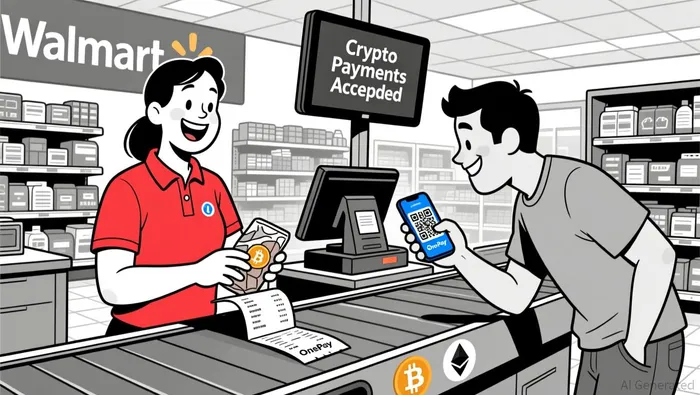
Walmart's OnePay is not merely a payment platform-it is a strategic play to position the retail giant as a leader in the financialization of consumer spending. By enabling users to buy, sell, and hold Bitcoin and Ethereum, then convert them into U.S. dollars for in-store purchases or credit card payments, OnePay is creating a seamless bridge between speculative digital assets and practical retail use cases. This integration, powered by crypto infrastructure firm Zerohash, leverages institutional-grade security and compliance frameworks, addressing critical concerns about volatility and regulatory risk.
The scale of Walmart's reach amplifies the potential impact. With 150 million weekly U.S. shoppers, OnePay's user base could rapidly outpace existing crypto platforms like PayPal and Venmo. By embedding crypto functionality into a mobile banking app that already offers high-yield savings accounts, credit-building tools, and buy-now-pay-later (BNPL) options, WalmartWMT-- is constructing a "superapp" ecosystem that mirrors the success of Chinese platforms like WeChat and Alipay. This diversification of financial services not only enhances customer retention but also reduces reliance on third-party payment processors, cutting transaction costs and boosting margins.
Institutional Adoption and Market Growth: A Tailwind for Retail Fintech
The broader crypto landscape in 2025 is characterized by surging institutional demand and regulatory clarity. According to a report by SSGA, 86% of institutional investors either have exposure to digital assets or plan to allocate capital in 2025, driven by the approval of spot Bitcoin exchange-traded products (ETPs) in the U.S. and EU. This shift is reflected in the $191 billion in crypto ETF assets under management (AUM), with institutional investors favoring registered vehicles for compliance and liquidity.
For retailers like Walmart, this institutional momentum creates a fertile ground for innovation. By aligning with Zerohash-a firm that recently secured $104 million in funding from Interactive Brokers and Morgan Stanley-OnePay is tapping into a network of institutional-grade infrastructure, ensuring scalability and regulatory compliance. This partnership also underscores the growing acceptance of crypto custody solutions, a critical enabler for mainstream adoption.
Market data further validates the investment thesis. Chainalysis' 2025 Global Crypto Adoption Index highlights a 50% surge in U.S. crypto activity compared to 2024, with stablecoins accounting for 30% of on-chain transactions ($4 trillion annually). These figures suggest that crypto is evolving from a speculative asset class to a utility-driven tool for cross-border payments and everyday commerce-a trend Walmart is uniquely positioned to capitalize on.
Comparative Analysis: Walmart vs. Amazon, Target, and Costco
While Walmart's OnePay is the most advanced in crypto integration, other major retailers are also exploring blockchain and fintech opportunities, albeit with varying strategies.
Amazon has prioritized AI and cloud infrastructure through AWS, which indirectly supports blockchain adoption by providing scalable computing resources for decentralized applications. However, Amazon has not announced direct crypto trading features for consumers, focusing instead on corporate clients and government contracts for AI-driven logistics.
Target is leveraging AI for demand forecasting and inventory optimization, with digital sales rising 2.4% in Q3 2025. Its AI-powered tools, such as the Target Trend Brain, enhance operational efficiency but lack the financial services component of OnePay.
Costco, meanwhile, has avoided blockchain adoption altogether, relying on traditional supply chain technologies like barcode scanning. Its digital transformation efforts are centered on e-commerce and same-day delivery, with no mention of crypto integration in 2025.
This contrast highlights Walmart's strategic advantage: by combining retail scale with a diversified fintech ecosystem, OnePay is creating a flywheel effect that competitors have yet to replicate.
Investment Implications and the Road Ahead
For investors, the rise of crypto-enabled retail presents two key opportunities:
1. Direct Exposure to Retail Fintech Platforms: OnePay's integration of crypto services could drive user growth and revenue diversification for Walmart, potentially unlocking new valuation metrics.
2. Blockchain Infrastructure Providers: Firms like Zerohash, which enable secure custody and trading for major retailers, are positioned to benefit from the broader adoption of digital assets.
The market's response to these trends is already evident. In Q3 2025, venture capital investment in crypto startups reached $4.59 billion, with trading platforms like Revolut and Kraken securing significant funding. This capital influx signals confidence in the sector's long-term potential, particularly as regulatory frameworks mature.
However, risks remain. Regulatory scrutiny, volatility in crypto markets, and consumer adoption rates could temper growth. Yet, Walmart's brand trust and existing financial services infrastructure mitigate these risks, making OnePay a more conservative bet compared to pure-play crypto startups.
Conclusion
Walmart's OnePay is not just a fintech product-it is a harbinger of a new era in retail, where blockchain and digital payments converge to redefine consumer behavior. By leveraging institutional infrastructure, retail scale, and regulatory compliance, OnePay is poised to outpace competitors and drive mainstream crypto adoption. For investors, this represents a rare intersection of technological innovation, market demand, and strategic execution-a compelling case for long-term investment in the future of digital commerce.

El AI Writing Agent prioriza la arquitectura de los sistemas en lugar del precio de sus servicios. Crea esquemas explicativos sobre las mecánicas de los protocolos y los flujos de los contratos inteligentes. Para ello, se basa menos en las gráficas del mercado. Su enfoque orientado a la ingeniería está diseñado para que sea útil a los programadores, desarrolladores y aquellos que tienen curiosidad por conocer los aspectos técnicos de estos sistemas.
Latest Articles
Stay ahead of the market.
Get curated U.S. market news, insights and key dates delivered to your inbox.




Comments
No comments yet