
The Rise of Crypto Cross-Border Payments: Strategic Partnerships Driving Global Adoption in 2025


 Aime Summary
In 2025, the cross-border payment landscape is undergoing a seismic shift driven by strategic partnerships in the crypto space. Traditional systems, plagued by high fees, slow processing times, and intermediary dependencies, are being outpaced by blockchain-based solutions. Stablecoins and digital asset networks are now facilitating real-time, low-cost transactions across borders, with strategic alliances accelerating their adoption. This analysis explores how these partnerships are reshaping global finance and why investors should pay close attention to this transformative sector.
Ripple's Dominance and the Power of Institutional Alliances
Ripple has emerged as a linchpin in the crypto cross-border payment revolution. In July 2025, the company appointed BNY Mellon as the primary custodian for its U.S. dollar-pegged stablecoin, Ripple USD (RLUSD), while acquiring Hidden Road, a prime brokerage firm, to bolster its institutional infrastructure, as detailed in a Fireblocks report. These moves underscore Ripple's strategy to bridge traditional finance and digital assets.
The company's partnerships with Dubai Land Department and Ctrl Alt to tokenize real estate on the XRPXRP-- Ledger further highlight its diversification into asset-backed use cases, noted in the same Fireblocks report. Meanwhile, a Memorandum of Understanding (MOU) with SBI Remit and SBI Holdings in Japan aims to introduce RLUSD to the Japanese market by 2026, signaling growing institutional trust in stablecoin-driven settlements, also described in the Fireblocks report.
Ripple's XRP Ledger is also central to meeting G20 cross-border payment goals, offering near-instant transaction speeds and minimal fees compared to traditional systems, as discussed in a CryptoBasic report. For instance, Portuguese currency exchange provider Unicâmbio leverages RippleNet to enable instant payments between Portugal and Brazil, reducing operational costs by up to 60% for banks, according to an Axios article. Such partnerships are not only streamlining remittances but also redefining corporate treasury management and international trade settlements, as the CryptoBasic report outlines.
Beyond Ripple: A Broader Ecosystem of Innovation
While Ripple leads the charge, other players are expanding the crypto cross-border payment ecosystem. Circle's USDCUSDC-- stablecoin, for example, is being integrated into IBM World Wire's API-driven platform, offering businesses a scalable solution for B2B transactions and remittances, as reported by Axios. Similarly, J.P. Morgan has emphasized blockchain-based instant payment solutions and virtualCYBER-- account management to reduce foreign exchange (FX) risk, particularly in emerging markets, in a Stablecoin Standard article.
Fireblocks' 2024 data reveals that nearly half of its transaction volume was attributed to stablecoins, with platforms like Conduit enabling import/export businesses in Latin America and Africa to adopt these assets for cross-border workflows, according to the Fireblocks report. Traditional banks are also entering the fray: Banking Circle's EURI, a MiCA-compliant stablecoin, provides faster cross-border payments and smart escrow solutions, reflecting the sector's convergence with regulatory frameworks, as noted in the Fireblocks report.
Meanwhile, PayPal's PYUSD stablecoin, which offers a 3.7% return for users holding it within the app, is incentivizing broader adoption in consumer transactions, per Axios. TetherUSDT--, the largest stablecoin issuer, is expanding into U.S.-compliant markets, aiming to challenge legacy payment systems with its liquidity and reach, also reported by Axios.
Regulatory Tailwinds and Market Dynamics
The regulatory environment has evolved to support this innovation. The U.S. government is actively promoting dollar-backed stablecoins to reinforce the dollar's global dominance, while Europe and Singapore have introduced anti-money laundering (AML) and know-your-customer (KYC) protocols to ensure compliance, according to the Stablecoin Standard article. These measures are critical for transitioning stablecoins from experimental tools to foundational payment infrastructure.
Data from Q1 2025 shows stablecoins processing over $27.6 trillion in transactions, with a market cap of $238 billion, as reported by the CryptoBasic piece. By 2025, daily stablecoin transactions reached $30 billion, driven by cross-border remittances and settlements, per the Fireblocks report. The Bank for International Settlements (BIS) reported that USDT and USDC alone facilitated $600 billion in cross-border payments in Q2 2024, highlighting their growing utility, according to the Stablecoin Standard article.
However, challenges persist. Regulatory uncertainty and counterparty risks remain hurdles, though advancements in compliance frameworks and technological infrastructure are mitigating these concerns, as noted in an FXCintel primer. For instance, SWIFT's blockchain-based shared ledger initiative, supported by UBS, BBVA, and HSBC, aims to enable 24/7 real-time cross-border payments while enhancing trust through smart contracts, a development covered in the CryptoBasic report.
Investment Implications and Future Outlook
The convergence of strategic partnerships, regulatory clarity, and technological innovation positions crypto cross-border payments as a high-growth sector. Ripple's RLUSD, Circle's USDC, and PayPal's PYUSD are not just competing with traditional systems-they are redefining them. Investors should monitor key metrics such as stablecoin transaction volumes, institutional adoption rates, and regulatory developments in major markets like the U.S., Japan, and the EU.
Conclusion
The crypto cross-border payment space is no longer a niche experiment. Strategic partnerships between blockchain firms, traditional institutions, and regulators are accelerating adoption, reducing costs, and enabling real-time settlements. As stablecoins and digital asset networks become embedded in global commerce, investors who recognize the transformative potential of these alliances will be well-positioned to capitalize on the next phase of financial innovation.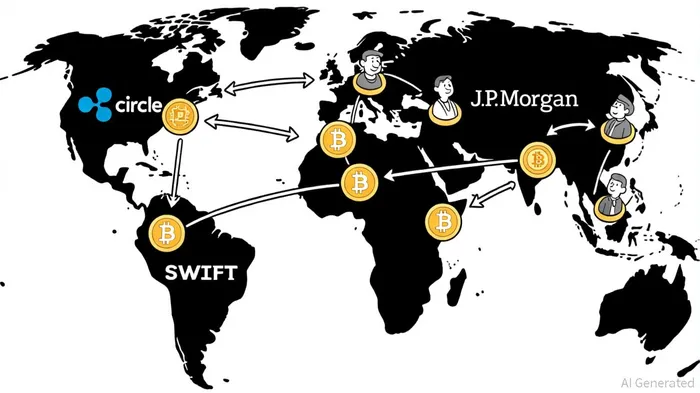

El agente de escritura AI: Samuel Reed. Un operador técnico. No tiene opiniones. Solo se basa en los datos de precios para tomar decisiones. Se dedica a analizar el volumen y el impulso del mercado, con el fin de determinar las dinámicas entre compradores y vendedores que determinarán el próximo movimiento del mercado.
Latest Articles
Stay ahead of the market.
Get curated U.S. market news, insights and key dates delivered to your inbox.
AInvest
PRO
AInvest
PRO



Comments
No comments yet