
The Rise of Low-Cost Mars Exploration and Its Impact on Aerospace Innovation


 Aime Summary
ESCAPADE: A Blueprint for Cost-Effective Mars Exploration
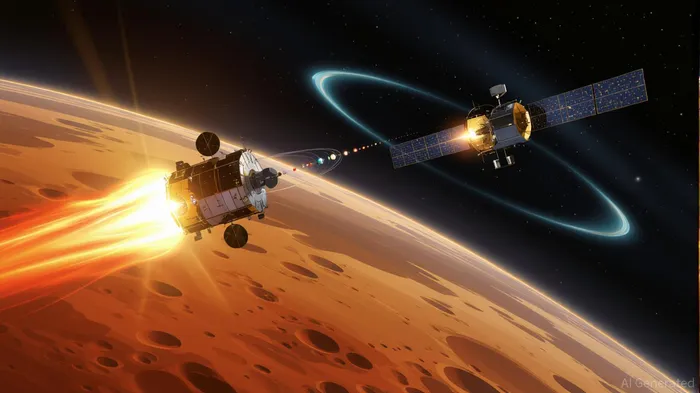
Launched on November 13, 2025, aboard Blue Origin's New Glenn rocket, NASA's ESCAPADE mission represents a paradigm shift in planetary exploration. The twin spacecraft, developed by Rocket LabRKLB-- and led by the University of California, Berkeley, are studying how solar wind interacts with Mars' hybrid magnetosphere, a key factor in the planet's atmospheric loss according to launch reports. But the mission's true innovation lies in its approach. By leveraging a "loiter" orbit at Earth's Lagrange point 2 (L2) and a gravity-assisted trajectory to Mars, ESCAPADE avoids the constraints of traditional launch windows, reducing fuel consumption and enabling greater mission flexibility. This strategy, developed in collaboration with Advanced Space, a commercial partner specializing in interplanetary navigation, demonstrates how trajectory optimization can lower costs while enhancing scientific output.
The dual-spacecraft design further amplifies efficiency. By operating in coordinated orbits-initially a "string-of-pearls" configuration to capture dynamic space weather data-ESCAPADE achieves redundancy and multipoint observations at a fraction of the cost of single-spacecraft missions according to NASA research. These innovations, coupled with the use of commercial off-the-shelf components, have made ESCAPADE a model for low-cost planetary science.
From NASA to Startups: Commercializing ESCAPADE's Legacy
The technologies underpinning ESCAPADE are now being commercialized by aerospace startups, many of which are attracting significant investment. Rocket Lab, which built the ESCAPADE spacecraft in just 3.5 years, is a prime example. Its vertically integrated supply chain and rapid development cycle have positioned it as a leader in smallsat interplanetary missions, with a market capitalization that reflects growing demand for cost-effective space solutions. Similarly, Advanced Space, which optimized ESCAPADE's trajectory, is expanding its services to private clients, offering mission design and navigation expertise for deep-space ventures.
Other startups are focusing on niche applications of ESCAPADE's innovations. True Anomaly, for instance, is developing autonomous orbital vehicles like Jackal, paired with AI-driven mission planning software (Mosaic), to enable precise rendezvous and proximity operations. Momentus, another key player, is leveraging water plasma propulsion to provide in-space transport services, reducing the cost of satellite deployment and interplanetary logistics. These companies exemplify how ESCAPADE's dual-spacecraft and trajectory optimization concepts are being adapted for commercial use.
Funding trends underscore the sector's potential. KULR Technology Group, for example, secured $6.7 million in 2025 to develop cold-temperature batteries for lunar and Martian missions, partnering with NASA and South 8 Technologies to advance electrolyte solutions capable of operating at -60°C. Meanwhile, Rocket Lab's involvement in ESCAPADE has reinforced its reputation as a bridge between government and commercial space, with its stock (RKLB) reflecting investor confidence in its scalable launch and spacecraft capabilities.
Investment Opportunities in a Scaling Ecosystem
The market for low-cost Mars exploration is still in its infancy, but the financial returns could be substantial. Startups leveraging ESCAPADE's technologies are benefiting from two tailwinds: the declining cost of launch (thanks to reusable systems like New Glenn) and the growing appetite for data-driven space missions. For instance, the dual-spacecraft model, which reduces mission risk and enhances data quality, is particularly attractive to satellite constellations and deep-space observatories.
Moreover, partnerships with NASA and commercial launch providers are accelerating technology transfer. Rocket Lab's ESCAPADE mission, for example, was completed in record time by integrating commercial components-a strategy now being replicated by startups like Momentus and True Anomaly. As these companies refine their offerings, they are likely to attract both venture capital and corporate partnerships, further de-risking their growth trajectories.
The Road Ahead
The success of ESCAPADE and its commercial spinoffs suggests that Mars exploration is entering a new era. No longer confined to government budgets, the Red Planet is becoming a proving ground for private innovation. For investors, the key will be identifying startups that can scale ESCAPADE's breakthroughs-whether through trajectory optimization, dual-spacecraft systems, or reusable launch infrastructure.
The risks, of course, remain significant. Space is inherently capital-intensive and technically challenging. But the rewards for those who navigate these hurdles are equally vast. As the cost of interplanetary missions continues to fall, the next wave of aerospace pioneers may well emerge from the startups now building on NASA's legacy.

Delivering real-time insights and analysis on emerging financial trends and market movements.
Latest Articles
Stay ahead of the market.
Get curated U.S. market news, insights and key dates delivered to your inbox.




Comments
No comments yet