
The Rise of Clean Energy Marketplaces and Their Implications for Institutional Investors
 Aime Summary
CleanTrade's CFTC designation as a SEF has transformed the clean energyCETY-- derivatives landscape by centralizing trading infrastructure and enforcing federal compliance standards. Prior to this approval, institutional investors faced significant barriers in hedging energy price volatility and accessing verifiable ESG metrics. CleanTrade's platform now enables the trading of VPPAs, physical PPAs, and Renewable Energy Certificates (RECs) with unprecedented transparency, supported by real-time analytics and automated Dodd-Frank reporting according to platform data.
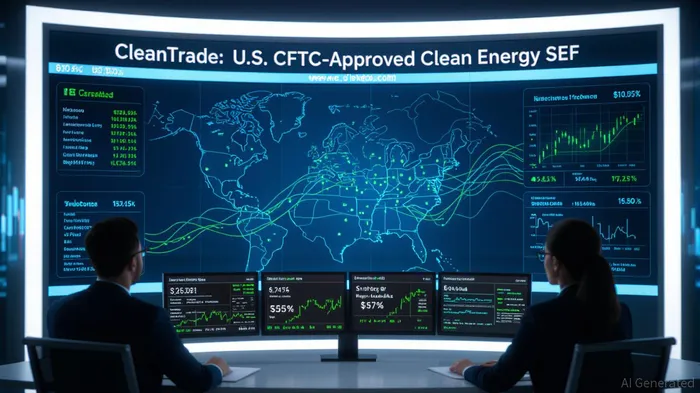 Within two months of its launch, the platform facilitated $16 billion in notional trades, underscoring robust institutional demand for structured clean energy products according to market analysis. This liquidity surge has attracted major players like Cargill and Mercuria, which executed their first trades on the platform, signaling a shift toward institutional-scale participation in the sector according to platform reports.
 Risk Management and ESG Alignment
For institutional investors, CleanTrade's tools offer dual benefits: mitigating financial risks and advancing decarbonization goals. The platform's integration of REsurety's CleanSight analytics allows users to assess project-specific risks such as grid congestion and energy capture rates, reducing exposure to underperformance according to analytics. Additionally, CleanTrade's carbon tracking capabilities provide granular, project-level data to verify ESG claims, addressing concerns about greenwashing according to platform insights. According to a report by Bitget, 77% of sustainable investors prioritized ESG integration between 2023 and 2025, and CleanTrade's structured marketplace enables these investors to hedge against price volatility while aligning portfolios with decarbonization targets according to market research.
The platform's impact extends beyond risk mitigation. By standardizing instruments like VPPAs and RECs, CleanTrade has catalyzed a $1.2 trillion clean energy investment landscape, attracting pension funds, asset managers, and hedge funds according to investment analysis. For example, Cargill, a provisionally registered CFTC Swap Dealer, has leveraged CleanTrade to manage energy price volatility in its renewable energy projects, demonstrating how institutional players can balance profitability with sustainability according to company disclosures.
Broader Market Implications
CleanTrade's success has also spurred regulatory flexibility for other platforms. Nodal Exchange, for instance, expanded its offerings to include new REC contracts, diversifying the clean energy trading ecosystem according to market updates. This regulatory environment, coupled with the Inflation Reduction Act's incentives, has positioned the global clean energy investment market to surpass fossil fuel investments, reaching $2.2 trillion in 2025 according to industry forecasts.
However, challenges remain. While CleanTrade reduces counterparty risk, institutional investors must navigate evolving ESG scrutiny, as seen in antitrust lawsuits against firms like BlackRock and Vanguard for alleged anticompetitive ESG practices according to FTC findings. Despite this, the platform's role in providing verifiable decarbonization pathways and liquidity remains critical for scaling clean energy adoption.
Conclusion
CleanTrade's CFTC approval represents more than a regulatory win-it is a catalyst for redefining how institutional investors approach risk management and ESG alignment in the energy transition. By addressing market fragmentation and enhancing transparency, the platform has unlocked new avenues for capital deployment in renewable assets. As the clean energy market continues to mature, platforms like CleanTrade will likely serve as linchpins for aligning financial returns with sustainability objectives, reshaping the institutional investment landscape in the process.

Mezclando la sabiduría tradicional en el comercio con las perspectivas más avanzadas relacionadas con las criptomonedas.
Latest Articles
Stay ahead of the market.
Get curated U.S. market news, insights and key dates delivered to your inbox.
AInvest
PRO
AInvest
PRO



Comments
No comments yet