
The Rise of China's AI Chip Ecosystem: Can It Dethrone Nvidia?
 Aime Summary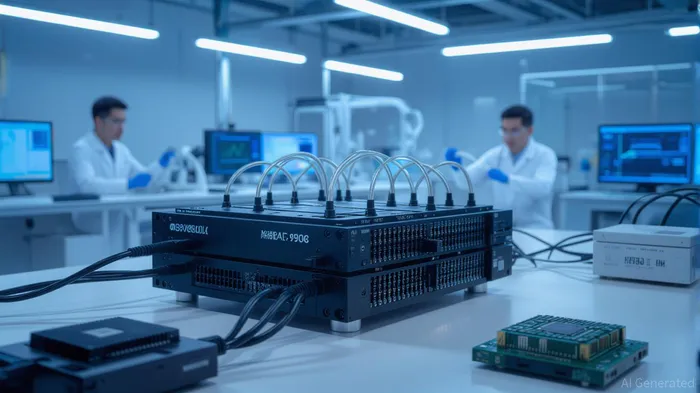
The global AI chip landscape is undergoing a seismic shift. For years, Nvidia's dominance in AI computing seemed unassailable, with its CUDA ecosystem and H100/H200 chips powering the world's most advanced AI models. However, 2025 has marked a turning point as China's semiconductor sector, driven by state-backed innovation and geopolitical necessity, begins to close the gapGAP--. This article evaluates the strategic investment potential in China's emerging AI chip ecosystem, weighing technological breakthroughs, government-driven momentum, and the looming shadow of U.S. export controls.
The Huawei Factor: System-Level Innovation Challenges Nvidia
Huawei's Ascend 910B and 910C chips have long been seen as underdogs in the AI race. While they lag in memory bandwidth compared to Nvidia's H20 (offering only 80% of its performance), Huawei's CloudMatrix 384 system—a 384-chip cluster with all-optical networking—has outperformed Nvidia's GB200 NVL72 in compute power and integrated networking. This system-level leap demonstrates Huawei's pivot from component-level parity to holistic AI infrastructure optimization.
The company's resilience is further underscored by its ability to scale production despite U.S. export restrictions. By transitioning from TSMCTSM-- to SMIC and leveraging state-backed procurement (e.g., illegally sourcing 2 million TSMC dies in 2024), Huawei has maintained supply chains. Its developer community has grown tenfold in four years, and early adopters like DeepSeek and ByteDance are testing its chips for model training.
The Ecosystem Gap: Software and Talent
Nvidia's dominance is not just about hardware—it's about CUDA, a decades-old software ecosystem with 10 million developers. Huawei's CANN and MindSpore frameworks, while improving, still lack the maturity and developer base to rival CUDA. This creates a chicken-and-egg problem: without widespread adoption, software optimization lags, which in turn limits chip performance.
However, the tide is shifting. Goldman SachsGS-- forecasts Cambricon's revenue to grow 3.7x to 5.5 billion yuan in 2025, driven by a $100 million order from ByteDance. Moore Threads' FP8 precision tech and Biren's AI accelerators are also gaining traction. These players are filling niches in the ecosystem, reducing reliance on a single vendor.
Government-Driven Momentum: Big Fund III and Strategic Alliances
China's third iteration of the National IC Industry Investment Fund (Big Fund III) injected $47.5 billion into the sector in 2024, targeting EDA tools, HBM production, and advanced packaging. This funding has accelerated progress in mature-node logic chips (10–28nm) and compound semiconductors (SiC, GaN), where China now leads 50% of global SiC wafer supply.
The government's 2025 self-sufficiency target—50% domestic production—has also spurred partnerships with non-U.S. allies. Japan and South Korea remain critical for materials and equipment, while open-source RISC-V adoption is reducing dependency on ARM.
Geopolitical Risks and Opportunities
U.S. export controls have been a double-edged sword. While they restrict access to EUV lithography and advanced foundries, they've also forced China to accelerate self-reliance. The 100% tariff on Chinese semiconductor imports and rare-earth export controls have deepened the bifurcation of global supply chains.
Yet, this bifurcation creates opportunities. Chinese firms are now prioritizing domestic alternatives, with telecom providers ordered to replace foreign chips by 2027. The National Data Administration's report highlights China's intelligent computing power surging to 788 EFLOPS in 2025—up from 90 EFLOPS in 2024—driven by AI adoption in healthcare, agriculture, and smart cities.
Investment Thesis: Balancing Optimism and Caution
For investors, the Chinese AI chip sector offers high-growth potential but requires a nuanced approach:
- Leading the Pack: Huawei and Cambricon are the most compelling bets. Huawei's system-level innovation and state support position it to capture market share in large-scale AI clusters. Cambricon's revenue surge and ByteDance partnership signal strong demand for specialized AI chips.
- Diversified Exposure: ETFs like the China Semiconductor Index (CHSI) or regional funds (e.g., iShares MSCI China ETF) provide broad exposure to the sector's growth.
- Long-Term Play: Companies like SMIC and Yangtze Memory Technology (YMTC) are critical for manufacturing self-sufficiency. While they face U.S. restrictions, their progress in 7nm and HBM production is a key indicator of China's trajectory.
However, risks remain. The U.S. could tighten controls further, and Chinese firms must overcome software ecosystem gaps. Investors should also monitor geopolitical tensions, such as the recent 100% tariff on semiconductorON-- imports and China's rare-earth leverage.
Conclusion: A New Era in AI Computing
China's AI chip ecosystem is no longer a distant dream—it's a credible challenger to Nvidia's throne. While the road to full self-sufficiency is long, the combination of state funding, system-level innovation, and geopolitical pressure is creating a fertile ground for disruption. For investors, the key is to balance optimism with caution, focusing on companies with strong fundamentals and strategic alignment with China's 2025 goals.
As Jensen Huang of NvidiaNVDA-- recently acknowledged, “The competition is intensifying.” The question is no longer if China can dethrone Nvidia, but how quickly it will close the gap—and what that means for the future of global AI leadership.

Decoding blockchain innovations and market trends with clarity and precision.
Latest Articles
Stay ahead of the market.
Get curated U.S. market news, insights and key dates delivered to your inbox.
AInvest
PRO
AInvest
PRO



Comments
No comments yet