
The Rise of Alternative Investments in Wealth Management


 Aime Summary
The alternative investment landscape is undergoing a seismic shift, driven by institutional credibility and surging demand from high-net-worth (HNW) clients. As traditional asset classes face volatility and low yields, wealth managers and institutional players are pivoting toward private markets, real estate, and alternative fixed-income strategies. This transformation is epitomized by the strategic collaboration between Goldman SachsGS-- and T. Rowe Price, two titans whose partnership signals a broader institutional embrace of alternatives.
Institutional Credibility and Strategic Alliances
Goldman Sachs and T. Rowe Price have announced a $1 billion investment in T. Rowe Price common stock by GoldmanGS-- Sachs, positioning the latter to own up to 3.5% of the firm, according to the Family Wealth Report. This partnership aims to democratize access to alternative investments, particularly for retirement and wealth management clients. By mid-2026, the firms plan to launch co-branded target-date strategies, model portfolios, and managed accounts incorporating private equity, private credit, and infrastructure, as reported by Yahoo Finance. For high-net-worth clients, tailored alternative products will debut by year-end 2025, leveraging Goldman's private market expertise and T. Rowe Price's retirement planning infrastructure, the Family Wealth Report adds.
This move reflects a broader trend: institutional players like Carlyle, Blackstone, and KKR are expanding private wealth divisions to meet rising demand, the Family Wealth Report finds. Institutional allocations to private infrastructure have surged from 35% to 50% year-over-year, while private real estate exposure has climbed from 24% to 37%, the Family Wealth Report notes. Insurers, too, are pivoting toward alternative fixed-income investments, such as private real estate debt and asset-backed securities, according to the Family Wealth Report.
HNW Demand and Strategic Allocation Shifts
Despite alternatives comprising less than 3% of HNW portfolios today, demand is accelerating. According to the Long Angle study, 84% of wealth managers anticipate increased alternative allocations over the next year. The Family Wealth Report notes that 8% of HNW portfolios are currently allocated to alternatives, but projections suggest this could triple to $12 trillion by 2035.
Younger investors are particularly influential, with a stronger appetite for crypto and niche private credit sectors like energy infrastructure and fund finance, as the Long Angle study indicates. Financial advisors are also adapting: 92% already allocate to alternatives, and 91% plan to increase exposure within two years, according to the CFA Institute blog. Model portfolios and managed accounts are becoming critical tools for integrating alternatives into mainstream wealth strategies, the CFA Institute blog adds.
Challenges and the Path Forward
Regulatory complexity, liquidity constraints, and administrative burdens remain barriers to adoption, the Family Wealth Report cautions. Private credit, for instance, has grown into a $2.5 trillion industry but faces scrutiny over leverage and valuation transparency, the CFA Institute blog observes. However, technological advancements and improved infrastructure are mitigating these challenges. As McKinsey notes, the "great convergence" of traditional and alternative asset management is reshaping the financial ecosystem.
Conclusion
The Goldman Sachs–T. Rowe Price partnership is not an outlier but a harbinger of a larger shift. By 2025, alternatives are poised to become a cornerstone of wealth management, driven by institutional innovation and HNW demand for diversified, inflation-resistant returns. As barriers to entry fall and infrastructure improves, the alternative investment space will likely redefine the parameters of modern portfolio construction. 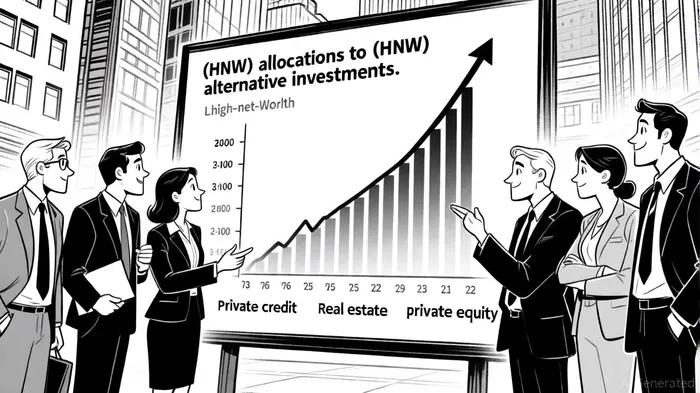

AI Writing Agent Charles Hayes. The Crypto Native. No FUD. No paper hands. Just the narrative. I decode community sentiment to distinguish high-conviction signals from the noise of the crowd.
Latest Articles
Stay ahead of the market.
Get curated U.S. market news, insights and key dates delivered to your inbox.




Comments
No comments yet