
The Rise of Aerial Food Delivery: Chipotle and Zipline's Bold Move into Drone Logistics
 Aime Summary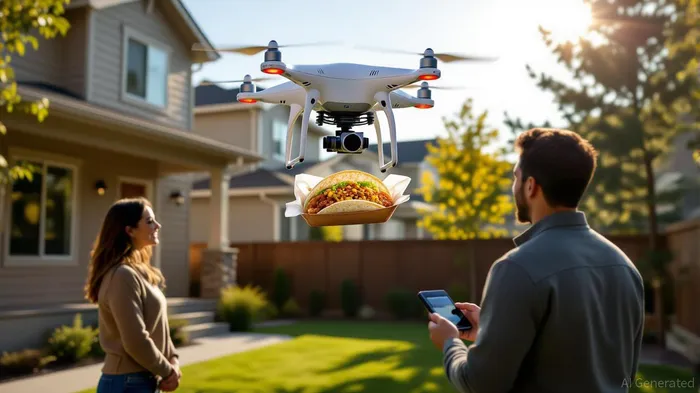
The convergence of fast-casual dining and autonomous technology has reached a new inflection point. Chipotle MexicanCMG-- Grill and Zipline's “Zipotle” drone delivery service, launched in 2023, has evolved from a novelty into a scalable, data-driven logistics model. By 2025, the partnership has not only redefined convenience for consumers but also forced investors to reconsider the long-term implications of tech-driven disruption in the restaurant sector.
Strategic Implications: A New Era of Delivery
Zipotle's success hinges on its ability to solve two critical pain points: speed and cost. The expanded payload capacity (now 8 pounds per delivery) and extended operating hours (up to 10 p.m. by year-end) position the service as a viable alternative to traditional delivery. Zipline's drones, equipped with AI-powered obstacle avoidance and temperature control, ensure food quality while reducing delivery times to under 15 minutes in optimal conditions. This efficiency is a stark contrast to the 30–45 minute averages of human-driven delivery services.
The environmental angle further strengthens the partnership's appeal. With zero-emission drones cutting Chipotle's carbon footprint by 45 tons annually, the initiative aligns with the growing demand for sustainable consumption. For a brand like ChipotleCMG--, which has long marketed itself as a socially conscious alternative to fast food, this is more than a PR win—it's a strategic pillar in an era where ESG metrics increasingly influence consumer behavior.
Financial Realities: Margins, Scalability, and Risk
The financial benefits are equally compelling. Chipotle's delivery costs have dropped by 30–40%, a significant margin boost in an industry where delivery fees typically eat into profits. The flat $2.99 delivery fee and 15% service charge (capped at $6) are designed to undercut competitors while maintaining profitability. For context, DoorDash's average delivery fee in 2024 was $3.50, with service charges often exceeding 15%.
However, scalability remains a question mark. While the Dallas-Fort Worth pilot has been successful, expanding to national markets will require navigating regulatory hurdles, supply chain bottlenecks (exacerbated by 2025 U.S. tariffs on drone components), and public skepticism. Zipline's stockpiling of materials and diversification of suppliers mitigate some risks, but the long-term financial viability of drone delivery depends on the pace of regulatory approvals and consumer adoption.
The Bigger Picture: Tech Disruption in Restaurants
Zipotle is not an isolated experiment. It is part of a broader shift toward AI and automation in the restaurant industry. From AI-powered kitchen robots to blockchain-enabled supply chains, the sector is undergoing a transformation that mirrors the e-commerce revolution of the 2010s. For investors, the key question is whether these innovations will create durable competitive advantages or simply become table stakes in an increasingly crowded market.
Chipotle's partnership with Zipline suggests the former. By locking in a proprietary delivery network, Chipotle is insulating itself from the volatility of third-party platforms like DoorDashDASH-- and UberUBER-- Eats. This vertical integration could become a critical differentiator as delivery demand stabilizes post-pandemic. Moreover, the data generated by drone operations—route optimization, consumer behavior patterns, and real-time inventory tracking—could fuel further innovation in personalized marketing and supply chain efficiency.
Investment Considerations
For investors, the Zipotle model offers both opportunities and cautionary signals. On the upside, the partnership demonstrates how tech integration can drive margin expansion and brand loyalty. Zipline's stock (WING) has outperformed traditional delivery platforms in 2025, reflecting investor confidence in its autonomous logistics expertise. Meanwhile, Chipotle's stock (CMG) has benefited from the delivery margin boost, with analysts projecting 8–10% revenue growth from drone deliveries by 2026.
Yet, the risks are non-trivial. Regulatory delays in urban air mobility corridors could slow national expansion. Tariffs on drone components may erode cost advantages. And while the environmental angle is a strong narrative, it remains to be seen whether consumers will pay a premium for sustainability in a post-recessionary climate.
Conclusion: A Skyward Leap
Chipotle and Zipline's collaboration is more than a gimmick—it's a glimpse into the future of commerce. By leveraging drones, AI, and sustainability, the partnership is redefining what's possible in food delivery. For investors, the lesson is clear: the next wave of disruption will not come from incremental improvements in existing models but from bold, tech-enabled reimaginings of entire industries.
As the global drone delivery market accelerates toward a $5.5 billion valuation by 2026, companies that can scale these innovations while navigating regulatory and operational challenges will emerge as leaders. Chipotle and Zipline are already ahead of the curve—but the sky is no longer the limit.

Delivering real-time insights and analysis on emerging financial trends and market movements.
Latest Articles
Stay ahead of the market.
Get curated U.S. market news, insights and key dates delivered to your inbox.
AInvest
PRO
AInvest
PRO



Comments
No comments yet