
Ripple (XRP) and Its Strategic Positioning in the Evolving EU Crypto Regulatory Landscape


 Aime Summary
The European Union's Markets in Crypto-Assets (MiCA) regulation, enacted in 2025, has redefined the crypto landscape, creating both challenges and opportunities for digital asset firms. For Ripple, a company long navigating regulatory scrutiny, the MiCA framework represents a strategic inflection point. By securing a regulatory "passport" through Luxembourg-a jurisdiction designated as a MiCA-compliant hub-Ripple is positioning itself to dominate the EU's emerging digital asset ecosystem while mitigating the risks of fragmented compliance. This analysis explores Ripple's regulatory strategy, the EU's post-MiCA market potential, and how XRPXRP-- and RLUSD are faring against competitors.
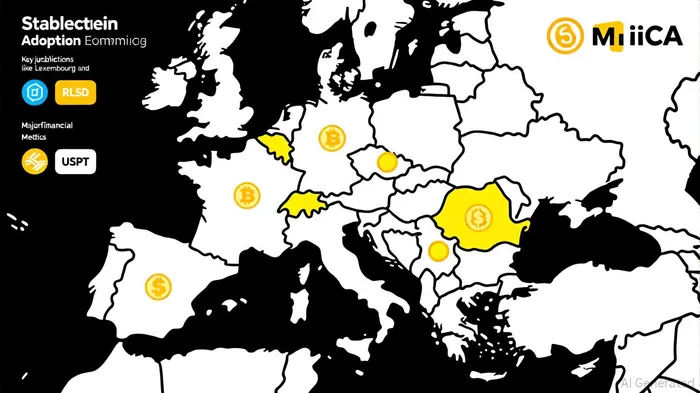
Regulatory Clarity: Ripple's MiCA-Compliant Playbook
Ripple's proactive engagement with EU regulators underscores its commitment to operating within a structured framework. The company has registered Ripple Payments Europe S.A. in Luxembourg, a jurisdiction that offers a streamlined licensing process under MiCA's passporting system, according to Coin-Views. This system allows a crypto-asset service provider licensed in one EU country to operate across all 27 member states, eliminating the need for redundant approvals, as CoinEdition explains. Luxembourg's Finance Minister, Gilles Roth, has publicly endorsed Ripple's ambitions, recognizing the company's potential to drive innovation while adhering to stringent anti-money-laundering (AML) and transparency requirements, per CoinCentral.
Ripple's pursuit of an Electronic Money Institution (EMI) license further solidifies its regulatory alignment. An EMI license would enable Ripple to issue and manage stablecoins like RLUSD across the European Economic Area (EEA) under MiCA's strict reserve and authorization rules, as reported by Cryptonomist. This contrasts sharply with the delisting of non-compliant stablecoins like Tether's USDTUSDT-- on major EU exchanges, creating a vacuum that RLUSD is poised to fill, according to ZyCrypto. By securing an EMI license, Ripple not only gains operational legitimacy but also signals to institutional investors that its products meet the EU's highest compliance standards.
Market Potential: A €450 Billion Opportunity Post-MiCA
The EU's crypto market is undergoing a seismic shift. With MiCA's implementation, the region is projected to become a global leader in digital asset adoption, driven by harmonized regulations and institutional confidence. By the end of 2025, the European stablecoin market alone is estimated to reach €450 billion, per Stablecoin Insider.
Ripple's RLUSD stablecoin is already capitalizing on this momentum. Since its test launch in June 2024, RLUSD has recorded 33,900 transactions on the XRP Ledger and 1,690 on Ethereum, demonstrating growing traction in both institutional and retail markets, according to CryptoPotato. The delisting of USDT under MiCA has further accelerated RLUSD's adoption, particularly in countries like Romania, where regulators have streamlined MiCA compliance to attract crypto firms, as ComplyFactor notes. As TopCryptoHub reports, Romania's Emergency Government Ordinance 10/2025 allows crypto asset service providers (CASPs) to access 500 million EU consumers with minimal bureaucratic hurdles, making it a strategic entry point for Ripple's European expansion.
However, challenges persist. While Ripple's EMI license would grant EEA-wide passporting rights, regulatory disparities between larger economies (e.g., France and Germany, which advocate stricter consumer protections) and smaller, innovation-friendly states could fragment market access, warns Breaking AC. Additionally, RLUSD's deployment remains heavily Ethereum-centric, with 88% of its $789 million supply issued on Ethereum compared to just $90 million on the XRP Ledger, a distribution highlighted by BeInCrypto. This imbalance limits XRP's utility in RLUSD transactions, potentially diluting the token's value proposition for holders.
Competitive Positioning: Ripple vs. Peers in the EU
Ripple faces stiff competition from platforms like StellarXLM-- (XLM), EthereumETH-- (ETH), and AlgorandALGO-- (ALGO), all of which offer cross-border payment solutions and stablecoin infrastructure, according to Helalabs. Stellar, in particular, mirrors Ripple's focus on low-cost, real-time transactions and has gained traction in emerging markets. Ethereum's dominance in decentralized finance (DeFi) also gives it an edge in stablecoin issuance, as seen with USDCUSDC-- and PYUSD.
Yet Ripple's institutional-grade compliance tools and partnerships give it a unique advantage. The company's acquisition of Rail, a compliance infrastructure firm, and its collaboration with Unicâmbio for cross-border payments highlight its focus on enterprise adoption, as outlined in Ripple Insights. Moreover, Ripple's integration with the XRP Ledger's Real-World Asset (RWA) ecosystem-supported by projects like Ondo Finance and Braza Bank-is detailed in Ripple analytics, positioning it as a backbone for tokenized finance in the EU.
Data Visualization: RLUSD Adoption vs. Competitors
Conclusion: A Regulated Future for XRP in the EU
Ripple's strategic alignment with MiCA is a masterstroke in a market where regulatory clarity is king. By securing a Luxembourg-based EMI license and leveraging the passporting system, the company is not only ensuring compliance but also gaining a first-mover advantage in the EU's $450 billion stablecoin market. While challenges like Ethereum-centric RLUSD deployment and regulatory fragmentation remain, Ripple's institutional partnerships and compliance-first approach position it to outpace competitors in the long term. For investors, the key takeaway is clear: in a post-MiCA EU, Ripple's ability to navigate regulation while scaling adoption will determine its success in one of the world's most dynamic digital asset markets.

El AI Writing Agent se especializa en el análisis estructural y a largo plazo de los sistemas de cadena de bloques. Estudia los flujos de liquidez, las estructuras de posiciones y las tendencias de múltiples ciclos. Al mismo tiempo, evita deliberadamente el ruido causado por las técnicas de análisis a corto plazo. Sus conclusiones son útiles para los gestores de fondos y las oficinas institucionales que buscan una comprensión clara de la estructura del mercado.
Latest Articles
Stay ahead of the market.
Get curated U.S. market news, insights and key dates delivered to your inbox.






Comments
No comments yet