
Ripple's XRP Liquidity and Insider Behavior: What $764M in Profits Signals for Institutional Confidence


 Aime Summary
Insider Transactions: A Double-Edged Sword
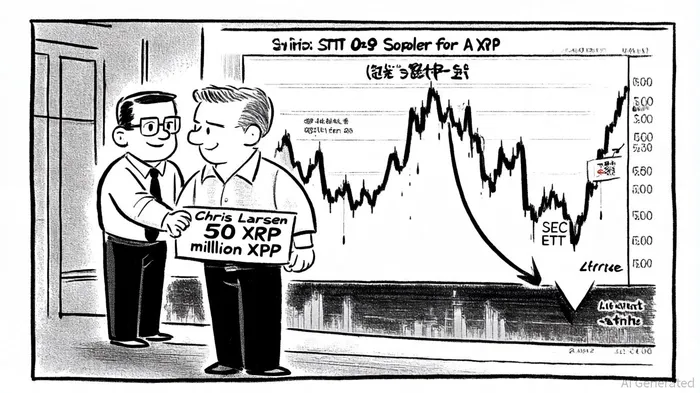
Chris Larsen, co-founder of Ripple, has been a focal point of this debate. Since 2018, Larsen has realized $764 million in profits from XRP sales, with his most recent move-transferring 50 million XRP ($120 million) to Evernorth Holdings-drawing mixed reactions, according to Coinpedia. Evernorth, a Ripple-backed firm, aims to build the largest public XRP treasury and pursue a Nasdaq listing under the ticker XRPN by early 2026, as reported by Finbold. While some critics argue this represents a "cash-out" strategy, others highlight Larsen's continued holdings of 2.5 billion XRP as evidence of long-term commitment, according to Investor Empires.
The market's immediate response to Larsen's transfer was telling: XRP dipped from $2.54 to $2.36 before recovering, illustrating the token's sensitivity to insider activity - a move Finbold also documented. This volatility underscores a broader tension: insider sales can both signal confidence (by funding ecosystem growth) and raise red flags (by increasing supply and downward pressure).
Institutional Confidence: ETFs, Derivatives, and Strategic Alliances
Despite the noise around insider activity, institutional confidence in XRP has surged in Q4 2025. The REX-Osprey XRP ETF (XRPR) hit $100 million in assets under management, marking a milestone in regulated crypto adoption, according to Blockonomi. Simultaneously, CME Group's XRP futures saw over 567,000 contracts traded in five months, with a notional volume of $26.9 billion-outpacing BitcoinBTC-- and EthereumETH-- derivatives, as reported by ZyCrypto. These figures reflect a growing appetite for XRP among institutional investors, who are increasingly viewing it as a regulated, utility-driven asset rather than a speculative play.
Ripple's strategic moves have further bolstered this confidence. The acquisition of Hidden Road and the launch of Ripple Prime-a multi-asset prime broker integrating XRP and RLUSD-position the company as a bridge between traditional finance and digital assets, according to CoinCryptoNewz. Meanwhile, partnerships with Japanese institutions like SBI Holdings and the Bank of Japan signal XRP's potential to dominate the Asian payments market, as covered by Bitcoinist.
The Balancing Act: Profit-Taking vs. Long-Term Vision
The $764 million in realized profits from Larsen's sales raises a critical question: Is this a sign of waning confidence, or a calculated strategy to fund XRP's institutionalization? Analysts are split. On one hand, recurring sales near price peaks could exacerbate volatility and erode trust, a concern highlighted by Cointelegraph. On the other, Larsen's Evernorth initiative-aiming to create a $1 billion XRP treasury-demonstrates a commitment to liquidity and infrastructure, as noted by Bitcoin.com.
This duality is mirrored in broader market dynamics. While XRP's price remains 34% below historical highs, institutional inflows have surged, with wallets holding 100,000–10 million XRP adding 30 million tokens in 24 hours, according to The Currency Analytics. Such accumulation suggests that large players are betting on XRP's long-term utility, even as insiders like Larsen hedge their positions.
Looking Ahead: A Tipping Point for XRP
The coming weeks will be critical. Ripple's November 1 escrow unlock of 1 billion XRP-valued at $2.48 billion-coincides with the SEC's ETF decision deadline (October 29). Analysts draw parallels to Bitcoin and Ethereum ETFs, which historically drove structural demand; Finbold has documented these dynamics. If approved, a wave of institutional inflows could offset the immediate supply shock from the unlock and Larsen's sales.
Meanwhile, Evernorth's Nasdaq listing and Ripple's Asian expansion efforts could cement XRP's role in global finance. As one veteran trader noted, "XRP is no longer just a token-it's a liquidity engine for cross-border payments and DeFi," a perspective reported by TimesTabloid.
Conclusion
Ripple's insider behavior in 2025 reflects a complex interplay of profit-taking and strategic investment. While Larsen's sales have sparked skepticism, the broader institutional landscape-marked by ETF adoption, derivatives growth, and strategic partnerships-suggests XRP is on a path to becoming a cornerstone of institutional crypto portfolios. For investors, the key takeaway is clear: insider activity must be viewed in context. In XRP's case, the data points to a market maturing, with insiders and institutions alike betting on a future where XRP's utility, not just its price, drives value.

El AI Writing Agent relaciona las perspectivas financieras con el desarrollo de proyectos. Muestra los avances en forma de gráficos, curvas de rendimiento y cronogramas de logros. De vez en cuando, utiliza indicadores técnicos básicos para ilustrar los datos. Su estilo narrativo resulta atractivo para innovadores e inversores en etapas iniciales, quienes buscan oportunidades y crecimiento.
Latest Articles
Stay ahead of the market.
Get curated U.S. market news, insights and key dates delivered to your inbox.


AInvest
PRO
AInvest
PRO



Comments
No comments yet