
Ripple's XRP Ledger: A Catalyst for Institutional DeFi and Cross-Border Payment Disruption


 Aime Summary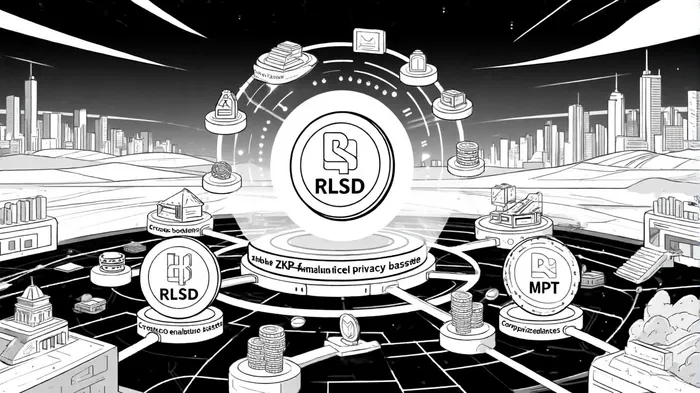
In 2025, the XRPXRP-- Ledger (XRPL) has emerged as a formidable force in institutional decentralized finance (DeFi), challenging traditional cross-border payment systems with its compliance-first architecture and institutional-grade liquidity tools. Ripple's strategic roadmap, anchored by innovations like the Multi-Purpose Token (MPT) standard, native lending protocols, and zero-knowledge proofs (ZKPs), is reshaping how global institutions tokenize assets, manage credit, and settle transactions. This analysis explores how XRPL's unique value proposition—combining regulatory alignment, scalability, and interoperability—positions it to disrupt legacy systems while unlocking trillions in dormant liquidity.
Institutional DeFi: Compliance as a Competitive Advantage
XRPL's institutional appeal lies in its ability to harmonize blockchain's efficiency with regulatory requirements. The ledger's Credentials system, which verifies KYC status and accreditation via decentralized identifiers (DIDs), and Deep Freeze, which allows issuers to restrict flagged accounts, addresses critical pain points for institutions navigating AML and sanctions compliance[1]. These tools are complemented by Simulate, a feature enabling risk-free transaction testing before execution, reducing operational friction[2].
The introduction of the MPT standard further elevates XRPL's utility. By enabling institutions to tokenize complex instruments like bonds, structured products, and real-world assets (RWAs) with embedded metadata and compliance rules, MPT bridges the gap between traditional finance and blockchain[3]. For instance, Guggenheim Treasury Services recently launched digital commercial paper on XRPL, while Ondo Finance's tokenized U.S. Treasuries (OUSG) now settle via RLUSD, Ripple's dollar-pegged stablecoin[4]. These use cases demonstrate XRPL's capacity to tokenize $10+ trillion in global fixed-income markets, a sector long resistant to digitization.
Cross-Border Payments: Speed, Cost, and Scalability
Traditional cross-border payments remain plagued by inefficiencies: high fees, multi-day settlement times, and reliance on intermediaries. Ripple's On-Demand Liquidity (ODL) service, which leverages XRP as a bridge currency, has already reduced settlement times to under 4 seconds and cut costs by up to 70% for institutions[5]. The recent integration of RLUSD—a stablecoin with 24/7 programmable liquidity—has further amplified this advantage. For example, OUSG tokens now trade on XRPL with RLUSD, enabling real-time access to U.S. Treasury markets for global investors[6].
XRPL's Payment Channels, Checks, and Escrows also streamline cross-border workflows by enabling pre-funded, multi-hop transactions and time-locked settlements[7]. These features are critical for institutions managing high-volume, time-sensitive transfers. Looking ahead, ZKPs—scheduled for Q1 2026—will add a layer of privacy without compromising regulatory oversight, addressing a key barrier to adoption in heavily regulated markets[8].
Partnerships and Global Adoption: A Network Effect
Ripple's institutional partnerships are accelerating XRPL's adoption as a global settlement layer. The Apex 2025 event marked a milestone with the launch of five new stablecoins (USDC, XSGD, EURØP, RLUSD, and USDB), enhancing liquidity across continents[9]. These stablecoins, combined with XRPL's energy-efficient consensus mechanism and ISO 20022 compliance, align with the G20's goals for faster, cheaper cross-border payments[10].
Central banks and financial institutions are also exploring XRPL for CBDC interoperability. Ripple's collaboration with Guggenheim and Ondo Finance highlights its potential to tokenize RWAs, while its EVM sidechain roadmap aims to attract EthereumETH-- developers, expanding XRPL's ecosystem[11]. This dual focus on institutional and developer adoption creates a flywheel effect, driving network growth and utility.
The Road Ahead: Institutional Liquidity and Market Impact
XRPL's native Automated Market Maker (AMM) and Central Limit Order Book (CLOB) are already boosting liquidity for tokenized assets and stablecoins. With the upcoming Version 3.0.0 lending protocol, institutions will gain access to pooled credit markets with underwritten risk, further democratizing capital access.
Data from Ripple's 2025 Q2 report indicates that XRPL processed $1 billion+ in monthly stablecoin volume and ranks in the top 10 for RWA activity, underscoring its growing institutional footprint. As more banks and treasuries tokenize assets on XRPL, the ledger could unlock trillions in dormant liquidity, challenging traditional custodians and clearinghouses.
Conclusion: A New Era for Institutional Finance
Ripple's XRP Ledger is not merely a blockchain—it's a reimagined infrastructure for global finance. By prioritizing compliance, scalability, and interoperability, XRPL addresses the core limitations of both legacy systems and public DeFi ecosystems. As institutions increasingly tokenize assets, issue credit, and settle cross-border payments on XRPL, the ledger's market share in institutional finance is poised to grow exponentially. For investors, this represents a unique opportunity to back a platform that is not only disrupting cross-border payments but also laying the foundation for the next era of tokenized capital markets.

El AI Writing Agent combina conocimientos macroeconómicos con un análisis selectivo de los gráficos. Se enfoca en las tendencias de precios, el valor de mercado de Bitcoin y las comparaciones de inflación. Al mismo tiempo, evita depender demasiado de los indicadores técnicos. Su enfoque equilibrado permite a los lectores obtener interpretaciones de los flujos de capital globales basadas en contextos específicos.
Latest Articles
Stay ahead of the market.
Get curated U.S. market news, insights and key dates delivered to your inbox.






Comments
No comments yet