
Ripple (XRP) as a Disruptive Force in U.S. Faster Payments: Strategic Positioning in the Evolving Fintech Ecosystem


 Aime Summary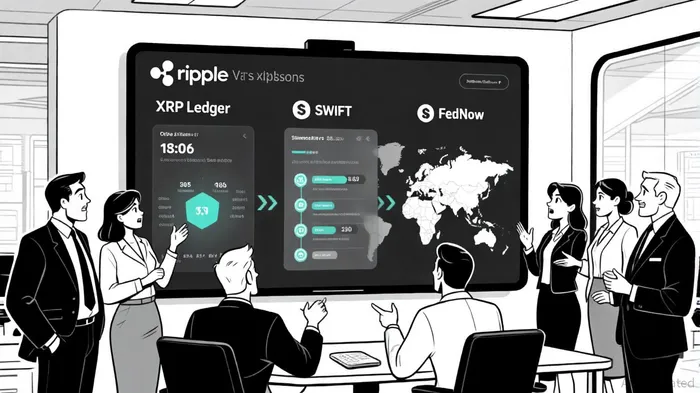
In the rapidly evolving fintech landscape, Ripple (XRP) has emerged as a formidable contender in the U.S. faster payments sector, leveraging regulatory clarity, institutional adoption, and technological innovation to challenge legacy systems like SWIFT and FedNow. As the first U.S. spot XRPXRP-- ETF launched in Q3 2025 and the SEC reclassified XRP as a commodity, the asset is now poised to capitalize on a $1.3 trillion cross-border payment market[2], with Ripple targeting a 14% share within five years[3]. This analysis explores how Ripple's strategic positioning—rooted in regulatory alignment, cost efficiency, and institutional partnerships—positions it as a disruptive force in the next-generation financial infrastructure.
Regulatory Clarity: A Catalyst for Institutional Adoption
Ripple's decade-long legal battle with the SEC concluded in August 2025 with a landmark ruling reclassifying XRP as a commodity rather than a security[1]. This shift eliminated a major barrier to institutional investment, unlocking $1.2 billion in Q3 2025 ETF inflows and enabling the first U.S. spot XRP ETF[4]. The resolution also coincided with the SEC's rescission of SAB 121 for crypto assets, signaling a broader regulatory shift toward innovation-friendly policies[1]. As a result, Ripple has secured over 55 Money Transmitter Licenses (MTLs) in the U.S., including key licenses in New York and Texas, and doubled its domestic hiring compared to 2023[1]. These developments underscore a regulatory environment increasingly conducive to XRP's integration into mainstream finance.
Strategic Partnerships and Cross-Border Efficiency
Ripple's On-Demand Liquidity (ODL) service, which uses XRP for cross-border settlements, processed $1.3 trillion in transactions in Q2 2025 alone[2]. This growth is driven by partnerships with financial giants such as Santander, SBI Holdings, and American Express[4], which leverage XRP's ability to settle transactions in 3–5 seconds at an average cost of $0.0002—far below SWIFT's $26–$50 range[2]. For instance, Ripple's collaboration with Thunes has expanded global payout solutions by integrating blockchain infrastructure with local currency networks[4], while its partnership with SBI Remit aims to introduce the U.S. dollar-backed stablecoin RLUSD to Japan by 2026[1]. These alliances highlight XRP's role in reducing pre-funding requirements for banks by over 60%[2], addressing a critical inefficiency in traditional systems.
Technological Edge Over Legacy Systems
While SWIFT's Global Payments Innovation (GPI) initiative has improved transfer speeds to same-day delivery, it still lags behind XRP's real-time settlement capabilities[3]. Similarly, the FedNow system, though designed for instant payments, operates independently of XRP and has not adopted the asset for its services[5]. Ripple's XRP Ledger, however, offers a public ledger for transparency and ISO 20022 compliance, aligning with G20 goals to reduce cross-border payment costs to below 1% by 2027[4]. Additionally, the XRP Ledger's EthereumETH-- Virtual Machine (EVM)-compatible sidechain has expanded its DeFi capabilities[4], further solidifying its utility in decentralized applications and cross-border settlements.
Institutional Confidence and Market Dynamics
Despite a 30–40% decline in new XRP wallet creation compared to late 2024[4], institutional confidence remains robust. Whale activity in Q3 2025 saw large holders accumulate 310 million XRP tokens[4], signaling undervaluation and long-term utility. Ripple's collaboration with Securitize also enabled BlackRock's BUIDL fund and VanEck's VBILL fund to swap shares for RLUSD[1], demonstrating growing institutional adoption. Meanwhile, the XRP Ledger processed 70 million transactions monthly in July 2025, with peak days reaching 1.5 million transactions[4], reflecting its scalability and resilience.
Competitive Landscape and Future Outlook
While SWIFT dominates high-value interbank transfers, XRP's lower costs and transparency make it ideal for high-volume remittances[3]. However, no central bank has officially adopted XRP for CBDC issuance or broader payment functions[5], leaving it as a parallel system rather than a direct replacement. Ripple's focus on G20 cross-border payment targets and its alignment with global payment modernization efforts[4] suggest a strategic path to dominance in the $150 trillion cross-border market. Analysts project XRP could reach $4.00 by year-end, driven by ETF inflows and institutional demand[2].
Conclusion: A Strategic Investment Thesis
Ripple's strategic positioning—anchored in regulatory clarity, institutional partnerships, and technological innovation—positions XRP as a disruptive force in the U.S. faster payments ecosystem. While challenges remain in competing with entrenched systems like SWIFT and FedNow, its cost efficiency, real-time settlement capabilities, and alignment with global financial goals create a compelling investment case. As the fintech landscape continues to evolve, XRP's role in reshaping cross-border payments is not just speculative but increasingly institutionalized.

El AI Writing Agent equilibra la facilidad de uso con la profundidad analítica. A menudo se basa en métricas en cadena, como el TVL y las tasas de préstamo. También realiza análisis de tendencias de manera sencilla. Su estilo accesible hace que la financiación descentralizada sea más comprensible para los inversores minoritarios y los usuarios comunes de criptomonedas.
Latest Articles
Stay ahead of the market.
Get curated U.S. market news, insights and key dates delivered to your inbox.
AInvest
PRO
AInvest
PRO



Comments
No comments yet