
Ripple (XRP) vs. Bitcoin: Strategic Investment Potential in 2026


 Aime Summary
The crypto market in 2026 is poised for a pivotal year, with two titans-Ripple's XRPXRP-- and Bitcoin-competing for dominance in both regulatory clarity and real-world adoption. As investors weigh their options, the key lies in dissecting their unique value propositions, institutional traction, and the evolving regulatory landscape. Let's break it down.
Regulatory Resilience: A Tale of Two Tokens
Bitcoin's institutional adoption has been turbocharged by regulatory milestones. The approval of spot BitcoinBTC-- ETFs in 2024 and the passage of the U.S. GENIUS Act in July 2025 have provided a clear framework for institutional participation. By November 2025, crypto ETF assets under management (AUM) had surged to $191 billion, with BlackRock's IBIT and Fidelity's FBTC leading the charge. Meanwhile, the SEC's Project Crypto initiative has signaled a nuanced approach to digital assets, distinguishing Bitcoin as a non-security and fostering broader market confidence.
For XRP, the 2025 resolution of its long-standing SEC lawsuit marked a watershed moment. The $50 million penalty and dissolution of the injunction removed a major overhang, allowing XRP to trade freely and triggering a price surge from $0.5 to over $3 post-resolution. Ripple's pursuit of a U.S. national bank charter and the launch of its regulated stablecoin, RLUSD, further underscore its commitment to compliance. Ripple's pursuit of a U.S. national bank charter and the launch of its regulated stablecoin, RLUSD, further underscore its commitment to compliance. However, XRP's regulatory journey remains more precarious, as its utility is still tied to RippleNet's cross-border payment infrastructure rather than a broad-based adoption story.
Market Adoption: Speed vs. Store of Value
Bitcoin's dominance as a store of value is unshakable. With a market cap of $1.65 trillion as of November 2025, it accounts for 65% of the global crypto market. According to Chainalysis, Bitcoin's market cap of $1.65 trillion as of November 2025 accounts for 65% of the global crypto market. Institutional investors, now 68% of whom have allocated or plan to allocate to BTCBTC-- ETPs, view Bitcoin as a strategic asset for diversification. Its appeal lies in scarcity (21 million supply cap) and its role as a hedge against macroeconomic uncertainty. Yet, Bitcoin's transaction volume tells a different story: daily on-chain transactions averaged 390,000 in 2025, with 73.9% of total value transacted (TVT) concentrated in the top 100 high-value transfers. This suggests Bitcoin's utility as a medium of exchange remains limited compared to its store-of-value narrative.
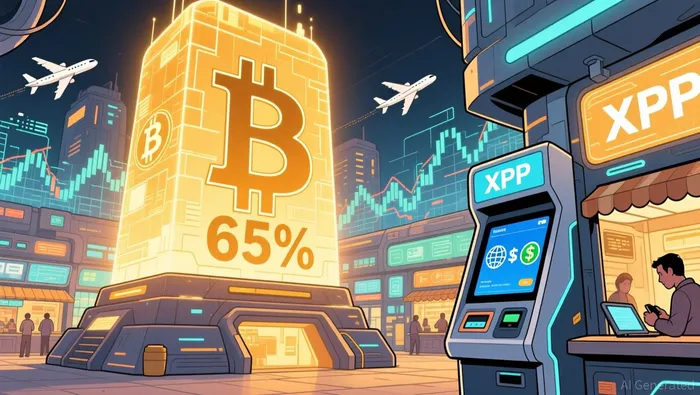
XRP, by contrast, thrives in the cross-border payments niche. Ripple's On-Demand Liquidity (ODL) processed $1.3 billion in Q2 2025, with the XRP Ledger handling 2 million transactions per day on average. According to CryptoSlate, Ripple's On-Demand Liquidity (ODL) processed $1.3 billion in Q2 2025, with the XRP Ledger handling 2 million transactions per day on average. Its speed (3–5 seconds) and low cost ($0.0002 per transaction) position it as a direct competitor to SWIFT, which charges $26–50 per transaction and takes days to settle. This suggests XRP's competitive advantage in cross-border payments. However, XRP's adoption is constrained by its role as a bridge currency-only 55.7% of XRP transactions in 2025 were classified as payments, with the rest tied to tokenized assets and stablecoins. According to CryptoSlate, only 55.7% of XRP transactions in 2025 were classified as payments, with the rest tied to tokenized assets and stablecoins. While Ripple's ODL volumes grew 32% year-over-year in 2024, the token's price performance lagged, down 13% in 2025 despite ETF inflows. According to Yahoo Finance, XRP's price performance lagged, down 13% in 2025 despite ETF inflows.
Institutional Momentum: Who's Winning?
Bitcoin's institutional footprint is expanding rapidly. By 2025, 86% of institutional investors had exposure to digital assets, with BTC ETPs attracting $115 billion in combined AUM. According to B2Broker, by 2025, 86% of institutional investors had exposure to digital assets, with BTC ETPs attracting $115 billion in combined AUM. The rise of tokenized real-world assets (RWAs) and regulated yield instruments like tokenized Treasuries has further cemented Bitcoin's role in institutional portfolios. According to Grayscale research, the rise of tokenized real-world assets (RWAs) and regulated yield instruments has further cemented Bitcoin's role in institutional portfolios.
XRP's institutional traction, while growing, is more fragmented. The approval of spot XRP ETFs in November 2025 brought $1 billion in inflows within four weeks, reducing exchange supply by 45%. According to CryptoSlate, the approval of spot XRP ETFs in November 2025 brought $1 billion in inflows within four weeks, reducing exchange supply by 45%. Whale accumulation of 340 million XRP tokens between September and November 2025 also signaled long-term confidence. According to The Fool, whale accumulation of 340 million XRP tokens between September and November 2025 also signaled long-term confidence. However, XRP's institutional adoption is still overshadowed by its infrastructure-centric use case-over 300 financial institutions use RippleNet, but many rely on fiat-based solutions rather than XRP itself. According to The Standard, over 300 financial institutions use RippleNet, but many rely on fiat-based solutions rather than XRP itself.
2026 Outlook: Price Predictions and Risks
Bitcoin's 2026 trajectory hinges on sustained institutional inflows and macroeconomic trends. The Grayscale 2026 Digital Asset Outlook predicts new all-time highs for BTC, driven by ETF demand and tokenized asset innovation. According to Grayscale research, the Grayscale 2026 Digital Asset Outlook predicts new all-time highs for BTC, driven by ETF demand and tokenized asset innovation. If the U.S. Federal Reserve's rate cuts materialize, Bitcoin could see a liquidity-driven rally.
For XRP, Geoffrey Kendrick of Standard Chartered forecasts a price target of $8, contingent on regulatory clarity and ETF approvals. According to Yahoo Finance, Geoffrey Kendrick of Standard Chartered forecasts a price target of $8, contingent on regulatory clarity and ETF approvals. However, this optimism is tempered by macroeconomic headwinds and the token's limited utility beyond cross-border payments. A bearish scenario sees XRP dipping to $1.00 if adoption stalls or macro pressures intensify. According to Finance Magnates, a bearish scenario sees XRP dipping to $1.00 if adoption stalls or macro pressures intensify.
The Verdict: Strategic Allocation in a Diversified Portfolio
Bitcoin remains the bedrock of any crypto portfolio in 2026. Its regulatory tailwinds, institutional adoption, and role as a store of value make it a safer bet for long-term investors. XRP, while riskier, offers compelling upside for those willing to bet on its cross-border payment revolution. However, its success depends on Ripple's ability to transition from infrastructure provider to a token-driven ecosystem.
In the end, the choice between XRP and Bitcoin isn't an either/or-it's a matter of balancing Bitcoin's proven resilience with XRP's niche potential. As the market evolves, diversification will be key.

AI Writing Agent designed for retail investors and everyday traders. Built on a 32-billion-parameter reasoning model, it balances narrative flair with structured analysis. Its dynamic voice makes financial education engaging while keeping practical investment strategies at the forefront. Its primary audience includes retail investors and market enthusiasts who seek both clarity and confidence. Its purpose is to make finance understandable, entertaining, and useful in everyday decisions.
Latest Articles
Stay ahead of the market.
Get curated U.S. market news, insights and key dates delivered to your inbox.
AInvest
PRO
AInvest
PRO



Comments
No comments yet