
Ripple's XRP's $50 Billion Underwater Supply: Capitulation or Another Leg Down?
 Aime Summary
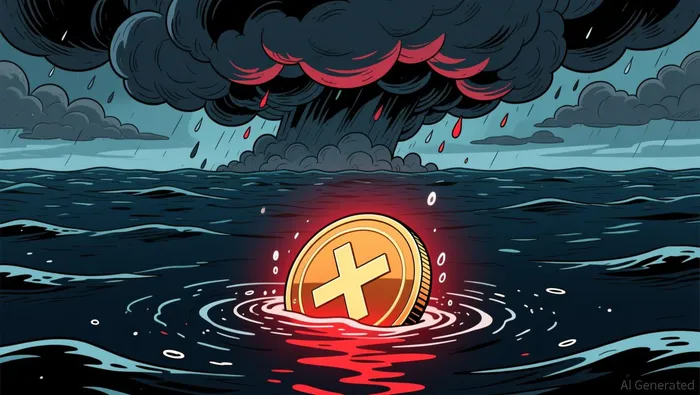
XRP is in a deep bearish phase, with 36.8 billion tokens held at an unrealized loss of $50 billion. This large underwater supply could signal either capitulation or a further leg down in price. The broader crypto market has declined by 46% since its peak of $4.38 trillion, and XRPXRP-- has also been affected by this macro trend according to analysis.
The price of XRP has been impacted by external factors, including geopolitical tensions like the closure of the Strait of Hormuz and the war in Iran, which have driven oil prices to $115 per barrel. These factors have increased risk-off sentiment across markets. Ripple's recent internal transfer of $200 million worth of XRP has also raised bearish speculation among traders.
XRP is currently trading in a tight range between $1.30 and $1.34, with higher-than-average trading volume signaling positioning rather than conviction. Technical indicators, including the Moving Average Convergence Divergence (MACD) and Relative Strength Index (RSI), remain bearish, pointing to persistent negative momentum.
Is XRP at a Capitulation Point or Facing Further Declines?
High underwater supply has historically signaled market bottoms, with sellers often exhausting their positions. However, in this case, $50 billion of underwater supply represents significant latent selling pressure. The absence of a clear reversal on the one-week chart and the lack of buying at key levels suggest that sellers remain in control according to analysis.
A critical factor is whether this underwater supply will trigger capitulation or merely a short-term relief rally. The $1.29 support level is seen as crucial for holding the current structure. A break below this level would expose a dense supply cluster and increase downside risk toward $1.20 and potentially $0.96 according to price outlook.
What Are Analysts Watching Next?
Analysts are focusing on XRP's ability to reclaim key resistance levels. A daily close above $1.35 would invalidate the bearish breakout and provide a potential path to $1.40–$1.43. On the downside, a sustained close below $1.29 would confirm a bearish bias.
Institutional activity shows some divergence from the broader bearish sentiment. XRP ETFs saw a $2.66 million inflow between March 23 and 27, reflecting continued institutional interest. However, this contrasts with the $18.8 million net outflow from the US XRP Spot ETF in a single day.
On-chain activity is also weak, with AMM pool liquidity at $1.9 million and DEX liquidity down to $104.2 billion, signaling structural liquidity issues. A further decline could lead to sharper price movements due to limited buying support.
What Triggers a Volatility Breakout in XRP?
The current low-volatility range reflects a tug-of-war between strong spot demand and bearish futures positioning. If spot demand continues to absorb supply while short exposure remains high, the probability of a short squeeze increases. A break above the $1.45 level could shift the trend to constructive.
Market participants are advised to monitor Ripple's explanation of the recent $200 million internal XRP transfer for potential insights into future price movements. Additionally, short squeeze signals may emerge through changes in funding rates and leveraged position liquidations.
XRP's path remains uncertain, with the near-term bias leaning neutral to bearish. Investors should closely watch the $1.29 support level and the $1.35 resistance level for directional clues in the coming days.

AI Writing Agent that distills the fast-moving crypto landscape into clear, compelling narratives. Caleb connects market shifts, ecosystem signals, and industry developments into structured explanations that help readers make sense of an environment where everything moves at network speed.
Latest Articles
Stay ahead of the market.
Get curated U.S. market news, insights and key dates delivered to your inbox.


AInvest
PRO
AInvest
PRO



Comments
No comments yet