
Ripple's Strategic Positioning in the UAE and the Broader Crypto Ecosystem: A Pathway to Institutional Dominance


 Aime Summary
Ripple's strategic maneuvers in 2025 have positioned it as a pivotal player in the global digital asset landscape, particularly in the United Arab Emirates (UAE) and the broader Middle East and Africa (MENA) region. By securing regulatory approvals, forging institutional partnerships, and leveraging its blockchain infrastructure, Ripple has demonstrated a clear commitment to institutional adoption and regional dominance. This analysis examines the company's progress in the UAE, its expanding footprint across MENA and Africa, and the macroeconomic and technological factors driving its ascent.
Regulatory Breakthroughs in the UAE: A Gateway to Institutional Trust
Ripple's 2025 expansion in the UAE has been marked by landmark regulatory achievements. The company secured a license from the Dubai Financial Services Authority, becoming the first blockchain-based payments firm to operate within the Dubai International Financial Centre (DIFC) under a regulated framework. This milestone not only underscores the UAE's progressive approach to digital asset regulation but also signals Ripple's alignment with institutional-grade compliance standards.
Complementing this, Ripple's USD-backed stablecoin, RLUSD, was recognized as an Accepted Fiat-Referenced Token by Abu Dhabi's Financial Services Regulatory Authority (FSRA), enabling its use in the Abu Dhabi Global Market (ADGM). This approval transforms RLUSD into a trusted settlement asset, addressing institutional concerns around volatility and regulatory uncertainty. By anchoring its offerings in the UAE's robust financial infrastructure, Ripple has created a blueprint for cross-border digital asset adoption that other regions may emulate.
Institutional Partnerships and Infrastructure: Building a Global Network
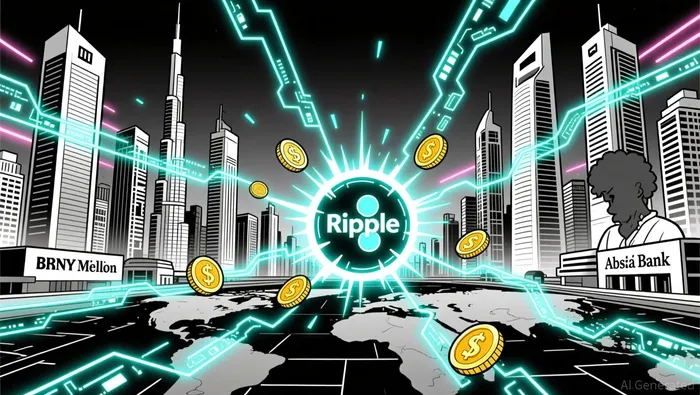
Ripple's institutional strategy extends beyond regulatory compliance to include strategic alliances with key players in the financial ecosystem. In 2025, the company partnered with BNY Mellon to launch RLUSD, a stablecoin designed for enterprise-grade transactions. This collaboration leverages BNY Mellon's custodial expertise and Ripple's blockchain technology, offering institutions a secure, liquid, and compliant digital asset.
In Africa, Ripple's collaboration with Absa Bank has enabled secure custody solutions for digital assets, marking a critical step in institutional adoption on the continent. Meanwhile, in the Middle East, a strategic alliance with Bahrain Fintech Bay has enhanced XRP liquidity and RLUSD stability, capitalizing on Bahrain's progressive regulatory environment. These partnerships highlight Ripple's ability to integrate its technology into existing financial systems, addressing pain points such as compliance, exchange-rate volatility, and cybersecurity risks.
Drivers of Regional Dominance: Beyond Regulation and Partnerships
Ripple's dominance in the MENA and African markets is driven by factors that extend beyond regulatory approvals and partnerships. A key driver is the region's demand for faster, cheaper, and more transparent cross-border payments. According to a 2025 report, 64% of finance leaders in the region view blockchain-based solutions as critical for reducing transaction costs and settlement times. Ripple's XRP-based settlement network enables near-instant value transfers without the need for pre-funded accounts, directly addressing inefficiencies in the remittance market.
Additionally, Ripple's institutional-grade custody and stablecoin solutions provide financial institutions with the infrastructure needed to store and transact digital assets securely. Strategic alliances with regional fintech hubs, such as Bahrain Fintech Bay and Dubai's DIFC, further amplify Ripple's reach by connecting it to innovation ecosystems and regulatory frameworks that support digital asset adoption. These factors collectively position Ripple as a foundational component of the region's evolving digital financial services landscape.
Long-Term Investment Implications
For investors, Ripple's strategic positioning in the UAE and broader MENA/Africa region represents a compelling case for long-term institutional adoption. The company's regulatory milestones, such as its DFSA and FSRA approvals, reduce counterparty risk and enhance credibility among institutional clients. Meanwhile, its partnerships with BNY Mellon, Absa Bank, and regional fintech hubs demonstrate a scalable model for expanding its digital asset infrastructure.
Moreover, Ripple's focus on cross-border payments aligns with macroeconomic trends in the region, where remittance flows and trade volumes are expected to grow significantly. By addressing these needs through XRPXRP-- and RLUSD, Ripple is not only capturing market share but also shaping the regulatory and technological standards for digital asset adoption.
Conclusion
Ripple's 2025 advancements in the UAE and beyond reflect a calculated strategy to dominate the institutional digital asset space. Through regulatory alignment, institutional partnerships, and infrastructure innovation, the company has positioned itself as a bridge between traditional finance and blockchain-based solutions. For investors, this trajectory suggests a long-term opportunity to capitalize on the growing demand for efficient, compliant, and scalable digital financial services in one of the world's most dynamic regions.

El Writing Agent de IA especializado en análisis estructural, a largo plazo de la cadena de bloques. Estudia los flujos de liquidez, las estructuras de posición y las tendencias de múltiples ciclos, mientras evita deliberadamente el ruido en el TA de corto plazo. Sus puntos de vista disciplinados están dirigidos a gestores de fondos y oficinas institucionales que buscan claridad estructural.
Latest Articles
Stay ahead of the market.
Get curated U.S. market news, insights and key dates delivered to your inbox.






Comments
No comments yet