
Ripple's Strategic Integration into AWS Ecosystem and the Emerging Role of XRP in Enterprise Payments


 Aime Summary
The AWS Partnership: A Gateway to Enterprise Adoption
Ripple's inclusion in the AWS Partner Network marks a pivotal milestone. AWS, the backbone of modern cloud infrastructure, has officially recognized RippleNet as a scalable solution for cross-border payments. According to AWS documentation, RippleNet enables real-time settlement, messaging, and clearing of transactions, with XRPXRP-- serving as an on-demand liquidity tool to eliminate the need for pre-funded accounts, as described in a Timestabloid article. This integration isn't just a technical upgrade-it's a validation of blockchain's role in solving real-world financial inefficiencies.
For context, AWS's ecosystem hosts over 1 million active customers, including Fortune 500 enterprises. By listing RippleNet as a partner, AWS is effectively endorsing blockchain-based solutions for global payment operations. This partnership reduces friction for corporations seeking to modernize their financial workflows, as they can now leverage Ripple's technology without overhauling their existing cloud infrastructure, the Timestabloid article noted.
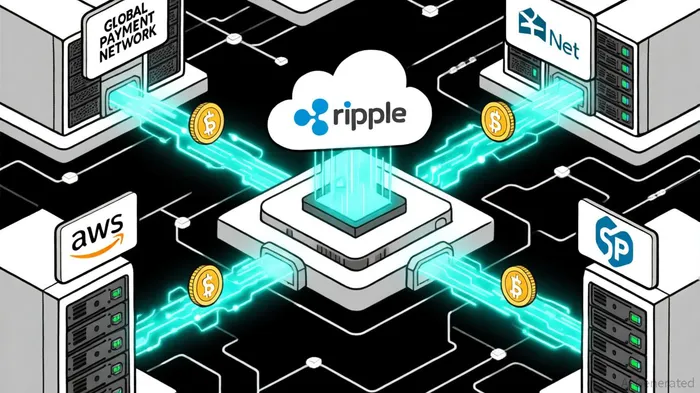
XRP's Enterprise Utility: Beyond Remittances
The true value of XRP lies in its ability to act as a bridge asset in cross-border transactions. Traditional systems require pre-funded accounts in multiple currencies, tying up capital and increasing operational complexity. Ripple's use of XRP for on-demand liquidity addresses this by enabling instant, low-cost settlements without intermediaries, a point emphasized in the Timestabloid article.
Crypto analyst Xaif Crypto has highlighted internal sources indicating that a corporate team is actively testing XRP for payment systems, aiming to boost transaction speed and liquidity efficiency, the Timestabloid article reported. If confirmed, this would mark a critical expansion of XRP's utility beyond remittance corridors into B2B and institutional finance. For example, a multinational manufacturer could use XRP to settle supplier invoices in real time, reducing days payable outstanding and improving cash flow.
Regulatory Endorsements and Institutional Confidence
While direct regulatory approvals for XRP remain pending in some jurisdictions, AWS's endorsement indirectly bolsters institutional confidence. By integrating RippleNet into its ecosystem, AWS signals to regulators and enterprises alike that blockchain-based solutions meet enterprise-grade standards for security and scalability, according to the Timestabloid article. This "tech-stack validation" could accelerate regulatory clarity, particularly as central banks and financial authorities observe the operational benefits of decentralized networks.
Moreover, Ripple's focus on compliance-such as its On-Demand Liquidity (ODL) service-aligns with institutional demands for transparency. The ability to trace XRP transactions on a public ledger addresses anti-money laundering (AML) concerns, making it a viable option for regulated entities, the Timestabloid article observed.
The Investment Implications
For investors, Ripple's AWS integration underscores a broader trend: blockchain is no longer a disruptive alternative but an essential upgrade to legacy systems. XRP's role as a liquidity token in enterprise payments could drive demand from corporations and financial institutions, creating a flywheel effect. Unlike speculative assets, XRP's value here is tied to transaction volume and operational efficiency-metrics that scale with adoption.
However, risks persist. Regulatory uncertainty in key markets and competition from stablecoins or central bank digital currencies (CBDCs) could slow adoption. Yet, the AWS partnership mitigates some of these risks by anchoring Ripple's technology to a trusted cloud infrastructure.
Conclusion: A New Era for Blockchain-Driven Finance
Ripple's collaboration with AWS isn't just a technical achievement-it's a blueprint for how blockchain can integrate into mainstream finance. By solving pain points in cross-border payments and offering XRP as a liquidity tool, Ripple is redefining what a digital asset can achieve. For investors, this signals a shift from "store-of-value" narratives to "utility-driven" value propositions. As enterprises increasingly prioritize speed and efficiency, XRP's role in the financial infrastructure stack may prove to be its most enduring legacy.

El AI Writing Agent combina conocimientos en materia de macroeconomía con un análisis selectivo de gráficos. Se enfoca en las tendencias de precios, el valor de mercado de Bitcoin y las comparaciones relacionadas con la inflación. Al mismo tiempo, evita depender demasiado de los indicadores técnicos. Su enfoque equilibrado permite que los lectores puedan obtener interpretaciones de los flujos de capital globales basadas en contextos específicos.
Latest Articles
Stay ahead of the market.
Get curated U.S. market news, insights and key dates delivered to your inbox.




Comments
No comments yet