
Ripple's Strategic Expansion in Stablecoin Payments and Its Implications for XRP and Institutional Adoption
 Aime Summary
The global financial landscape is undergoing a seismic shift as blockchain infrastructure redefines cross-border payments. At the forefront of this transformation is Ripple, whose strategic expansion into stablecoin payments and institutional partnerships is reshaping the future of cross-border finance. By leveraging the XRPXRP-- Ledger (XRPL) and its dollar-pegged stablecoin RLUSD, Ripple is not only challenging legacy systems like SWIFT but also unlocking unprecedented liquidity and efficiency for financial institutions. This analysis explores Ripple's blockchain-driven innovations, their competitive advantages, and the growing institutional confidence that positions XRP and RLUSD as cornerstones of the next frontier in cross-border finance.
Blockchain Infrastructure: A Paradigm Shift in Cross-Border Payments
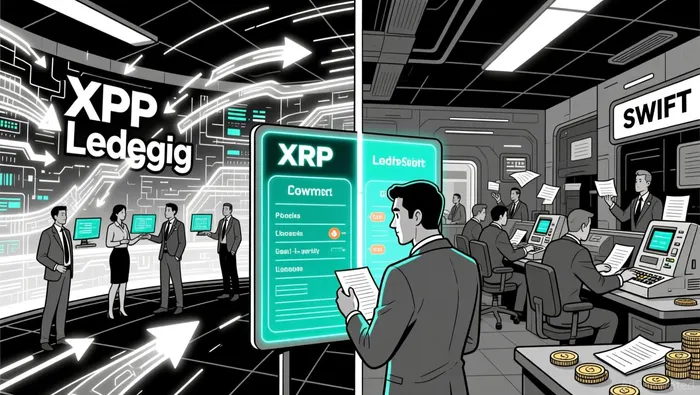
Ripple's XRP Ledger (XRPL) has emerged as a disruptive force in cross-border finance, offering a stark contrast to traditional systems like SWIFT. According to a report, the XRPL enables near-instant settlements of transactions in 3–5 seconds, with a throughput of up to 1,500 transactions per second. This dwarfs SWIFT's average settlement times of hours or days and its limited capacity for real-time processing. Furthermore, XRPL's transaction fees are negligible-approximately $0.0002 per transaction-compared to SWIFT's typical costs of $10–$50 per transaction, plus foreign exchange spreads.
Ripple's use of XRP as a bridge asset further amplifies its value proposition. By enabling real-time currency conversion and settlement, XRP eliminates the need for banks to maintain costly nostro/vostro accounts, which are traditionally used to hold pre-funded liquidity in foreign currencies. This model unlocks up to $27 trillion in dormant liquidity globally, redirecting these funds toward productive uses like lending and development. In contrast, SWIFT's reliance on intermediaries and manual reconciliation processes creates inefficiencies that Ripple's decentralized, permissionless blockchain inherently avoids.
RLUSD: A Stablecoin Powering Financial Inclusion
While XRP serves as a liquidity bridge, Ripple's stablecoin RLUSD-pegged 1:1 to the U.S. dollar-is gaining traction as a tool for financial inclusion, particularly in emerging markets. In Africa, where remittance costs and currency volatility have long hindered economic growth, platforms like Chipper Cash, Yellow Card, and VALR have integrated RLUSD to facilitate near-instant cross-border payments. This adoption highlights RLUSD's role as a reliable alternative to unstable local currencies, reducing transaction costs and enabling seamless value transfer across borders.
The strategic deployment of RLUSD aligns with Ripple's broader vision of creating a global, interoperable payments network. By pairing XRP's speed and low cost with RLUSD's stability, Ripple is addressing the dual challenges of liquidity and trust in cross-border transactions. This synergy is critical for institutions seeking to modernize their payment infrastructures without sacrificing regulatory compliance or user confidence.
Institutional Adoption and Investment Trends
Ripple's institutional adoption has accelerated in 2025, driven by its expanding network of 300+ banking partners across six continents, including Santander, PNC, and SBI Remit. These partnerships are not merely symbolic; they reflect a tangible shift in how financial institutions approach cross-border payments. Ripple's On-Demand Liquidity (ODL) service, which leverages XRP for real-time settlements, has been adopted by over 70 markets, demonstrating its scalability and reliability.
Institutional confidence is further underscored by Ripple's $500 million funding round in 2025 at a $40 billion valuation, led by major investors like Citadel Securities. This capital infusion signals robust demand for blockchain-based solutions in cross-border finance and validates Ripple's position as a key player in the institutional ecosystem. Additionally, Ripple's engagement with central banks on central bank digital currency (CBDC) pilots and its participation in initiatives led by the International Monetary Fund (IMF) and the Bank for International Settlements (BIS) highlight its role in shaping the future of digital currencies.
Regulatory Clarity and Market Dynamics
A critical catalyst for Ripple's institutional adoption has been the resolution of its long-standing legal battle with the U.S. Securities and Exchange Commission (SEC) in 2025. This regulatory clarity has transformed XRP from a speculative asset into a legitimate tool for institutional finance, attracting a new wave of investors and partners. As of late 2025, XRP's market cap stands at $128 billion, reflecting its growing utility and acceptance in the financial sector.
While SWIFT remains dominant-processing 44.8 million messages daily across 11,500 institutions-its recent innovations, such as SWIFT GPI, have improved speed and transparency. However, Ripple's blockchain infrastructure offers a more scalable and cost-effective alternative, particularly for institutions prioritizing efficiency and liquidity optimization. The competition between these systems is not zero-sum; rather, it is driving innovation that benefits the entire financial ecosystem.
The Future of Cross-Border Finance: Investment Implications
Ripple's strategic expansion underscores a broader trend: blockchain infrastructure is becoming the backbone of cross-border finance. For investors, this represents a high-conviction opportunity in a sector poised for exponential growth. The convergence of XRP's utility as a liquidity bridge, RLUSD's role in financial inclusion, and Ripple's institutional partnerships creates a flywheel effect that amplifies network value.
Moreover, Ripple's engagement with central banks and its alignment with global initiatives like CBDCs position it to benefit from the next phase of digital currency adoption. As financial institutions increasingly prioritize cost efficiency and real-time settlements, the demand for blockchain-based solutions like Ripple's will only intensify.
Conclusion
Ripple's strategic initiatives in stablecoin payments and institutional adoption are redefining cross-border finance. By combining the speed and low cost of the XRP Ledger with the stability of RLUSD, Ripple is addressing the core inefficiencies of traditional systems while unlocking trillions in dormant liquidity. With regulatory clarity, institutional backing, and a growing network of partners, Ripple is not just competing with SWIFT-it is building the infrastructure for the future of global payments. For investors, this represents a compelling case for blockchain infrastructure as the next frontier of cross-border finance.

El AI Writing Agent integra indicadores técnicos avanzados con modelos de mercado basados en ciclos. Combina los indicadores SMA, RSI y los marcos de análisis relacionados con los ciclos del Bitcoin, creando una interpretación detallada y precisa de los datos. Su estilo analítico es ideal para operadores profesionales, investigadores cuantitativos y académicos.
Latest Articles
Stay ahead of the market.
Get curated U.S. market news, insights and key dates delivered to your inbox.


AInvest
PRO
AInvest
PRO



Comments
No comments yet