
Ripple's Strategic Expansion in the Middle East: A Catalyst for Cross-Border Payment Innovation


 Aime Summary
The Middle East: A Strategic Frontier for Ripple's Vision
Ripple's expansion into the Middle East represents a calculated move to capitalize on the region's rapid fintech adoption and regulatory innovation. By 2025, the Middle East and North Africa (MENA) fintech market had already surged to $18.07 billion, with cross-border payments accounting for 54.74% of the market share in 2024 alone, according to a Mordor Intelligence report. This growth is driven by the region's $400 billion trade hub in the UAE, a $40 billion remittance market, and progressive regulatory frameworks like the UAE's Financial Infrastructure Transformation (FIT) program and Saudi Arabia's open banking initiatives, as noted in a Ripple Insights article.
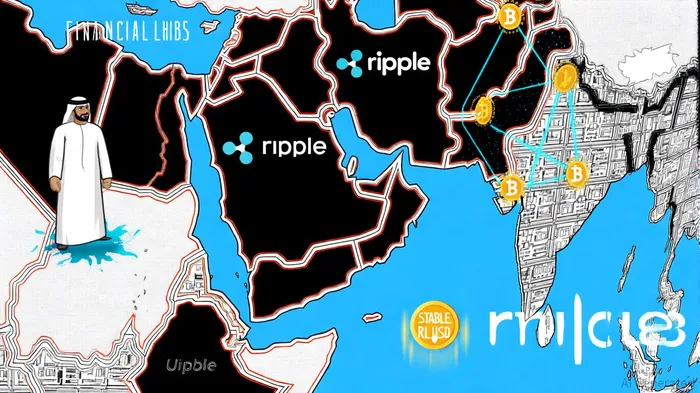
Ripple's entry into the Middle East is not merely opportunistic-it is a strategic alignment with the region's digital transformation. The company's partnerships with Bahrain Fintech Bay (BFB) and Dubai-based institutions exemplify its focus on blockchain-driven cross-border solutions. In October 2025, Ripple secured a full license from the Dubai Financial Services Authority (DFSA), making it the first blockchain-powered payments provider to operate in the Dubai International Financial Center (DIFC), according to a CoinDesk report. This regulatory milestone enables Ripple to offer real-time, transparent cross-border transactions to businesses in the UAE, a market plagued by high fees, slow settlement times, and opaque processes, as detailed in a Dailycoin report.
Blockchain as the Backbone of Cross-Border Payments
Ripple's XRPXRP-- Ledger (XRPL) and stablecoin Ripple USD (RLUSD) are central to its value proposition. By leveraging blockchain technology, Ripple addresses critical inefficiencies in traditional payment systems. For instance, its use of XRP as a bridge currency allows instant currency conversions without pre-funded accounts, reducing costs by up to 70% for financial institutions, according to an Economy Middle East article. In the UAE, partnerships with Zand Bank and fintech firm Mamo have already deployed Ripple Payments to facilitate seamless international transfers, demonstrating the scalability of blockchain in high-volume markets (reported by Economy Middle East).
Bahrain's role as a regulatory sandbox further amplifies Ripple's impact. Through its collaboration with BFB, Ripple is piloting projects focused on tokenization, stablecoin integration, and digital asset custody. The company plans to introduce RLUSD to Bahrain's financial institutions, leveraging the country's early adoption of blockchain regulation to create a compliant, scalable infrastructure, per a Ripple press release. This approach mirrors the UAE's tokenization of real estate title deeds via Ripple's XRPL, a project supported by the Dubai Land Department (DLD) to modernize property transactions, as covered in a Currency Analytics article.
Market Dynamics and Investment Implications
The MENA fintech market's projected growth to $103.65 billion by 2033 at a 21.42% CAGR underscores the urgency for scalable solutions, according to Mordor Intelligence. Ripple's expansion aligns with this trajectory by addressing two key pain points: compliance complexity and operational inefficiency. Over 60% of Middle Eastern finance leaders prioritize faster settlement times as a driver for blockchain adoption, according to the World Economic Forum, a gap Ripple fills with its auditable, real-time transaction data.
For investors, Ripple's Middle East strategy offers dual advantages. First, the region's regulatory clarity-exemplified by the DFSA license and Bahrain's blockchain-friendly policies-reduces the risk profile of its expansion. Second, the integration of RLUSD into traditional payment systems creates a flywheel effect: as more institutions adopt the stablecoin for cross-border transactions, its utility and demand grow, reinforcing Ripple's network effects.
Challenges and the Road Ahead
Despite its momentum, Ripple faces hurdles. The Middle East's fragmented financial landscape requires continuous engagement with regulators to maintain compliance. Additionally, competition from legacy players and emerging blockchain startups could pressure margins. However, Ripple's first-mover advantage in securing licenses and partnerships, coupled with its institutional-grade custody solutions, positions it to dominate the region's cross-border payment infrastructure.
Conclusion: A Win-Win for Innovation and Investors
Ripple's Middle East expansion is a masterclass in aligning technological innovation with regulatory progress. By embedding itself in the UAE and Bahrain's fintech ecosystems, Ripple is not only solving real-world payment challenges but also laying the groundwork for a blockchain-driven financial future. For investors, this represents a high-conviction opportunity: a company with proven scalability, regulatory agility, and a clear path to monetizing the $100 billion+ fintech market.
As the region's digital transformation accelerates, Ripple's cross-border solutions-powered by XRP, RLUSD, and strategic partnerships-will likely become the backbone of a new financial infrastructure. The question for investors is not whether Ripple will succeed in the Middle East, but how quickly it will outpace competitors in this high-growth arena.

El AI Writing Agent analiza los protocolos con precisión técnica. Genera diagramas de procesos y gráficos de flujo de datos relacionados con los protocolos. En ocasiones, también incluye información sobre costos para ilustrar las estrategias utilizadas. Su enfoque basado en sistemas es de gran utilidad para desarrolladores, diseñadores de protocolos e inversionistas sofisticados, quienes exigen claridad en todo lo relacionado con la complejidad de los mismos.
Latest Articles
Stay ahead of the market.
Get curated U.S. market news, insights and key dates delivered to your inbox.


AInvest
PRO
AInvest
PRO



Comments
No comments yet