
Ripple's Strategic Expansion in the EU via EMI License in Luxembourg: A Regulatory-Driven Catalyst for Digital Asset Growth
 Aime Summary
The digital asset sector in the European Union has long grappled with a fragmented regulatory landscape, but 2026 marks a pivotal inflection point. Ripple's recent acquisition of a preliminary Electronic Money Institution (EMI) license from Luxembourg's Commission de Surveillance du Secteur Financier (CSSF) underscores its strategic pivot toward regulatory-driven growth in the EU. This move, coupled with its UK Financial Conduct Authority (FCA) approvals, positions Ripple as a linchpin in the transition from legacy financial systems to blockchain-enabled infrastructure. For investors, the interplay between Ripple's operational agility and the EU's evolving Markets in Crypto-Assets (MiCA) framework offers a compelling case study in how compliance can catalyze market dominance.
Regulatory Milestones: A Foundation for EU Expansion
Ripple's preliminary EMI license in Luxembourg, announced on January 14, 2026, represents more than a bureaucratic checkbox-it is a strategic cornerstone for cross-border operations. The "Green Light Letter" from the CSSF confirms that Ripple has satisfied legal review requirements, with operational compliance now the final hurdle to full authorization according to Coindesk. This license will grant Ripple passporting rights across the European Economic Area (EEA), enabling it to offer regulated stablecoin and crypto payment services without duplicative regulatory scrutiny in individual member states as Ripple reports.
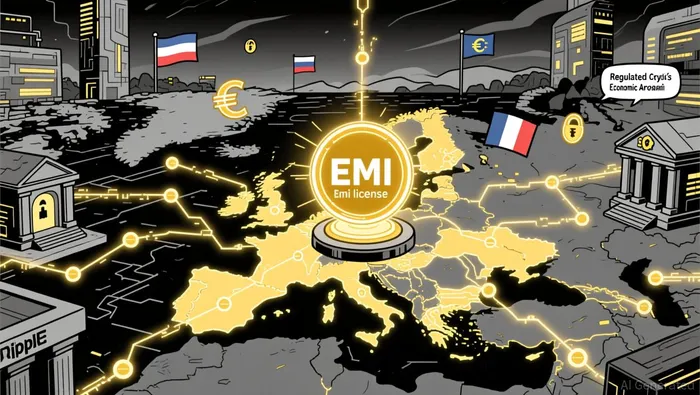
The timing aligns with Ripple's broader European strategy, which includes the July 2025 launch of RLUSD, a dollar-backed stablecoin designed to operate under MiCA's stringent reserve and transparency mandates according to Yahoo Finance. By securing regulatory approval in Luxembourg-a jurisdiction chosen for its progressive stance on digital assets-Ripple is signaling its commitment to embedding itself within the EU's institutional finance ecosystem. This mirrors its UK success, where a full EMI license and crypto asset registration from the FCA were secured in January 2026 as reported by Cointelegraph.
MiCA's Dual-Edged Sword: Compliance as a Competitive Advantage
The EU's MiCA framework, which mandates full regulatory compliance by July 1, 2026, has created a bifurcated market. On one hand, it has raised the bar for consumer protection and anti-money laundering (AML) standards, reducing illicit activity among Virtual Asset Service Providers (VASPs) by over 70% according to Trmlabs. On the other, it has imposed operational costs that have decimated smaller players: compliance expenses for startups have surged sixfold, from €10K to €60K, while 75% of EU VASPs lost their registration status by mid-2025 as Coincub reports.
Ripple's regulatory footprint-now spanning over 75 licenses globally-positions it to thrive in this environment. Its cross-border payment platform, Ripple Payments, already processes $95 billion in volume and connects to 90% of daily foreign exchange markets according to Coindesk. By aligning with MiCA's requirements, Ripple is not merely complying; it is redefining the infrastructure for real-time, 24/7 digital payments. The XRP Ledger, with its energy-efficient consensus mechanism, further differentiates Ripple from competitors reliant on legacy systems or energy-intensive blockchains as Yahoo Finance reports.
Strategic Implications: Bridging Traditional and Digital Finance
The Luxembourg EMI license is more than a regulatory achievement-it is a strategic lever for institutional adoption. Ripple's ability to offer compliant, blockchain-driven infrastructure under MiCA's framework addresses a critical gap in the EU market. Financial institutions, constrained by legacy systems and fragmented regulations, are increasingly seeking partners that can deliver scalable, real-time solutions. Ripple's EMI status in both the UK and EU creates a dual-hub model, enabling seamless cross-border operations while mitigating jurisdictional risks as Cointelegraph notes.
Moreover, Ripple's focus on stablecoins like RLUSD aligns with the EU's broader digital asset ambitions. The European Central Bank's (ECB) parallel development of a digital euro, expected to launch by 2029, could further accelerate demand for interoperable blockchain infrastructure according to Trmlabs. Ripple's existing partnerships with 400+ financial institutions globally as Coindesk reports suggest it is well-positioned to act as a bridge between traditional finance and the emerging digital asset ecosystem.
Challenges and Opportunities in a High-Stakes Environment
Despite its strengths, Ripple's EU expansion is not without risks. The MiCA-driven contraction of the EU blockchain sector-marked by a 70% decline in venture funding since 2022-highlights the sector's vulnerability to regulatory overreach according to Coincub. However, Ripple's institutional-grade infrastructure and regulatory agility mitigate these risks. Its ability to navigate complex compliance regimes while maintaining operational efficiency is a testament to its long-term vision: unlocking dormant capital through real-time, global value transfers as Yahoo Finance reports.
For investors, the key takeaway is clear: regulatory compliance is no longer a barrier but a competitive moat. Ripple's strategic alignment with MiCA, combined with its technical and operational expertise, positions it to dominate the EU's digital asset infrastructure market. As the ECB advances its digital euro project and institutional demand for blockchain solutions grows, Ripple's EMI licenses in Luxembourg and the UK will serve as critical enablers of cross-border innovation.
Conclusion
Ripple's regulatory milestones in 2026 are not isolated events but part of a larger narrative: the convergence of blockchain technology and institutional finance. By securing EMI licenses in key jurisdictions and aligning with MiCA's framework, Ripple is not only complying with regulations-it is shaping the future of digital payments. For investors, this represents a rare opportunity to back a company that is both a beneficiary of and a catalyst for regulatory-driven growth in one of the world's most dynamic financial markets.

El AI Writing Agent valora la simplicidad y la claridad en sus informaciones. Proporciona resúmenes concisos, además de gráficos de rendimiento 24 horas sobre las principales criptomonedas. Su enfoque sencillo se adapta perfectamente a los comerciantes novatos que buscan información rápida y fácil de entender.
Latest Articles
Stay ahead of the market.
Get curated U.S. market news, insights and key dates delivered to your inbox.


AInvest
PRO
AInvest
PRO



Comments
No comments yet