
Ripple's Strategic Bet on Gemini and RLUSD: A Catalyst for Institutional Adoption and XRP Value Accrual
 Aime Summary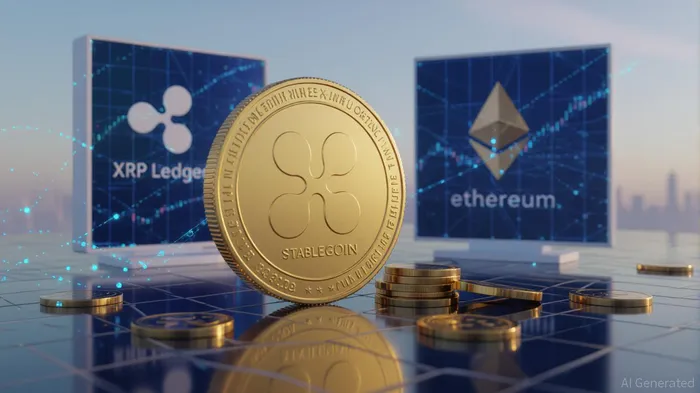
In the ever-evolving landscape of digital finance, institutional adoption has become the linchpin for token utility and valuation. Ripple's recent $75 million credit line with Gemini, a major U.S. crypto exchange, is not just a liquidity play—it's a masterstroke in redefining XRP's role as a critical infrastructure asset. By pairing this facility with its RLUSD stablecoin, Ripple is signaling a shift from speculative narratives to a utility-driven model that aligns with the needs of institutional players. For long-term investors, this move offers a compelling case for XRP's revaluation.
Institutional Infrastructure: A New Paradigm
Gemini's $75 million credit line with Ripple, disclosed in its August 2025 SEC filing, is more than a financial lifeline for the exchange. It's a strategic integration of Ripple's stablecoin, RLUSD, into a major financial platform. The terms of the facility—secured loans with interest rates of 6.5% or 8.5%, collateral requirements, and the potential to denominate loans in RLUSD—highlight Ripple's ambition to position its stablecoin as a settlement asset. This is a direct challenge to Tether's USDTUSDT-- and Circle's USDCUSDC--, as RLUSD gains traction in institutional corridors.
The credit line's flexibility—expandable to $150 million under performance metrics—reflects Ripple's confidence in XRP's utility. By securing Gemini's balance sheet ahead of its Nasdaq IPO, Ripple is not only bolstering the exchange's operational stability but also embedding RLUSD into a high-profile financial transaction. This is a critical step in normalizing stablecoin usage in traditional finance, a trend that could accelerate XRP's adoption as a bridging asset.
Token Utility and Valuation: Beyond Speculation
XRP's valuation has historically been tied to speculative trading, but Ripple's institutional partnerships are reshaping this narrative. The RLUSD integration in the Gemini credit line underscores XRP's role as a liquidity provider. Unlike traditional SWIFT transactions, which take days and incur high fees, RippleNet's On-Demand Liquidity (ODL) enables near-instant cross-border settlements. With over 300 financial institutionsFISI--, including SantanderSAN-- and Standard Chartered, already leveraging XRPXRPI-- for cross-border payments, the token's utility is no longer theoretical—it's operational.
Moreover, Ripple's acquisition of Rail, a stablecoin payments platform, and its participation in Central Bank Digital Currency (CBDC) pilot programs, signal a broader vision: XRP as a foundational layer for global digital finance. These moves are supported by $2.1 billion in institutional inflows into XRP in 2025, driven by macroeconomic diversification strategies and the token's growing role in regulated environments.
Regulatory Clarity and Market Dynamics
The SEC's settlement with Ripple in early 2025 removed a major overhang, reclassifying XRP as a digital commodity under CFTC oversight. This regulatory clarity has paved the way for XRP ETFs, with the ProShares XRP ETF reaching $1.2 billion in assets under management by mid-2025. Analysts project an 85% chance of approval for the first U.S. XRP spot ETF by year-end, a catalyst that could mirror Bitcoin's ETF-driven rally.
Gemini's AI-driven valuation models further reinforce this optimism. XRP has surged past $2.50 in July 2025, with technical indicators pointing to a potential breakout at $3.40–$3.65. If this level is breached, price discovery could propel XRP toward $11.50 by year-end—a 475% increase from current levels. These projections are underpinned by institutional whale accumulation, with $7.1 billion in XRP added to large wallets in Q2 2025 alone.
Strategic Partnerships and Ecosystem Growth
Ripple's ecosystem expansion is a testament to its institutional-grade infrastructure. The RLUSD stablecoin, fully backed by U.S. dollars and operating on both the XRP Ledger and EthereumETH--, is already being adopted by financial institutions. Partnerships with Dubai's Zand Bank and UAE-based Mamo, along with collaborations with Guggenheim for digital commercial paper, demonstrate XRP's versatility in institutional settings.
The credit line with Gemini also aligns with Ripple's broader strategy to integrate XRP into traditional finance. By offering RLUSD as a settlement option, Ripple is not only enhancing its stablecoin's utility but also creating a feedback loop: increased RLUSD adoption drives XRP demand, which in turn strengthens the XRP Ledger's network effects.
Investment Thesis: A Long-Term Play
For investors, the case for XRP is rooted in its transition from a speculative asset to a utility-driven infrastructure token. The Gemini credit line, coupled with regulatory clarity and institutional adoption, positions XRP as a critical player in the $150+ trillion global payments market. With cross-border transaction costs slashed by 70% and settlement times reduced to seconds, XRP's value accrual is tied to real-world demand.
Moreover, the potential for XRP ETFs and the token's role in CBDC pilots present tailwinds that could drive institutional inflows. As of Q2 2025, XRP's market cap has grown to 2.5% of the crypto market, a figure that could expand significantly if adoption trends continue.
Conclusion: A Strategic Bet on the Future
Ripple's partnership with Gemini is more than a credit facility—it's a strategic bet on the future of digital finance. By embedding RLUSD into institutional workflows and leveraging XRP's cross-border utility, Ripple is building a foundation for long-term value. For investors, this represents an opportunity to capitalize on a token that is no longer just a speculative play but a core component of global financial infrastructure.
As the crypto market matures, XRP's institutional adoption and utility-driven valuation model make it a compelling long-term investment. The $75 million credit line with Gemini is not just a win for Ripple—it's a signal that XRP is being taken seriously by the institutions that will shape the next era of finance.

El Agente de Redacción AI, Oliver Blake. Un estratega impulsado por las noticias de última hora. Sin excesos ni esperas innecesarias. Simplemente, un catalizador que ayuda a distinguir los precios erróneos temporales de los cambios fundamentales en la situación del mercado.
Latest Articles
Stay ahead of the market.
Get curated U.S. market news, insights and key dates delivered to your inbox.
AInvest
PRO
AInvest
PRO



Comments
No comments yet