
Ripple’s RLUSD Platform: A Game-Changer for Cross-Border Payments and XRP’s Strategic Role


 Aime Summary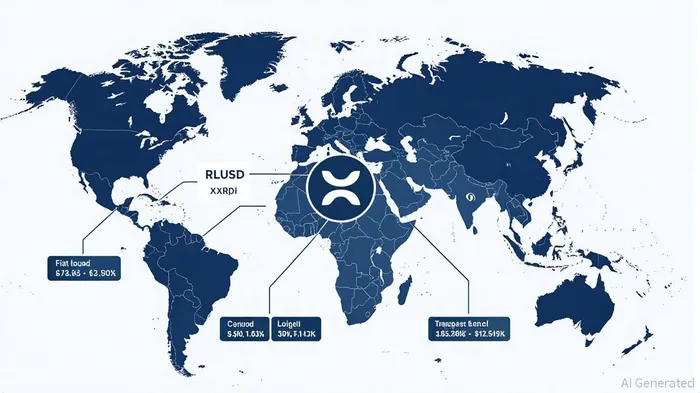
In the evolving landscape of global finance, Ripple’s RLUSD stablecoin and XRPXRP-- have emerged as transformative forces, redefining cross-border payments and institutional blockchain adoption. By leveraging a hybrid infrastructure that bridges traditional finance and decentralized ecosystems, Ripple has positioned itself as a critical player in the fintech sector, offering enterprises a scalable, cost-efficient, and regulatory-compliant solution.
The RLUSD Platform: A New Paradigm for Cross-Border Payments
Ripple’s RLUSD stablecoin, pegged 1:1 to the U.S. dollar, serves as the backbone of its payments platform, enabling real-time transactions across 50 countries. Unlike legacy systems like SWIFT, which rely on intermediaries and take days to settle, RLUSD leverages the XRP Ledger (XRPL) to facilitate instant conversions between fiat and digital currencies. For instance, businesses can now convert RLUSD into British pounds or Japanese yen at live exchange rates, with transparent tracking and sub-5-second settlement times [1]. This efficiency has driven a 40% increase in cross-border payment volumes for institutions like SantanderSAN-- and SBI Holdings in high-traffic corridors such as Europe to Latin America [2].
The platform’s integration with Aave’s Horizon RWA Market further underscores its strategic vision. By allowing tokenized real-world assets (RWAs) like U.S. Treasuries to be used as collateral for RLUSD loans, Ripple is bridging traditional finance with DeFi. This innovation enables institutions to access liquidity while adhering to regulatory standards, with RLUSD’s 80.5% loan-to-value (LTV) ratio making it a compliance-friendly option [3].
XRP’s Strategic Role: Liquidity Bridge and Utility Catalyst
XRP’s role as a liquidity bridge is central to Ripple’s value proposition. By acting as an intermediary between fiat and digital assets, XRP reduces the need for pre-funded accounts in foreign currencies, cutting liquidity management costs by up to 70% compared to SWIFT [4]. For example, Ripple’s On-Demand Liquidity (ODL) service processed $1.3 trillion in Q2 2025, achieving 90% cost savings and sub-5-second settlement times [5]. This efficiency has attracted institutional investors like Gumi Inc., which allocated ¥2.5 billion to XRP for cross-border infrastructure, prioritizing utility over speculation [6].
Regulatory clarity has further amplified XRP’s appeal. The U.S. SEC’s 2025 reclassification of XRP as a non-security unlocked $7.1 billion in institutional flows, accelerating ETF approvals and fostering partnerships with central banks in Palau and Bhutan [7]. These developments position XRP as a bridge between traditional finance and emerging digital currency ecosystems, including CBDC infrastructure [8].
Competitive Advantages and Enterprise Adoption
Ripple’s hybrid model combines the speed and cost efficiency of blockchain with the compliance frameworks of traditional finance. Its enterprise-grade infrastructure, including next-generation hub servers with sub-33ms latency, supports high-volume transactions for institutions [9]. Partnerships with SBI Group and American ExpressAXP-- have solidified RLUSD’s adoption in Japan and the U.S., with $24 million of RLUSD minted in a single week in Japan [10].
Compared to competitors like StellarXLM-- (XLM) and Remittix (RTX), Ripple’s focus on institutional-grade solutions and regulatory alignment gives it a distinct edge. While newer platforms target consumer-centric models with deflationary tokenomics, Ripple’s dual-asset strategy—pairing XRP’s liquidity with RLUSD’s stability—captures a broader segment of the $1.3 trillion cross-border payments market [11].
Future Outlook: A Bridge to Global Finance
Ripple’s strategic expansion into DeFi and tokenized assets signals its long-term vision. By integrating RLUSD into platforms like Aave’s Horizon RWA Market, Ripple is creating a unified framework for cross-border payments and asset settlements. Analysts project XRP could capture 14% of SWIFT’s $150 trillion volume by 2030, driven by its role in instant conversions and institutional adoption [12].
For investors, Ripple’s ecosystem represents a compelling opportunity. The interplay between RLUSD’s utility in enterprise payments and XRP’s role as a liquidity bridge offers a dual catalyst for growth, supported by regulatory clarity and strategic partnerships. As global finance continues to digitize, Ripple’s hybrid infrastructure is poised to redefine the boundaries of cross-border transactions and institutional blockchain adoption.
Source:
[1] Ripple unveils RLUSD platform demo supporting 50 global markets [https://coincentral.com/ripple-unveils-rlusd-platform-demo-supporting-50-global-markets/]
[2] XRP vs. SWIFT Statistics 2025: Transaction Speed, Fees [https://coinlaw.io/xrp-vs-swift-statistics/]
[3] Ripple RLUSD integrates with Aave's Horizon RWA market [https://thepaypers.com/crypto-web3-and-cbdc/news/ripple-launches-rlusd-stablecoin-on-aaves-horizon-rwa-market]
[4] XRP's Strategic Rise: Regulatory Clarity and Cross-Border Payment Dominance in 2025 [https://www.ainvest.com/news/xrp-strategic-rise-regulatory-clarity-cross-border-payment-dominance-2025-2509]
[5] Ripple's Strategic Edge in Cross-Border Payments with ... [https://www.ainvest.com/news/ripple-strategic-edge-cross-border-payments-xrp-liquidity-2509/]
[6] XRP's Institutional Adoption and Strategic Corporate Partnerships as Catalyst for Price Surge [https://www.ainvest.com/news/xrp-institutional-adoption-strategic-corporate-partnerships-catalyst-price-surge-2508/]
[7] XRP in 2025: Trends, Technology and Future Outlook for ... [https://www.linkedin.com/pulse/xrp-2025-trends-technology-future-outlook-enterprise-adoption-mishra-rluve]
[8] Ripple's Strategic Edge in Cross-Border Payments with ... [https://www.ainvest.com/news/ripple-strategic-edge-cross-border-payments-xrp-liquidity-2509/]
[9] State of XRP Ledger Q2 2025 [https://messari.io/report/state-of-xrp-ledger-q2-2025]
[10] Ripple and SBI Group Plan to Distribute RLUSD in Japan [https://financialit.net/news/cryptocurrencies/ripple-and-sbi-group-plan-distribute-rlusd-japan]
[11] XRP as a Strategic Bridge in the Next-Generation Cross- ... [https://www.ainvest.com/news/xrp-strategic-bridge-generation-cross-border-payment-ecosystem-2509/]
[12] XRP vs. SWIFT Statistics 2025: Transaction Speed, Fees [https://coinlaw.io/xrp-vs-swift-statistics/]

Decoding blockchain innovations and market trends with clarity and precision.
Latest Articles
Stay ahead of the market.
Get curated U.S. market news, insights and key dates delivered to your inbox.


AInvest
PRO
AInvest
PRO



Comments
No comments yet