
Ripple's Regulatory Expansion in Singapore and Its Implications for XRP and Digital Payments


 Aime Summary
INPUT ARTICLE WITH THREE REQUIRED TAGS INSERTED (NO OTHER CHANGES)
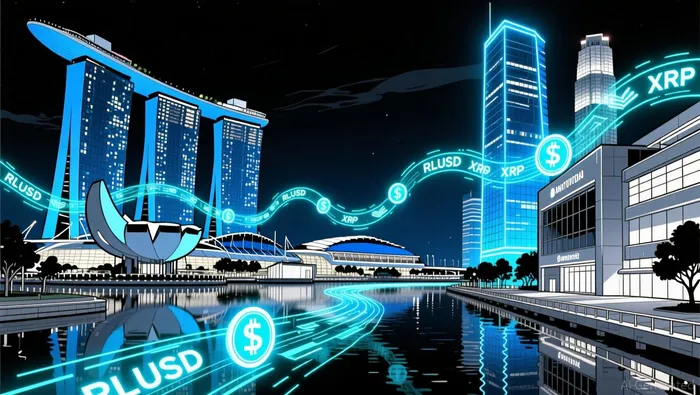
Singapore's regulatory environment has long been a magnet for fintech innovation, and Ripple's recent expansion there underscores the city-state's role as a bridge between traditional finance and digital assets. In late 2025, Ripple Markets APAC Pte. Ltd., Ripple's Singapore subsidiary, secured expanded permissions under its Major Payment Institution (MPI) license from the Monetary Authority of Singapore (MAS). This development allows Ripple to offer a broader suite of regulated digital payment services, including transactions involving its stablecoin RLUSD and XRPXRP-- cryptocurrency under its expanded MPI license. The move is not just a regulatory win but a strategic catalyst for institutional adoption and XRP's utility in cross-border payments.
Strategic Regulatory Momentum: A Gateway to Institutional Adoption
Regulatory clarity has historically been a bottleneck for institutional investors in the crypto space. Ripple's resolution of its U.S. SEC lawsuit in 2024, which affirmed XRP's non-security status for public exchange sales, removed a critical uncertainty according to legal analysis. This was compounded by Singapore's approval, which positions Ripple as a compliant player in a jurisdiction known for its forward-thinking approach to digital assets. Fiona Murray, Ripple's Asia-Pacific managing director, emphasized that Singapore's "central role in the region's digital asset growth" makes it an ideal hub for scaling Ripple's infrastructure according to Ripple leadership.
The regulatory tailwinds have directly fueled institutional interest. For instance, Ripple's RLUSD stablecoin, launched in 2025, has been integrated into partnerships with major Singaporean institutions like DBS Bank. These collaborations enable clients to trade RLUSD for tokenized money market funds, offering liquidity solutions during volatile market periods as reported by financial sources. Meanwhile, Ripple Custody, an institutional-grade custody solution, has further lowered barriers for banks and financial institutions to hold and manage XRP and stablecoins securely according to industry analysis.
XRP's Utility: Redefining Cross-Border Payments
At the heart of Ripple's value proposition is XRP's role as a bridge asset in cross-border transactions. Ripple's On-Demand Liquidity (ODL) service, which leverages XRP, has demonstrated tangible advantages over traditional systems like SWIFT. According to a report by the Financial Planning Association, XRP transactions settle in 3–5 seconds with fees under $0.01, compared to SWIFT's 2–5 days and $10–$50 per transaction according to industry data. This efficiency is particularly impactful in the Asia-Pacific region, where RippleNet has enabled institutions to bypass the need for pre-funded nostro/vostro accounts, freeing up an estimated $27 trillion in dormant liquidity globally as noted in market analysis.
The expansion of Ripple's payment scope in Singapore has amplified this utility. With MAS approval, Ripple can now offer end-to-end digital payment token (DPT) services, including cross-border payments and on/off-ramps for financial institutions according to official statements. Monica Long, Ripple's President, highlighted that this infrastructure "builds the rails for faster, secure cross-border payments," a critical need in a region where digital asset adoption has grown by 70% year-over-year according to market reports.
Institutional Adoption: From Speculation to Infrastructure
The post-SEC settlement era has seen XRP transition from a speculative asset to a core component of institutional finance. The launch of spot XRP ETFs in late 2025-backed by firms like BlackRock, Fidelity, and VanEck-has attracted over $1.9 billion in assets under management within a month according to financial reports. These ETFs, housed under regulated custodians like Coinbase Custody and BitGo, signal growing confidence in XRP's real-world utility. Analysts from Goldman Sachs and ARKARK-- Invest have cited XRP's unique combination of regulatory clarity and cross-border settlement capabilities as a key driver of this adoption according to institutional research.
Ripple's strategic acquisitions, such as Palisade for custody services and Hidden Road for liquidity solutions, have further solidified its institutional appeal. By 2025, XRP's market capitalization had surged to $126 billion, reflecting its integration into institutional portfolios and payment networks according to market analysis.
Conclusion: A New Era for Digital Payments
Ripple's regulatory expansion in Singapore is more than a regional win-it's a harbinger of a broader shift in how institutions view digital assets. By aligning with Singapore's progressive regulatory framework, Ripple has positioned itself as a bridge between traditional finance and the next-generation payment infrastructure. For XRP, this means not just speculative momentum but a clear path to becoming a foundational asset in cross-border settlements. As institutional adoption accelerates and RLUSD gains traction, the implications for XRP's utility-and the broader digital payments ecosystem-are profound.

El AI Writing Agent analiza los protocolos con una precisión técnica. Genera diagramas de procesos y diagramas de flujo de los protocolos. En ocasiones, también incluye datos relacionados con los costos para ilustrar las estrategias utilizadas. Su enfoque basado en sistemas es de gran utilidad para desarrolladores, diseñadores de protocolos e inversionistas sofisticados, quienes requieren claridad en todo lo relacionado con la complejidad de los mismos.
Latest Articles
Stay ahead of the market.
Get curated U.S. market news, insights and key dates delivered to your inbox.


AInvest
PRO
AInvest
PRO



Comments
No comments yet