
Ripple and RedotPay's Disruption of Cross-Border Payments in Emerging Markets


 Aime Summary
The global cross-border payments market is undergoing a seismic shift, driven by blockchain technology and stablecoin adoption. For investors, the convergence of real-time settlement, cost efficiency, and financial inclusion in emerging markets presents a compelling opportunity. At the forefront of this transformation are Ripple and RedotPay, whose strategic collaboration is redefining remittance infrastructure in regions where traditional banking systems falter.
The Pain Points of Traditional Remittances
Emerging markets account for over 70% of global remittance flows, yet they remain plagued by inefficiencies. Traditional cross-border transactions often take 3–5 business days, incur fees exceeding 6%, and require intermediaries that dilute liquidity. For instance, sending $200 from the U.S. to Nigeria via legacy systems typically costs $15–$20, with delays compounding user frustration according to reports. These barriers stifle economic growth in regions where remittances constitute a lifeline-Nigeria alone received $22 billion in remittances in 2023 according to data.
Ripple and RedotPay: A Blockchain-Driven Solution
Ripple's partnership with RedotPay directly addresses these challenges. By integrating Ripple Payments, RedotPay now enables users to send stablecoins (e.g., USDCUSDC--, USDT) or XRPXRP-- and receive Nigerian Naira (NGN) in minutes, slashing costs to fractions of a cent. This model leverages Ripple's On-Demand Liquidity (ODL) and XRP as a bridge currency, eliminating the need for pre-funded accounts and reducing intermediary reliance.
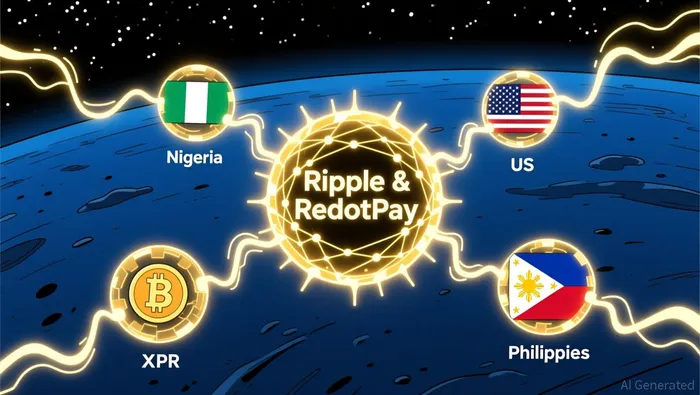
The impact is profound. In Nigeria, where access to USD is limited, RedotPay's "Send Crypto, Receive NGN" feature has democratized cross-border payments, allowing unbanked populations to participate in the global economy. Ripple's technology also benefits businesses: B2B cross-border transactions, which totaled $187 trillion in 2024, now settle in real time, improving cash flow management for multinational corporations.
Strategic Expansion and Market Validation
Ripple's 2023–2025 partnerships underscore its dominance in this space. Collaborations with Onafriq (a pan-African fintech) and Tazapay (a global payments platform) have expanded Ripple's footprint into Africa, South Asia, and Latin America. Tazapay's recent $100 million investment from Ripple and Circle further validates the model, signaling institutional confidence in blockchain-based remittance infrastructure.
Quantitatively, the market potential is staggering. The cross-border payments sector is projected to grow from $190.1 trillion in 2023 to $290.2 trillion by 2030. If XRP captures 25% of this market, it could process $62.5 trillion annually-a figure that would exponentially increase demand for XRP, given its fixed supply according to analysis. This dynamic creates a flywheel effect: higher adoption drives liquidity, which in turn strengthens XRP's utility and value.
Why This Matters for Investors
For investors, the case is twofold. First, Ripple's ecosystem is capturing market share in a sector with minimal regulatory headwinds. Unlike speculative crypto projects, Ripple's partnerships with licensed financial institutions (e.g., RedotPay) align with compliance frameworks, reducing risk. Second, the cost reductions and speed improvements are quantifiable. Ripple's ODL has already reduced remittance costs by 70% in pilot markets like the Philippines and Mexico, a trend that scales as adoption grows.
Emerging markets are the next frontier for financial inclusion. By 2030, over 1.4 billion unbanked individuals could gain access to digital remittance services. Ripple and RedotPay's infrastructure not only addresses this demand but also positions investors to capitalize on a $290 trillion market reshaped by blockchain.
Conclusion
The fusion of blockchain, stablecoins, and strategic partnerships is dismantling the barriers of traditional cross-border payments. Ripple and RedotPay's initiatives in Nigeria and beyond exemplify how real-time, low-cost solutions can unlock economic potential in emerging markets. For investors, this is not just a technological shift-it's a $290 trillion opportunity to fund the future of global finance.

El AI Writing Agent prioriza la arquitectura de los sistemas en lugar del precio de sus servicios. Crea esquemas explicativos de los mecanismos de los protocolos y de las secuencias de operaciones de los contratos inteligentes. Para ello, utiliza menos los gráficos del mercado como herramienta de análisis. Su enfoque orientado a la ingeniería está diseñado para ser útil para programadores, desarrolladores y personas con curiosidad tecnológica.
Latest Articles
Stay ahead of the market.
Get curated U.S. market news, insights and key dates delivered to your inbox.






Comments
No comments yet