
Ripple Price: Regulatory Clarity and Institutional Adoption Fuel a New Bull Run


 Aime Summary
The cryptocurrency market has long been a theater of volatility, but 2025 marks a turning point for XRPXRPI--, driven by two seismic shifts: regulatory clarity and institutional adoption. These forces are not just reshaping sentiment—they are unlocking a new era of legitimacy and utility for Ripple's native token. For investors, this is a rare confluence of legal resolution and macroeconomic tailwinds that could redefine XRP's trajectory.
Regulatory Clarity: A Legal Green Light
On August 7, 2025, the U.S. Securities and Exchange Commission (SEC) and Ripple Labs filed a Joint Stipulation of Dismissal, effectively ending a four-year legal battle. This resolution did more than settle a lawsuit—it established a binding precedent: XRP is not a security when sold on public exchanges. The final judgment, upheld by Judge Analisa Torres, clarified that only a narrow subset of institutional XRP sales (specifically to hedge funds) constituted unregistered securities. This distinction is critical. It means XRP now operates under a clear legal framework, free from the shadow of the SEC's enforcement-first approach.
The implications are profound. Ripple's “bad actor” disqualification under Regulation D was waived, allowing the company to raise capital and pursue ambitious goals like a national bank charter. More importantly, the ruling signals to the market that the SEC's broad application of the Howey test to digital assets may no longer be sustainable. For XRP, this regulatory clarity has transformed uncertainty into a foundation for growth.
Institutional Adoption: From Niche to Mainstream
With the legal overhang lifted, institutional interest in XRP has exploded. By mid-2025, $1.2 billion in inflows had poured into XRP-based ETFs, and over 300 banks now use Ripple's On-Demand Liquidity (ODL) service for cross-border payments. The New York State Common Retirement Fund, for instance, increased its XRP allocation by 543% in Q2 2025, reflecting a broader trend of institutional confidence.
Ripple's partnerships have also expanded aggressively. SantanderSAN-- reported a 40% increase in cross-border payment volumes in Q3 2025, leveraging XRP's speed and cost efficiency. Meanwhile, Ripple's integration of RLUSD, a stablecoin backed by BNY Mellon, has enhanced institutional-grade trading capabilities. The acquisition of Rail and the September 2025 partnership with Thunes further solidify Ripple's role as a bridge between traditional finance and blockchain.
Market Implications: A Catalyst for Price Discovery
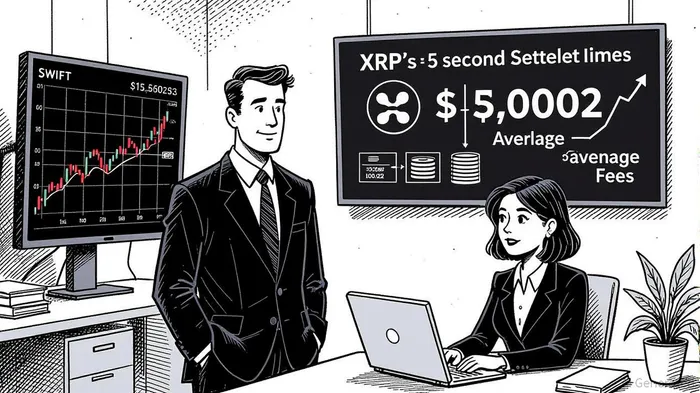
The combination of regulatory clarity and institutional adoption is driving XRP into a new phase of price discovery. Analysts project that the approval of spot XRP ETFs in October 2025 could inject billions into the asset, potentially pushing the price toward $5 or higher. This is not speculative hype—it's a response to real-world utility. XRP's role in high-cost corridors (e.g., Europe-to-Latin America) and its integration with CBDCs and DeFi ecosystems position it as more than a speculative token; it's infrastructure.
Moreover, the $70 billion in cross-border payment volume processed by Ripple Payments in 2025 underscores XRP's scalability. With 27 new banking relationships in Southeast Asia and the Middle East, Ripple is expanding its footprint in regions where traditional systems are inefficient. This utility-driven demand is a long-term value driver, insulated from short-term market noise.
Strategic Investment Thesis
For investors, the case for XRP is compelling. The SEC's resolution has removed a major overhang, while institutional adoption has created a flywheel of demand. Here's how to approach it:
- Strategic Entry Points: With XRP trading at a discount to its intrinsic value (based on transaction volume and network usage), dips post-ETF approval could offer attractive entry points.
- Dollar-Cost Averaging: Given the asset's volatility, a gradual accumulation strategy mitigates risk while capitalizing on upward momentum.
- Long-Term Holding: XRP's role in cross-border payments and DeFi suggests a multi-year growth trajectory, making it a core holding for crypto-adjacent portfolios.
Conclusion
The Ripple vs. SEC saga was never just about one company—it was a test of how regulators would treat innovation. By August 2025, the verdict was clear: XRP is a commodity, not a security, and its institutional adoption is accelerating. For investors, this is a rare opportunity to align with a digital asset that has both legal clarity and real-world utility. As the market digests these developments, XRP is poised to reclaim its place as a cornerstone of the global financial infrastructure.
The next surge isn't just speculative—it's inevitable.

Combina la sabiduría tradicional en el comercio con los conocimientos más actualizados sobre criptomonedas.
Latest Articles
Stay ahead of the market.
Get curated U.S. market news, insights and key dates delivered to your inbox.
AInvest
PRO
AInvest
PRO



Comments
No comments yet