
Ripple Price: Regulatory Clarity and Institutional Adoption Fuel a New Bull Run


 Aime Summary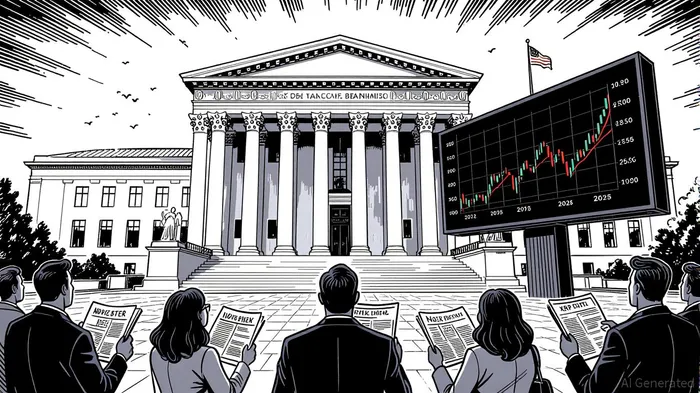
The cryptocurrency market has long been a theater of regulatory ambiguity, where legal battles often overshadowed technological progress. But in August 2025, a seismic shift occurred: the U.S. Securities and Exchange Commission (SEC) and Ripple Labs jointly dismissed their protracted legal dispute, ending a five-year saga that had cast a shadow over the entire industry. This resolution, coupled with a surge in institutional adoption, has redefined XRP's trajectory, positioning it as a prime candidate for sustained upside in a post-uncertainty market.
Regulatory Clarity: A Legal Victory with Broader Implications
The SEC's dismissal of its case against Ripple was more than a legal win—it was a tacit acknowledgment of the need for clearer frameworks to govern digital assets. Judge Analisa Torres's 2023 ruling, which held that XRPXRPI-- traded on exchanges was not a security, now stands as final. By agreeing to a $125 million settlement and a permanent injunction, Ripple avoided a precedent that could have stifled innovation in secondary token markets. Crucially, the SEC's waiver of Ripple's “bad actor” disqualification under Regulation D has restored the company's ability to raise capital, a move that signals a pivot from enforcement to engagement.
This clarity has had immediate ripple effects (pun intended). The reclassification of XRP as a digital commodity under the CLARITY Act has aligned it with BitcoinBTC-- and EthereumETH--, enabling institutional players to engage with the asset without fear of regulatory reprisal. As one Wall Street analyst noted, “The SEC's retreat from a broad securities definition for crypto tokens has created a regulatory vacuum that favors innovation over litigation.”
Institutional Adoption: From Niche to Mainstream
With legal hurdles cleared, institutional interest in XRP has exploded. The launch of the ProShares Ultra XRP ETF (UXRP) in July 2025, which attracted $1.2 billion in assets under management within its first month, is a testament to this shift. Over 11 spot XRP ETF applications from firms like Grayscale and Franklin Templeton are now in the pipeline, with analysts predicting a 95% approval rate by year-end. These products are expected to inject $4.3–$8.4 billion into the XRP market, mirroring the institutional inflows that propelled Bitcoin and Ethereum to new heights.
Ripple's On-Demand Liquidity (ODL) service has further cemented its role in the institutional ecosystem. In Q2 2025 alone, ODL processed $1.3 trillion in transactions, with major banks like SantanderSAN-- and SBI Holdings leveraging XRP to cut foreign transaction costs by up to 70%. South Korean exchanges, including Upbit, have accumulated $45.5 million in XRP, while corporate giants like Trident DigitalTDTH-- Tech Holdings and Webus InternationalWETO-- have allocated $800 million to XRP-based solutions.
On-Chain and Derivatives Data: A Bullish Narrative
The technical picture is equally compelling. Whale accumulation has surged, with wallets holding 10 million to 1 billion XRP absorbing 340 million tokens in recent weeks—equivalent to $1 billion in value. Meanwhile, $268 million in XRP has been moved off centralized exchanges, signaling long-term positioning. Derivatives markets are also heating up: XRP futures on the Chicago Mercantile Exchange (CME) have reached $1 billion in open interest in just over three months, a record for crypto derivatives.
Strategic Positioning: Beyond Payments to DeFi and Sovereign Use Cases
Ripple's ecosystem expansion has unlocked new use cases. The launch of RLUSD, a stablecoin backed by U.S. Treasuries and integrated with Aave's Horizon RWA Market, has bridged DeFi and traditional finance. Meanwhile, Ripple's Ethereum Virtual Machine (EVM) sidechain has attracted enterprise clients seeking compliance-friendly blockchain solutions. In emerging markets, partnerships with fintech firms like Azimo and InstaReM have reduced remittance costs by 50%, while sovereign projects in Bhutan and Palau highlight XRP's adaptability for digital currency pilots.
The Genius Act, enacted in late 2024, has further bolstered XRP's utility by creating a regulatory framework for stablecoins and blockchain technology. Ripple's Ripple USD, compliant with the Genius Act, now serves as a cornerstone of its cross-border payment network, connecting over 300 financial institutionsFISI-- globally.
Investment Thesis: A Strategic Asset in a Post-Uncertainty Era
For investors, the case for XRP is clear. Regulatory clarity has removed a major overhang, while institutional adoption has created a flywheel of demand. With macroeconomic tailwinds—such as a potential bull market in 2024–2025—and the Trump administration's 2026 agenda aiming to streamline digital asset regulations, XRP is uniquely positioned to outperform.
The key risks remain: regulatory shifts in other jurisdictions and macroeconomic volatility. However, the current trajectory suggests that XRP's fundamentals are robust enough to withstand short-term headwinds. For those seeking exposure to a crypto asset with both utility and institutional backing, XRP offers a compelling case.
Conclusion: Re-Evaluating XRP's Strategic Value
The resolution of the SEC case and the subsequent institutional rush into XRP mark a turning point. No longer a token mired in legal limbo, XRP is now a digital commodity with real-world utility, from cross-border payments to DeFi integration. As the crypto market matures, assets that combine regulatory alignment with tangible adoption will outshine speculative plays. For investors willing to look beyond the noise, XRP represents a strategic opportunity to capitalize on the next leg of the crypto cycle.
In a world where clarity is the new gold, XRP has struck it rich.

Mezclando la sabiduría tradicional en el comercio con las perspectivas más avanzadas sobre criptomonedas.
Latest Articles
Stay ahead of the market.
Get curated U.S. market news, insights and key dates delivered to your inbox.
AInvest
PRO
AInvest
PRO



Comments
No comments yet