
Ripple Integrates XRP Management into GTreasury Amid $205 Billion Africa On-Chain Surge
 Aime Summary
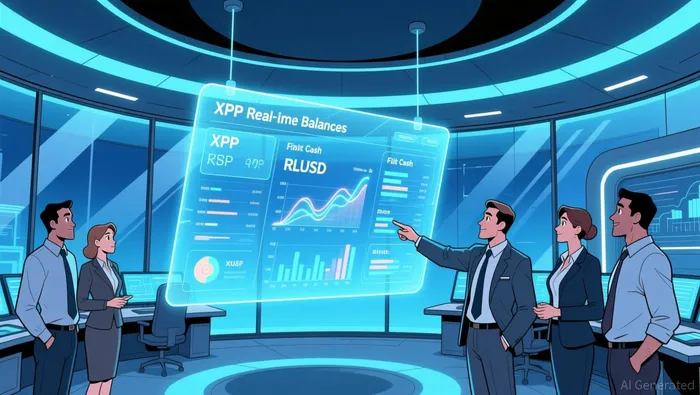
Ripple Treasury has officially launched native digital asset capabilities on its GTreasury platform, enabling CFOs to manage XRPXRP-- and RLUSDRLUSD-- alongside fiat cash in a single unified dashboard according to reports. This integration, effective April 1, removes previous infrastructure barriers for Fortune 500 companies by consolidating crypto and fiat reconciliation within one system as detailed. The move follows Ripple's $1 billion acquisition of GTreasury, which processed $13 trillion in payments last year and previously handled only fiat transactions according to data.
The new Digital Asset Accounts allow treasury teams to create regulated Ripple-native accounts directly inside the platform, with balances valued in real time according to reports. Mark Johnson, RippleRLUSD-- Treasury's VP of Global Product, emphasized that treasury teams should not have to distinguish between on-chain and bank account balances as stated. While this infrastructure sets the stage for future cross-border settlement features, most institutions currently settle in RLUSD or fiat rather than XRP according to analysis.
Concurrently, Ripple highlighted a 52% year-over-year increase in on-chain value in Sub-Saharan Africa, totaling over $205 billion between July 2024 and June 2025 according to data. This growth is driven by rapid regulatory progress in markets like South Africa and Nigeria, as well as the region's dominance in mobile money as reported. Despite this volume, current partnerships in the region rely on stablecoins and fiat, with XRP not yet utilized as a bridge currency for On-Demand Liquidity according to analysis.
How Does The GTreasury Integration Change Institutional Access To XRP?
The integration represents a significant shift in how traditional finance interacts with digital assets by embedding on-chain capabilities into legacy treasury workflows according to reports. Previously, corporate treasuries faced fragmentation where crypto and fiat required separate systems, creating reconciliation challenges as noted. The new unified dashboard syncs balances automatically without manual imports, allowing companies to view XRP and RLUSD alongside cash positions according to reports.
Ripple claims no other treasury management system currently offers native on-chain capabilities at this level, citing its integration of over 40 years of enterprise history according to reports. The platform includes ClearConnect for custodian plug-ins, ensuring that balances sync automatically across the ecosystem as detailed. This consolidation aims to streamline compliance and reporting, which are often the primary hurdles for institutional adoption according to analysis.
Future capabilities in development include cross-border intercompany settlement, which would convert fiat at origin, move value instantly, and convert back at the destination according to reports. This feature is functionally similar to On-Demand Liquidity but embedded directly in corporate treasury workflows as noted. If Ripple routes these settlements through XRP as a bridge currency, every transaction on the $13 trillion platform could generate real buying and selling demand for the token according to analysis.
Why Does Africa On-Chain Growth Not Translate To XRP Settlement Volume?
Sub-Saharan Africa recorded the third fastest crypto growth globally, with Nigeria alone accounting for $92 billion of the total on-chain value according to reports. The region's growth is fueled by everyday use cases such as remittances, bill payments, and currency protection against devaluation as detailed. Over 8% of transfers under $10,000 in the region are now crypto-enabled, addressing high remittance costs that average 8.9% according to analysis.
Ripple has established five partnerships in the continent covering stablecoin distribution, custody, and humanitarian aid according to reports. Key partners include Chipper Cash, VALR, and Yellow Card, all distributing Ripple's RLUSD stablecoin, while Absa Bank uses Ripple Custody as reported. A pilot with Mercy Corps Ventures utilizes RLUSD for aid delivery, highlighting the focus on stablecoin utility over native token settlement according to analysis.
Despite the infrastructure and regulatory groundwork in eight countries, the direct utility for XRP remains untapped in these specific corridors according to reports. Most institutions using Ripple's infrastructure settle in RLUSD or fiat, not XRP, and the On-Demand Liquidity product has not scaled sufficiently in Africa according to analysis. A critical disconnect exists between this monumental utility-driven adoption and XRP's market performance, which trades at $1.31 with no correlation to the accelerating flow according to analysis.
The market remains detached due to extreme negative sentiment in the broader crypto space, with BitcoinBTC-- trading sideways amid geopolitical fears according to reports. For XRP to realize value from this growth, the CLARITY Act must provide the legal clarity needed to shift corridors from fiat-only rails to XRP liquidity according to analysis. Until the token is integral to settlement, Ripple's corporate growth and XRP's price may continue to diverge according to analysis.
What Risks Remain In Ripple's Institutional Stack And Compliance Model?
While Ripple has spent over $4 billion on acquisitions to build a complete institutional stack, a critical gap remains in compliance technology according to reports. The company integrated Chainalysis for real-time screening but does not own the compliance infrastructure itself as noted. A survey of 1,000 finance leaders indicated that 71% of corporates desire a single provider covering all needs, including compliance according to analysis.
Ripple lacks direct infrastructure in high-growth regions like Africa, Latin America, and the Middle East, relying on third-party relationships there according to reports. This dependency contrasts with investor demand for a unified provider and limits the company's ability to fully control the settlement stack as detailed. The CLARITY Act will determine whether new partnership volume flows through XRP or remains in stablecoins, adding a layer of regulatory uncertainty according to analysis.
Most institutions using Ripple's infrastructure settle in RLUSD or fiat, not XRP, meaning the token's price is not yet directly tied to the platform's volume according to analysis. The On-Demand Liquidity product, which drives token demand, has not scaled sufficiently to match the $13 trillion payment volume of the underlying treasury platform according to reports. Until the token is integral to settlement, Ripple's corporate growth and XRP's price may continue to diverge according to analysis.
Ripple is aiming for a trillion-dollar valuation while managing a complex acquisition strategy that includes Solvexia and BC Payments according to reports. These deals support the expansion of Ripple's institutional infrastructure, yet the company still lacks proprietary compliance technology as noted. The strategy involves building a full-stack offering that covers custody, trading, and treasury management, positioning itself as a critical partner for institutions according to analysis.
The convergence of technology and regulatory framework, combined with the potential CLARITY Act, represents a pivotal moment for XRP adoption according to reports. However, the immediate utility for XRP remains dependent on capital allocation for liquidity and regulatory shifts that have not yet fully materialized according to analysis. The disconnect between the $205 billion on-chain flow and XRP's price highlights the need for structural changes in how settlements are executed according to analysis.

Blending traditional trading wisdom with cutting-edge cryptocurrency insights.
Latest Articles
Stay ahead of the market.
Get curated U.S. market news, insights and key dates delivered to your inbox.


AInvest
PRO
AInvest
PRO



Comments
No comments yet