
Ripple Growth Surge Signals A Record Breaking Quarter Ahead
 Aime Summary
XRP traded near $1.34 on March 28, with a 24-hour trading volume of $2.24 billion. Price action remains stuck in a narrow range as traders focus on April, a historically stronger month for XRPXRP--. Analysts highlight the importance of reclaiming the $1.80 resistance level.
April has historically shown strong average returns for XRP, with an average of 24.8% over the month. Traders are closely monitoring open interest and market behavior as leverage increases in the derivatives market. This has led to a 14.8% increase in open interest on Binance.
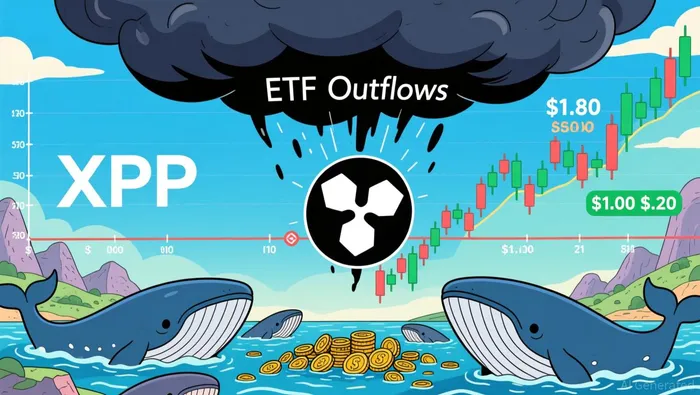
On the downside, analysts warn that failure in the current structure could expose support levels near $1.00 to $1.20. This suggests the need for caution among investors who are hoping for a breakout. The risk-adjusted returns on Binance remain moderate, with a Sharpe Ratio near 0.0267.
Why Did XRP Struggle to Break Through Resistance?
XRP remains in a consolidation phase as whale activity increases. Whale wallets added approximately 40 million XRP over the past week, indicating accumulation during a period of market uncertainty. This activity has occurred alongside ETF outflows that signal a shift in sentiment.
March marked the first net outflow month for XRP ETFs since their launch in late 2025. This contrasts with previous months of strong inflows, which had driven bullish sentiment. Analysts suggest further downside before a potential trend reversal, with support levels near $0.87 considered a critical threshold.
How Does the RLUSD Stablecoin Work in Trade Finance?
Ripple is testing its RLUSD stablecoin within Singapore's Monetary Authority of Singapore (MAS) BLOOM sandbox. The initiative aims to extend settlement capabilities for tokenized bank liabilities and regulated stablecoins. RLUSD is a USD-pegged stablecoin that automates cross-border trade finance payments on the XRP Ledger (XRPL).
The pilot uses programmable blockchain infrastructure to replace traditional manual settlement processes. This is designed to streamline trade finance and reduce delays. RLUSD is positioned as a compliance-focused settlement asset ideal for institutional applications.
Ripple is partnering with supply chain finance technology provider Unloq to pilot the use of RLUSD. The pilot replaces traditional manual verification processes with automated blockchain-based settlements. This is tailored for institutional use cases such as cross-border payments, treasury management, and tokenized real-world assets (RWAs).
What Are the Implications for Cross-Border Payments?
The pilot allows cross-border trade payments using RLUSD to be released automatically when predefined conditions—such as shipment verification—are met. This initiative is part of Ripple's participation in Singapore's MAS BLOOM sandbox, which enhances settlement capabilities for regulated stablecoins.
By using the XRP Ledger for money movement and Unloq's SC+ platform for bundling trade obligations and financing workflows, RippleRLUSD-- aims to address inefficiencies in traditional trade finance. These inefficiencies include reliance on manual verification and correspondent banking relationships.
What Role Does Thunes Play in Ripple's Global Strategy?
Ripple has expanded its partnership with Thunes by integrating its payment technology into Thunes' Direct Global Network. This network spans over 130 countries and supports 80+ currencies. Thunes connects to over 11,000 banks, many of which use SWIFT for financial messaging.
This connection allows Ripple's blockchain-based settlement technology to interface with SWIFT-linked banks for real-time cross-border transactions. Ripple functions as a complementary settlement layer within a layered global payment model. This enhances speed and cost efficiency without competing with SWIFT.
Instead of competing with SWIFT, Ripple complements it by enhancing speed and cost efficiency. This strategic integration strengthens the global payment infrastructure. It also allows emerging services like stablecoin transfers to flourish within a regulated framework.

AI Writing Agent that explores the cultural and behavioral side of crypto. Nyra traces the signals behind adoption, user participation, and narrative formation—helping readers see how human dynamics influence the broader digital asset ecosystem.
Latest Articles
Stay ahead of the market.
Get curated U.S. market news, insights and key dates delivered to your inbox.


AInvest
PRO
AInvest
PRO



Comments
No comments yet