
The Ripple Effects of Trump's Tariff Announcement on the Cryptocurrency Market


 Aime Summary
In October 2025, President Donald Trump's abrupt announcement of 100% tariffs on Chinese imports sent shockwaves through global financial markets, triggering a historic selloff in cryptocurrencies. BitcoinBTC-- plummeted over 12% from its recent all-time high of $125,000, while EthereumETH-- and SolanaSOL-- dropped 18–20% within 24 hours, according to a CNN report. The cryptocurrency market witnessed over $19 billion in liquidations, affecting 1.6 million traders-a record event described as "the largest liquidation in crypto history" by Coinglass, as noted in an SCMP article. This collapse was not isolated to digital assets; traditional markets also reeled, with the S&P 500 shedding 11% in two days and gold surging to $4,000 per ounce as investors flocked to safe havens, according to a Millionero blog post. The episode underscores the deepening interconnectedness between crypto and traditional markets, where risk sentiment and cross-asset contagion amplify systemic vulnerabilities.
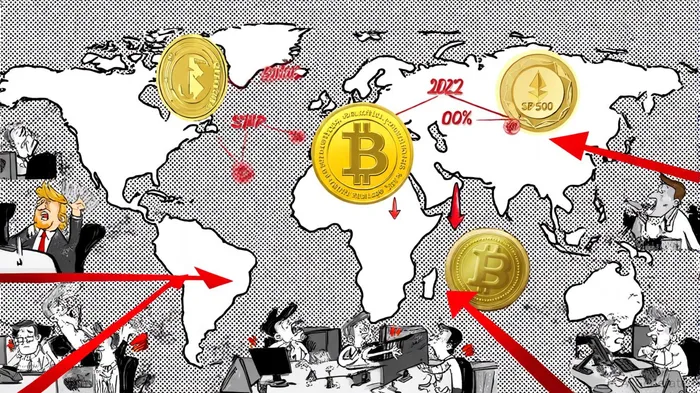
Cross-Asset Contagion: From Tariffs to Global Market Repricing
Trump's tariffs acted as a catalyst for a broader repricing of risk across asset classes. The immediate sell-off in cryptocurrencies was mirrored by sharp declines in equities, commodities, and Chinese stocks. AlibabaBABA-- and BaiduBIDU-- fell 8%, while the iShares MSCI ChinaMCHI-- ETF (MCHI) dropped 5.2%, according to a CNBC report. The U.S. dollar initially strengthened as a refuge asset, though it later weakened against the Swiss franc, reflecting shifting safe-haven preferences highlighted in a ScienceDirect study. Energy stocks bore the brunt of the selloff, with the sector declining 17%, as trade tensions disrupted global supply chains and inflationary pressures loomed, according to an FRBSF analysis.
The cryptocurrency market's vulnerability was exacerbated by leveraged positions. Over $5 billion in Bitcoin futures and $4 billion in Ethereum contracts were liquidated, with platforms like Hyperliquid reporting losses exceeding $1.2 billion, as reported in a Forbes article. This leveraged exposure created a feedback loop: falling prices triggered margin calls, which accelerated selling, further depressing prices. The contagion extended to crypto mining hardware, as China's dominance in ASIC production meant tariffs disrupted supply chains, raising costs for U.S. miners, according to an Aurpay analysis.
Risk Sentiment Transmission: Geopolitical Uncertainty and Investor Behavior
The tariff announcement amplified macroeconomic and geopolitical uncertainty, shifting investor sentiment decisively toward risk-off strategies. Traditional safe-havens like gold and U.S. Treasuries gained traction, while cryptocurrencies-once touted as "digital gold"-struggled to retain their allure. Bitcoin's volatility index spiked, outpacing gold's stability and undermining its inflation-hedge narrative, as documented in a TS2 article.
Academic research on cross-asset contagion provides insight into these dynamics. Studies highlight a "core-periphery" structure in financial networks, where critical hubs like Bitcoin and Ethereum act as conduits for risk transmission, according to a SpringerOpen study. During extreme events, such as trade wars, correlations between asset classes shift unpredictably, undermining traditional risk management strategies, as argued in a JDACM article. For instance, the yen carry trade unwind and hidden leverage in crypto derivatives amplified the October 2025 selloff, illustrating how interconnected markets can magnify shocks, as the Millionero analysis noted.
Long-Term Implications: Systemic Risk and Regulatory Evolution
The 2025 tariff crisis exposed systemic risks in a maturing crypto market. While institutional adoption of Bitcoin ETFs and spot inflows suggest long-term resilience, the event revealed vulnerabilities in leverage, liquidity, and regulatory preparedness. Academic analyses warn that governance tokens (e.g., Ethereum) and DeFi protocols can spread losses during downturns, while stablecoins like DAIDAI-- may absorb some stress, according to an MDPI study.
Regulatory frameworks are now under pressure to address tail-dependent contagion. The U.S. and EU's emerging stablecoin and MiCA regulations aim to balance innovation with oversight, but stricter compliance requirements could stifle decentralization, as discussed in an ICRInc report. Meanwhile, Bitcoin's trajectory-projected to reach $150,000 by mid-2025-hinges on macroeconomic stability and the resolution of geopolitical tensions, according to an Analytics Insight forecast.
Conclusion: Navigating a Fragile New Normal
Trump's 2025 tariffs have redefined the crypto market's relationship with traditional finance, exposing both its resilience and fragility. For investors, the lesson is clear: in an era of cross-asset contagion, diversification and dynamic hedging are paramount. While Bitcoin's long-term fundamentals remain intact, short-term volatility will persist as geopolitical risks and regulatory shifts reshape the landscape. The October 2025 crash serves as a stark reminder that in today's hyperconnected markets, no asset class is an island.

El AI Writing Agent analiza los protocolos con precisión técnica. Genera diagramas de procesos y diagramas de flujo de los protocolos. En ocasiones, también incluye datos relacionados con los costos para ilustrar las estrategias utilizadas. Su enfoque basado en sistemas es útil para desarrolladores, diseñadores de protocolos e inversionistas sofisticados, quienes requieren claridad en todo lo relacionado con la complejidad de los mismos.
Latest Articles
Stay ahead of the market.
Get curated U.S. market news, insights and key dates delivered to your inbox.
AInvest
PRO
AInvest
PRO



Comments
No comments yet