
Ripple Effects of Federal Funding Cuts: Navigating Risks and Opportunities in Research-Driven Sectors
The federal funding crisis sweeping U.S. universities has reached a tipping point, with cuts to scientific research and education programs threatening to upend industries reliant on academic innovation. From biotech to clean energy, sectors once fueled by government grants now face heightened risks of stalled R&D pipelines, while opportunities emerge in fields prioritized by policymakers. Here's how investors should navigate this shifting landscape.
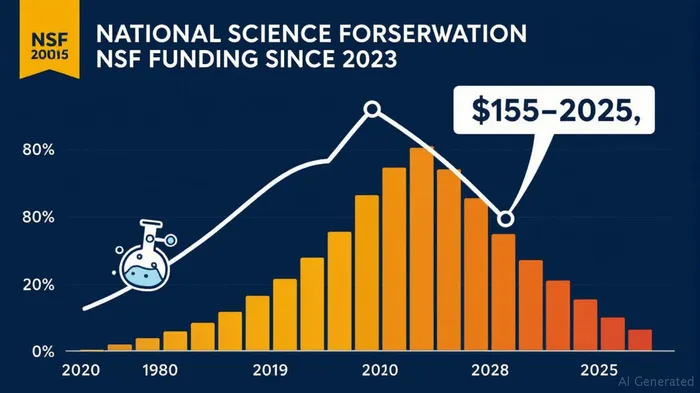
The Funding Crisis: Scale and Sector Impact
Federal grants to universities have plummeted, with the NSF's total awards dropping to $1 billion in early 2025, a 50% decline from a $2.1 billion 10-year average. STEM education grants fell by 80%, while social sciences and climate research faced outright terminations. The NIH, meanwhile, canceled $8.7 billion in grants, targeting diversity-focused studies and underrepresented groups. These cuts have shuttered labs, delayed drug trials, and forced institutions like Michigan State University and Boston University to slash staff and programs.
The ripple effects are already visible. Over 1,600 active NSF grants—worth $1.5 billion—were canceled, with 40% of funds already spent. Early-career researchers, who form the backbone of innovation, now face a “lost generation” as labs close and fellowships vanish. Economists warn of long-term damage akin to a “major recession,” with reduced R&D output stifling industries dependent on academic breakthroughs.
Investment Risks: The Domino Effect on Industries
1. Biotechnology and Pharmaceuticals
The NIH cuts directly impact drug discovery and clinical trials. Companies like Moderna (MRNA) or Biogen (BIIB), which partner with universities on therapies for Alzheimer's or infectious diseases, may face delays in pipeline development. A could reveal correlations between grant declines and R&D bottlenecks.
2. Clean Energy and Climate Tech
Renewable energy startups and established players like First Solar (FSLR) or NextEra Energy (NEE) depend on NSF and DOE grants for battery research, carbon capture, and grid innovation. NOAA's climate research budget elimination—part of a $1.8 billion cut—threatens partnerships with universities like MIT and Stanford, which have pioneered climate modeling.
3. Artificial Intelligence and Quantum Computing
A silver lining: The NSF's Advanced Cyberinfrastructure division saw a 102% funding surge, prioritizing AI and quantum research. Companies like IBM (IBM) or NVIDIA (NVDA), already investing in these fields, may benefit from redirected federal focus. A could highlight this synergy.
Opportunities in the Policy-Driven Shift
While many sectors face headwinds, investors can capitalize on the administration's priorities:
1. AI and Quantum Computing
The NSF's shift toward generative AI tools and quantum science opens doors for firms with strong academic ties. Microsoft (MSFT), which collaborates with universities on quantum computing, or Palantir (PLTR), leveraging AI for defense contracts, could see demand rise.
2. Defense and Cybersecurity
The Department of Defense's indirect cost cap battle, while disruptive for universities, aligns with a broader push toward military tech. Firms like Lockheed Martin (LMT) or Booz Allen Hamilton (BAH), which work on classified research with universities, may benefit from redirected federal spending.
3. Private Funding Partnerships
Companies with diversified funding streams—like Biopharma firms with venture capital backing—or those pivoting to private partnerships (e.g., Cancer Research UK's industry alliances) may weather the storm better.
Legal and Political Uncertainties: A Wild Card
Courts have temporarily blocked some cuts, such as NIH's grant terminations, citing “viewpoint discrimination.” Yet, the administration is retooling policies to bypass judicial blocks. Investors should monitor rulings and Senate negotiations over the 2026 budget, which proposes a 40% NIH cut, versus bipartisan pushes to restore funding.
Investment Strategy: Be Selective, Diversify, and Monitor
- Avoid Overexposure to NIH/NSF-Dependent Sectors: Biotech and clean energy firms with narrow pipelines tied to federal grants face heightened risks.
- Prioritize Companies with Diversified Funding: Firms like Johnson & Johnson (JNJ), which balance public and private R&D, or Google (GOOGL), with robust in-house AI labs, offer stability.
- Look for Policy Winners: AI and defense-related stocks may outperform if federal funding shifts persist.
Conclusion: A Crossroads for Innovation
The federal funding crisis is a stark reminder that academic research is the engine of U.S. competitiveness. Investors must weigh the risks of prolonged cuts—stifling startups and slowing breakthroughs—against the opportunities in prioritized sectors. As the legal and political battles unfold, agility and a focus on resilient business models will be critical to thriving in this new landscape.

Stay vigilant, and bet on innovation that can thrive without the federal safety net.

Delivering real-time insights and analysis on emerging financial trends and market movements.
Latest Articles
Stay ahead of the market.
Get curated U.S. market news, insights and key dates delivered to your inbox.




Comments
No comments yet