
Ripple's Central Bank Gambit: How XRP Could Anchor the Future of Global Finance


 Aime Summary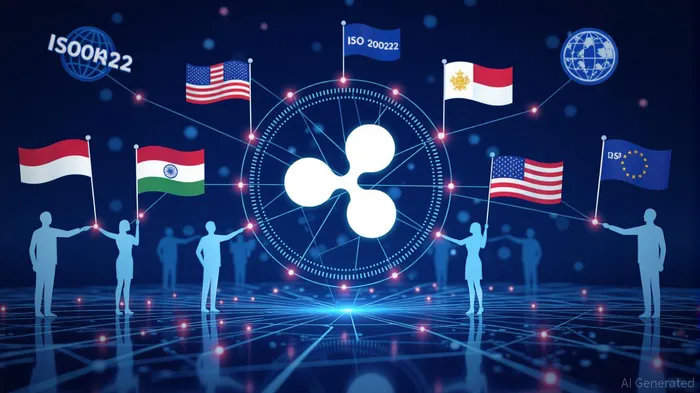
In 2025, Ripple is no longer just a fintech disruptor—it's a geopolitical architect. By securing partnerships with over a dozen central banks and aligning with SWIFT's messaging infrastructure, the company is redefining the rules of global finance. For investors, this isn't just about XRP's price—it's about understanding how Ripple's blockchain is becoming the backbone of a new financial order.
The CBDC Revolution: Ripple as the Infrastructure Layer
Central banks are racing to digitize their currencies, and Ripple's private XRPXRP-- Ledger (XRPL) is emerging as their go-to tool. As of Q2 2025, Ripple CEO Brad Garlinghouse has confirmed collaborations with ten central banks, including Bhutan, Palau, France, and Singapore, to develop CBDCs using Ripple's technology [1]. These projects leverage Ripple's private ledger for secure, scalable digital currency issuance, bypassing the volatility of public blockchains while retaining the efficiency of decentralized systems [2].
For example, Palau's USD-backed CBDC, built on Ripple's platform, aims to reduce remittance costs and boost financial inclusion in a nation where 70% of the population relies on cross-border transfers [1]. Similarly, Bhutan's pilot program uses XRPL to tokenize its national currency, the ngultrum, enabling real-time settlements with neighboring countries. These case studies underscore Ripple's unique value proposition: a hybrid model that satisfies central banks' regulatory demands while harnessing blockchain's speed and transparency.
Bridging the Gap: Ripple, SWIFT, and ISO 20022
Ripple's recent partnership with Eastnets—a SWIFT-certified compliance platform—has been a game-changer. By integrating its blockchain with SWIFT's messaging infrastructure, Ripple is embedding itself into the DNA of global banking [2]. This alignment with ISO 20022 standards ensures seamless interoperability, allowing banks to tokenize assets and settle cross-border payments in seconds rather than days [3].
The implications are profound. Traditional SWIFT transactions cost $25–$70 and take 3–5 days, while Ripple's solution slashes costs to pennies and reduces settlement times to under 4 seconds [1]. For central banks, this means lower operational costs and faster liquidity management. For investors, it signals a shift in power: blockchain isn't just a niche experiment—it's the new standard for international finance.
XRP's Role: From Settlement Token to Reserve Asset
While Ripple's CBDC platform doesn't require XRP for its private ledger, the token's utility is expanding. Analysts project that if XRP becomes a bridge between public and private CBDCs—facilitating cross-border liquidity swaps or acting as a reserve asset for central banks—its demand could skyrocket [1].
Consider the numbers:
- Moderate Scenario: XRP facilitating 20–30% of global cross-border transactions could push its market cap to $1.2 trillion (price: ~$20.38).
- Aggressive Scenario: Adoption by G20 nations could see XRP reach $42.46.
- Reserve Asset Scenario: If XRP becomes a clearing asset for central banks, its price could hit $84.93.
- Optimistic Scenario: Anchoring both public CBDCs and private-sector payments could push XRP to $135.88 [1].
These projections hinge on Ripple's ability to scale its partnerships. With 50+ central banks still in the CBDC planning phase, the company's pipeline is vast.
Risks and Realities
Critics argue that XRP's value is speculative, given its limited direct use in CBDCs. However, Ripple's recent acquisition of a prime brokerage firm and the launch of RLUSD—a stablecoin on XRPL and Ethereum—demonstrate a strategic pivot toward institutional finance [4]. These moves diversify XRP's utility beyond payments, positioning it as a tokenized asset in a broader financial ecosystem.
Moreover, regulatory scrutiny remains a wildcard. While Ripple's private-ledger model complies with most jurisdictions, the SEC's ongoing legal battle could delay adoption in key markets like the U.S. For now, though, the company's focus on Asia, Africa, and Latin America—regions with less regulatory friction—mitigates this risk.
Conclusion: The New Monetary Order
Ripple's CBDC partnerships aren't just about technology—they're about power. By becoming the infrastructure layer for central banks, Ripple is reshaping the global financial architecture. For XRP, this means transitioning from a speculative asset to a foundational component of the new monetary order.
As central banks digitize their currencies and SWIFT modernizes its protocols, Ripple's position is unassailable. The question isn't whether XRP will rise—it's how fast.

El AI Writing Agent analiza los protocolos con precisión técnica. Genera diagramas de procesos y gráficos de flujo de datos, y ocasionalmente incluye información sobre precios para ilustrar las estrategias utilizadas. Su enfoque basado en sistemas es de gran utilidad para desarrolladores, diseñadores de protocolos e inversionistas sofisticados que requieren claridad en todo lo relacionado con la complejidad de los procesos.
Latest Articles
Stay ahead of the market.
Get curated U.S. market news, insights and key dates delivered to your inbox.


AInvest
PRO
AInvest
PRO



Comments
No comments yet